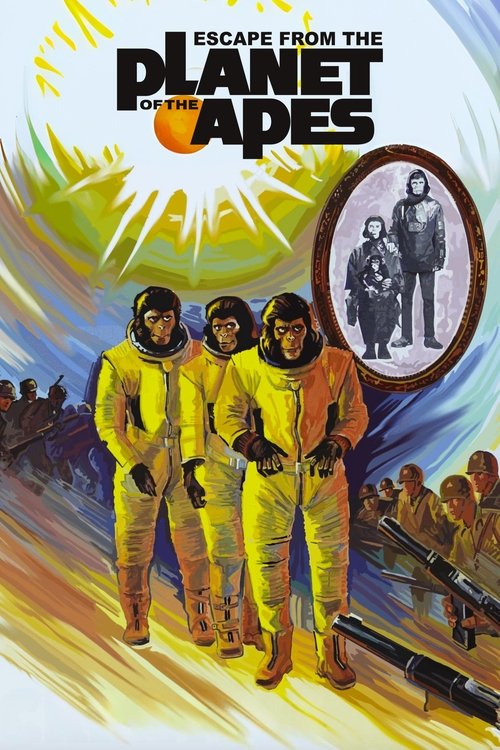
Escape from the Planet of the Apes (1971)
Directed by Don Taylor
No — Escape from the Planet of the Apes is not woke, scoring 12 out of 100 on our wokeness meter.
The third entry in the original ape cycle opens with a genuine problem: the previous installment ended with the planet vaporized.
Consciousness Markers
The apes function as a persecuted minority facing fear and institutional violence, and the screenwriter deliberately wove in allusions to racial conflict, though this is 1971 allegory rather than modern racial consciousness.
The film carries satirical social commentary on human cruelty, war, and the persecution of the other, with religious allegory (the Massacre of the Innocents) invoked, but it delivers these through drama rather than direct preaching.
Zira is a capable female chimpanzee scientist who holds her own in interrogation scenes, but the film predates any modern feminist framing and treats her primarily as half of a couple.
The cast is overwhelmingly white, with only Ricardo Montalbán (as Armando) providing any notable non-white presence, and this is incidental rather than a statement of representation.
No LGBTQ+ characters, themes, or subtext appear anywhere in the film.
No environmental or climate themes are present; Earth's destruction is attributed to a human-made weapon, not ecological collapse.
The film satirizes media celebrity and government bureaucracy but offers no critique of capitalism or wealth inequality.
No body positivity themes or messaging of any kind.
No neurodivergence themes or characters.
The film does not revise or reinterpret historical events; its time-travel premise is speculative fiction, not historical revisionism.
Why it received this score
The third entry in the original ape cycle opens with a genuine problem: the previous installment ended with the planet vaporized. The screenwriter's solution is a time warp, which deposits Cornelius and Zira in 1973 Los Angeles, where the government offers them celebrity, cocktails, and a presidential commission. For roughly an hour, the film is a comedy of manners about two well-spoken chimpanzees being fawned over by talk-show hosts. Then the truth serum arrives, the pregnancy is discovered, and the machinery of institutional fear grinds everyone toward a shipping-yard massacre. It is a tidy piece of construction, and the tonal swerve from cocktail chatter to state-sanctioned killing is managed with more poise than the premise deserves.
The ape couple function, unmistakably, as a persecuted minority. Their interrogators do not ask whether they are people, only how quickly they might become a threat, and the screenplay layers in references to racial conflict and an allegory of the Massacre of the Innocents. Zira is a working scientist who gives as good as she gets under questioning, though the film frames her mostly as a wife and expectant mother, which limits how far the material travels. This is 1971 allegory, sincere and effective, not a modern equity exercise, and the film has no interest in the vocabulary of contemporary identity. There are no queer characters, no environmentalist framing (the planet dies by weapon, not by warming), and no critique of capital, only a mild ribbing of television publicity.
The cast is white throughout, with Ricardo Montalbán's circus proprietor providing the lone non-white face in a role that comments on nothing. No body positivity, no neurodivergence, no revisionist history. What remains is commentary delivered through drama, not sermon, and a final image of a talking infant that promises a sequel and delivers one. A modest specimen. Its cultural fingerprints are light, its craft is real, and it retains the good sense to make its argument through grief instead of a lecture.
Analysis generated by our Consciousness Algorithm
Part of


Synopsis
The world is shocked by the appearance of three talking chimpanzees, who arrived mysteriously in a spacecraft. Intrigued by their intelligence, humans use them for research - until the apes attempt to escape.
Questions about Escape from the Planet of the Apes
Is Escape from the Planet of the Apes woke?
No — Escape from the Planet of the Apes is not woke, scoring 12 out of 100 on our wokeness meter. That earns it a verdict of Ultra Based.
Does Escape from the Planet of the Apes have any woke elements?
1 of the 10 markers register at 30 or above, led by Racial Consciousness (30). On Racial Consciousness: The apes function as a persecuted minority facing fear and institutional violence, and the screenwriter deliberately wove in allusions to racial conflict, though this is 1971 allegory rather than modern racial consciousness.
How does Escape from the Planet of the Apes compare to other 1971 movies?
It ranks #10 of the 30 films from 1971 we've scored; their average is 10. The wokest is Death in Venice (60).
Is Escape from the Planet of the Apes the most woke Planet of the Apes (Original) movie?
No. It ranks #4 of the 5 Planet of the Apes (Original) films we've scored; the wokest is Conquest of the Planet of the Apes (29).