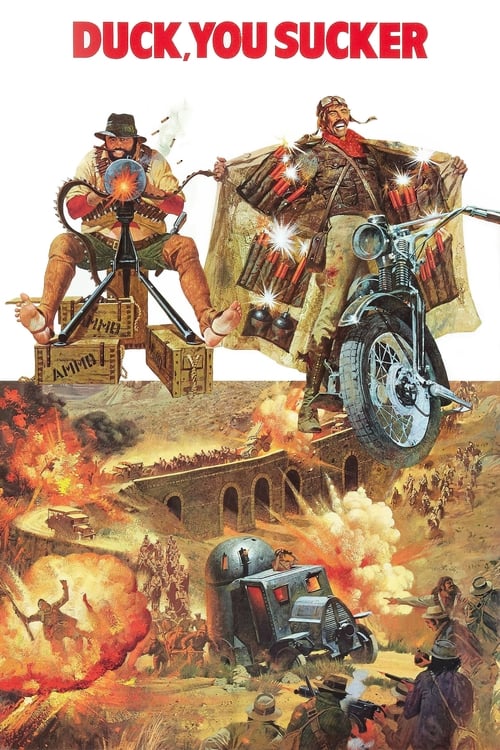
Duck, You Sucker (1971)
Directed by Sergio Leone
No — Duck, You Sucker is not woke, scoring 16 out of 100 on our wokeness meter.
Sergio Leone's Duck, You Sucker arrives near the end of the Zapata Western cycle, a 1971 epic in which a Mexican bandit and an Irish explosives expert stumble into a revolution neither of them wanted.
Consciousness Markers
The revolution against a tyrannical governor hoarding a fortune and the robbing of wealthy coach passengers carry clear class-struggle imagery, though Leone frames it as deconstruction rather than propaganda.
The Zapata Western setting foregrounds the oppression of Mexican peasants by wealthy landowners and federales, giving it a genuine, if class-inflected, ethnic-oppression dimension.
The film carries a cynical political thesis ('revolution means confusion') and some dialogue about ideals and betrayal, but it is deconstructive and character-driven rather than preachy.
The Mexican protagonist Juan is played by American Rod Steiger and the Irishman by American James Coburn, with an otherwise Euro-centric cast; this is the inverse of deliberate representation casting.
No LGBTQ+ characters, themes, or subtext appear anywhere in the film.
The film opens with Juan raping a female passenger, and women exist largely as victims or flashback objects; there is no feminist framework whatsoever.
No environmental or climate themes are present.
No body-positivity themes or messaging are present.
No neurodivergent characters or themes are depicted.
The film is a fictional Western set against the Mexican Revolution; Leone explicitly stated the revolution is a symbol, not a historical representation, so no revisionist-history project is at work.
Why it received this score
Sergio Leone's Duck, You Sucker arrives near the end of the Zapata Western cycle, a 1971 epic in which a Mexican bandit and an Irish explosives expert stumble into a revolution neither of them wanted. It is a handsomely mounted picture, all dust and dynamite, carrying the director's signature fatigue about violence as a human enterprise. What interests us here is how little of the modern social consciousness apparatus it brings along. This is a film from 1971, and it behaves like one.
On representation, the film offers a curious inversion. Juan, the Mexican peasant, is played by Rod Steiger of New Jersey, and the Irishman by James Coburn of Nebraska, surrounded by a largely European supporting cast. That is not deliberate inclusion but its opposite, a familiar mid-century habit of casting whoever the studio could afford. There is no LGBTQ content of any kind, no body-positivity messaging, no neurodivergent characters, and no environmental concern, which for a film about land and dispossession is a small irony. The treatment of women is where the picture becomes genuinely difficult to defend. It opens with Juan raping a coach passenger, and women thereafter function as victims or as ghosts in flashbacks. No feminist framework is available here, and none is attempted.
The film's political energies are real but class-based. Peasants are crushed by landowners and federales, a tyrannical governor hoards a fortune, and wealthy passengers are robbed with some relish. Leone, however, is a deconstructor, not a pamphleteer. He insisted the revolution was a symbol, and the thesis he advances, that revolution means confusion, arrives through character and betrayal instead of sermon. We are left with a picture that carries an ethnic-oppression dimension and a class-struggle pulse, and almost nothing else from the contemporary moral toolkit. We classify it accordingly, with the grim satisfaction of a sommelier identifying an old vintage that has not traveled well.
Analysis generated by our Consciousness Algorithm


Synopsis
At the beginning of the 1913 Mexican Revolution, greedy bandit Juan Miranda and idealist John H. Mallory, an Irish Republican Army explosives expert on the lam from the British, fall in with a band of revolutionaries plotting to strike a national bank. When it turns out that the government has been using the bank as a hiding place for illegally detained political prisoners -- who are freed by the blast -- Miranda becomes a revolutionary hero against his will.
Questions about Duck, You Sucker
Is Duck, You Sucker woke?
No — Duck, You Sucker is not woke, scoring 16 out of 100 on our wokeness meter. That earns it a verdict of Ultra Based.
Does Duck, You Sucker have any woke elements?
1 of the 10 markers register at 30 or above, led by Eat the Rich (40). On Eat the Rich: The revolution against a tyrannical governor hoarding a fortune and the robbing of wealthy coach passengers carry clear class-struggle imagery, though Leone frames it as deconstruction rather than propaganda.
How does Duck, You Sucker compare to other 1971 movies?
It ranks #4 of the 30 films from 1971 we've scored; their average is 10. The wokest is Death in Venice (60).
How is the Woke Score calculated?
An AI-assisted process researches the film and its reception, scores it 0–100 on ten markers, then combines those into one 0–100 Woke Score. It measures a specific set of 2020s cultural themes, not film quality.