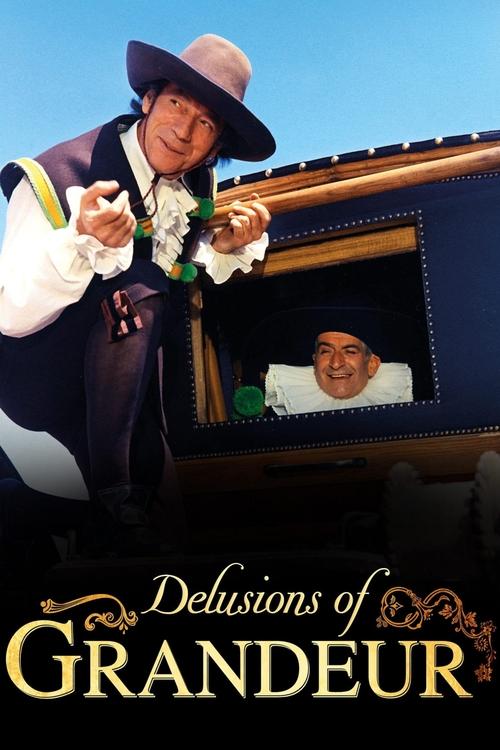
Delusions of Grandeur (1971)
Directed by Gérard Oury
No — Delusions of Grandeur is not woke, scoring 15 out of 100 on our wokeness meter.
Gérard Oury's Delusions of Grandeur arrives from 1971, an international co-production with a French heart and a Spanish setting, and adapts Victor Hugo's Ruy Blas into something Hugo would not have recognized.
Consciousness Markers
The plot features a greedy finance minister who embezzles taxes from the poor, and his valet Blaze who redistributes the wealth to peasants and taxes the rich instead — a genuine Robin Hood-style class theme, though framed as classic farce rather than modern anti-capitalist critique.
The cast is entirely white European (French, Italian, Spanish, German co-production) with no diverse or non-traditional casting of any kind.
No LGBTQ+ characters, themes, or subtext appear anywhere in this 17th-century court farce.
The female characters (the Queen, the duenna Doña Juana) exist as objects of seduction and slapstick, with Doña Juana's striptease played purely for laughs; no feminist consciousness is present.
The film engages no racial themes; its social conflict is strictly one of class and court intrigue.
No environmental or climate content whatsoever.
No body-positivity themes; the duenna's appearance is mocked for comic effect.
No neurodivergence themes; Don Salluste's final madness is played as farcical comeuppance, not representation.
A loose comedic adaptation of Victor Hugo's play set in Golden Age Spain; it invents freely for comedy but makes no modern revisionist historical argument.
This is a broad slapstick comedy with no preachy or didactic messaging; it aims only to amuse.
Why it received this score
Gérard Oury's Delusions of Grandeur arrives from 1971, an international co-production with a French heart and a Spanish setting, and adapts Victor Hugo's Ruy Blas into something Hugo would not have recognized. Louis de Funès plays Don Salluste, the finance minister of Charles II, a man who collects taxes personally and keeps most of them. Yves Montand is Blaze, the valet. The machinery is pure boulevard farce: disguises, a cockatoo delivering the wrong message, a striptease by a duenna, a bullfighting ring used as a trap. It is a comedy that wants nothing from its audience but laughter, and it gets it.
The film's only social content is economic, and it is old-fashioned in the best sense. Don Salluste robs the poor; Blaze, installed in his place, hands the stolen riches to the peasants and shifts the tax burden onto the nobility. This is Robin Hood arithmetic, a class grievance as ancient as the genre itself, and Oury stages it for laughs instead of instruction. No character turns to the camera to explain the injustice of wealth. The nobles are angry because they are being taxed, which is a joke about nobles, not a manifesto.
Elsewhere the ledger is empty, and honestly so. The women exist to be seduced or mocked, and Doña Juana's disrobing is played for the sight gag it is. Race, climate, and neurodivergence do not enter the frame, and Don Salluste's closing madness is a punchline, not a diagnosis. This is a well-built machine for making a postwar audience laugh, and it still runs. Whether that constitutes cultural progress is a question the film never asks, and never wanted to.
Analysis generated by our Consciousness Algorithm


Synopsis
Don Sallust is the minister of the King of Spain. Being disingenuous, hypocritical, greedy and collecting the taxes for himself, he is hated by the people he oppresses. Accused by The Queen, a beautiful princess Bavarian, of having an illegitimate child to one of her maids of honor, he was stripped of his duties and ordered to retire to a monastery.
Questions about Delusions of Grandeur
Is Delusions of Grandeur woke?
No — Delusions of Grandeur is not woke, scoring 15 out of 100 on our wokeness meter. That earns it a verdict of Ultra Based.
Does Delusions of Grandeur have any woke elements?
Very few. None of the 10 markers reaches 30, the level where a marker counts as present; the highest is Eat the Rich at 25.
How does Delusions of Grandeur compare to other 1971 movies?
It ranks #5 of the 30 films from 1971 we've scored; their average is 10. The wokest is Death in Venice (60).
How is the Woke Score calculated?
An AI-assisted process researches the film and its reception, scores it 0–100 on ten markers, then combines those into one 0–100 Woke Score. It measures a specific set of 2020s cultural themes, not film quality.