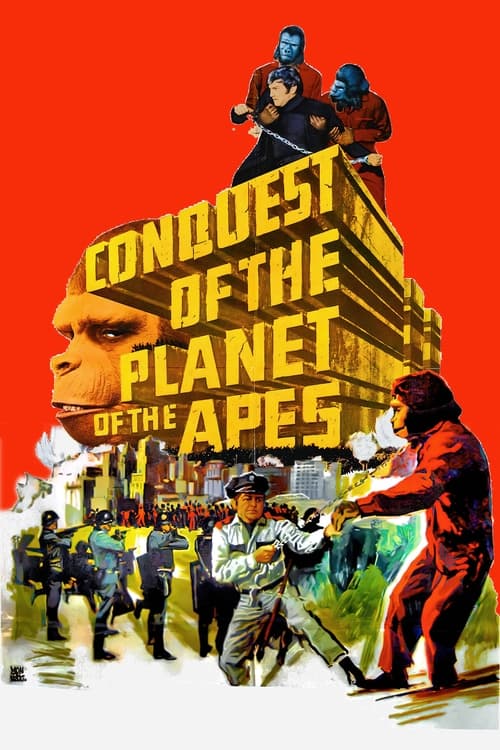
Conquest of the Planet of the Apes (1972)
Directed by J. Lee Thompson
No — Conquest of the Planet of the Apes is not especially woke, scoring 29 out of 100 on our wokeness meter.
Conquest of the Planet of the Apes arrives from 1972, a year when a science fiction sequel could stage a slave revolt in a corporate plaza and call it a metaphor.
Consciousness Markers
The screenwriter deliberately wove in references to early-1970s North American racial conflict, and MacDonald's African-American heritage is explicitly tied to his sympathy for the enslaved apes. It is a genuine racial allegory, though framed through a pre-woke 1972 lens.
The cast includes Ricardo Montalbán and Hari Rhodes, with Rhodes's Black character MacDonald carrying narrative weight. However, this is a 1972 production where diversity was largely incidental and not the result of a modern representation initiative.
Caesar's final plea for mercy and MacDonald's appeals carry a moral-allegory message about inhumanity, but the film is primarily action-driven and never lectures at length.
The ape slave-labor society, complete with auction blocks and a ruling governor, gestures at labor exploitation and class domination, though the state is fascist rather than corporate and the critique is not economic in intent.
The female ape Lisa delivers a single climactic objection to Caesar's bloodlust, but the film's power structure and cast are overwhelmingly male with no feminist framework.
No LGBTQ+ characters, themes, or subtext are present in the film.
No environmental or climate themes appear; the dystopia is political and social, not ecological.
No body-positive themes or messaging are present.
No neurodivergent characters or themes appear.
The film is set in a fictional future (1991) and is not a revisionist retelling of actual historical events.
Why it received this score
Conquest of the Planet of the Apes arrives from 1972, a year when a science fiction sequel could stage a slave revolt in a corporate plaza and call it a metaphor. The film places its dystopia in 1991, a date that has aged into an accidental joke, where a space-borne plague has wiped out the household pet and left humanity with apes in cages, auction blocks, and office uniforms. Director J. Lee Thompson shoots the brutality with the flat, fluorescent indifference of a news broadcast. The result is unsettling, and the racial charge is not accidental. Screenwriter Paul Dehn built the story around the racial conflicts of the early 1970s, and MacDonald, the governor's Black aide, sympathizes openly with the enslaved apes. His heritage is the text, not the subtext, though the film frames the alliance through a 1972 vocabulary that predates any modern sensibility.
The political imagination is broad, not sharp. Ape labor is bought and sold, which gestures at exploitation, but the villain is a fascist governor in a black turtleneck, not a boardroom. The critique lands on cruelty and authoritarianism, leaving economics largely untouched. On questions of gender the film barely registers: a female ape named Lisa speaks one word of objection at the climax and is otherwise furniture. LGBTQ themes, body positivity, neurodivergence, and ecological anxiety are entirely absent, and the film does not pretend otherwise. It is a product of its moment, and its moment had other concerns.
Where the film earns its keep is in the moral argument it stages and then declines to finish. Caesar's final plea, and MacDonald's appeals for mercy, carry an allegory about inhumanity that is delivered plainly but briefly, and the action never pauses long enough to sermonize. The film wants us to feel the horror of the whip, not to sit through a lecture about it. For a fourth installment in a franchise running low on ideas, that restraint is almost admirable. It is an angry film that mostly keeps its anger in its fists, and for that we can be grateful.
Analysis generated by our Consciousness Algorithm
Part of


Synopsis
In a futuristic world that has embraced ape slavery, a chimpanzee named Caesar resurfaces after almost twenty years of hiding from the authorities, and prepares for a revolt against humanity.
Questions about Conquest of the Planet of the Apes
Is Conquest of the Planet of the Apes woke?
No — Conquest of the Planet of the Apes is not especially woke, scoring 29 out of 100 on our wokeness meter. That earns it a verdict of Based.
Does Conquest of the Planet of the Apes have any woke elements?
2 of the 10 markers register at 30 or above, led by Racial Consciousness (55) and Representation Casting (35). On Racial Consciousness: The screenwriter deliberately wove in references to early-1970s North American racial conflict, and MacDonald's African-American heritage is explicitly tied to his sympathy for the enslaved apes.
How does Conquest of the Planet of the Apes compare to other 1972 movies?
It ranks #4 of the 24 films from 1972 we've scored; their average is 14. The wokest is Silent Running (69).
Is Conquest of the Planet of the Apes the most woke Planet of the Apes (Original) movie?
Yes. It scores highest of the 5 Planet of the Apes (Original) films we've scored.