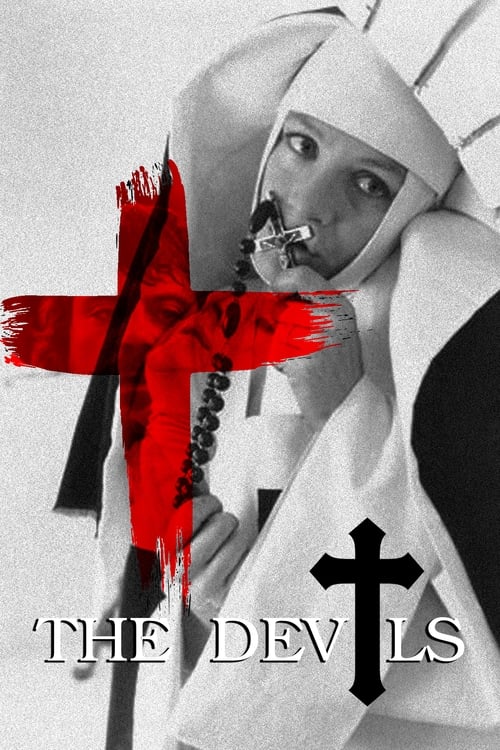
The Devils (1971)
Directed by Ken Russell
No — The Devils is not especially woke, scoring 28 out of 100 on our wokeness meter.
Ken Russell's 1971 immolation of church, state, and the viewer's composure arrives with the confidence of a man who has decided that subtlety is a form of cowardice.
Consciousness Markers
Russell uses the documented Loudun possessions as explicit allegory for totalitarianism and manufactured mass hysteria, while Jarman's anachronistic modernist set design is itself a revisionist gesture collapsing the 17th century into the present.
The film systematically depicts the institutional destruction of women through sexual repression and exploitation by church and state, but whether this constitutes a feminist agenda or a 1970s male director's lurid fascination with female hysteria remains a matter of legitimate dispute.
King Louis XIII's opening masque in heels and a bra presents genuinely gender-fluid imagery, and Derek Jarman's foundational role in British queer cinema inflects the visual aesthetic, but queerness is incidental rather than thematic.
Vanessa Redgrave's Sister Jeanne is portrayed with a physical disability integrated into her psychology, but casting choices are otherwise conventional for a 1971 British production with no evident modern representational intent.
Russell's political intentions are unambiguous, but the film delivers its thesis through visceral imagery and spectacle rather than explanatory dialogue, making it more of a scream than a sermon.
The film is deeply hostile to institutional power and political corruption, but the critique targets church-state collusion specifically rather than capitalism as an economic system.
Sister Jeanne's physical disability and repressed sexuality are used to explore bodily shame as an instrument of oppression, but this is a dramatic device rather than an affirmation of modern body-positive discourse.
No evidence of racial consciousness. The film is set in 17th-century provincial France and is entirely preoccupied with religious and political corruption.
No climate themes, not even metaphorically. The only burning is of heretics.
No evidence of neurodivergence as a theme or framing device in the film.
Why it received this score
Ken Russell's 1971 immolation of church, state, and the viewer's composure arrives with the confidence of a man who has decided that subtlety is a form of cowardice. Based on Aldous Huxley's account of the Loudun possessions and refracted through John Whiting's stage adaptation, the film deploys Derek Jarman's antiseptic white-tiled sets as a deliberate anachronism, collapsing the seventeenth century into something that looks uncomfortably like a modern institution. The message is delivered not through dialogue but through spectacle: orgiastic exorcisms, the weaponization of female desire, and the bureaucratic tidiness with which powerful men process inconvenient priests. Russell himself described it as his one political film, about brainwashing, about the state taking over, and for once a director's stated intentions and the finished work are in precise alignment.
The progressive sensibilities on display here are of the pre-digital, pre-hashtag variety. Sister Jeanne, played by Vanessa Redgrave with a commitment that borders on geological, is a figure simultaneously victimized by institutional repression and complicit in its machinery. The film is interested in how patriarchal structures produce women who destroy other people, which is a feminist-adjacent observation, but Russell renders it with a baroque relish that keeps the analysis at arm's length. King Louis XIII's opening masque, performed in heels and a brassiere, introduces a gender-fluid image of royal authority that would feel at home in certain contemporary discourse, but in context it reads as satire of decadence rather than an affirmation of identity. The film is not trying to make anyone feel seen. It is trying to make everyone feel singed.
What keeps The Devils from accumulating a higher social-consciousness score is precisely what makes it a significant film: it is too angry and too strange to be instructive. Modern progressive cinema tends toward clarity of moral instruction. Russell tends toward the burning of things. The institutional critique is genuine and the political allegory maps cleanly onto any era in which manufactured hysteria serves the interests of the powerful. But the film delivers this thesis by assaulting the audience rather than educating them, which is an approach that has fallen somewhat out of fashion. It is, in the end, a film about how societies destroy individuals who refuse to submit, made by a director who refused to submit to anything, including good taste. We note this without complaint.
Analysis generated by our Consciousness Algorithm
Synopsis
In 1634 France, charismatic Father Urbain Grandier becomes the target of sexually depraved Sister Jeanne's accusations of witchcraft, which corrupt officials of church and state are all too happy to exploit.
Questions about The Devils
Is The Devils woke?
No — The Devils is not especially woke, scoring 28 out of 100 on our wokeness meter. That earns it a verdict of Based.
Does The Devils have any woke elements?
2 of the 10 markers register at 30 or above, led by Revisionist History (35) and Feminist Agenda (30). On Revisionist History: Russell uses the documented Loudun possessions as explicit allegory for totalitarianism and manufactured mass hysteria, while Jarman's anachronistic modernist set design is itself a revisionist gesture collapsing the 17th century into the present.
How does The Devils compare to other 1971 movies?
It ranks #2 of the 30 films from 1971 we've scored; their average is 10. The wokest is Death in Venice (60).
How is the Woke Score calculated?
An AI-assisted process researches the film and its reception, scores it 0–100 on ten markers, then combines those into one 0–100 Woke Score. It measures a specific set of 2020s cultural themes, not film quality.