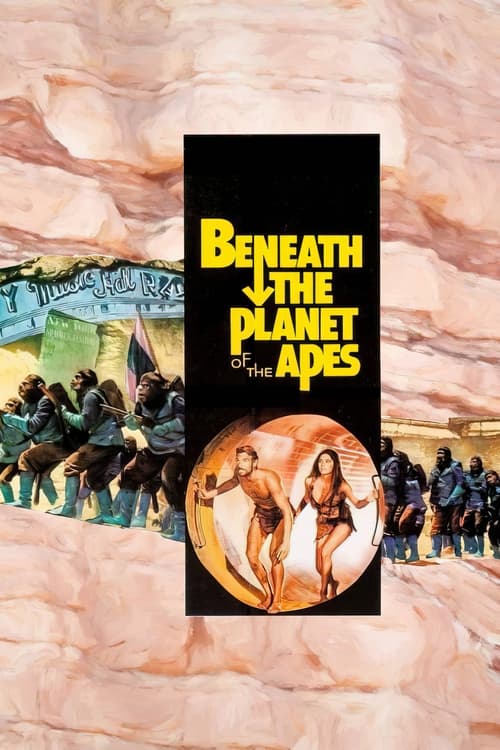
Beneath the Planet of the Apes (1970)
Directed by Ted Post
No — Beneath the Planet of the Apes is not woke, scoring 6 out of 100 on our wokeness meter.
The second installment arrives with its budget halved and its star visibly reluctant.
Consciousness Markers
The director's insistence on a moral — 'the loss of a planet is the loss of all hope' — yields a doom-laden anti-nuclear sermon, though it is delivered through spectacle rather than explicit preaching.
A 1970 studio production with an overwhelmingly white principal cast; the lone notable exception is Don Pedro Colley as a mutant council member, a minor role that exists without any commentary on representation.
Zira (Kim Hunter) is a competent female chimpanzee scientist and Nova is a resourceful mute human, but their presence reflects standard 1970 ensemble casting rather than any feminist thesis.
The ape-versus-human conflict is a species and Cold War allegory, not a meditation on race; the mutant named 'Negro' in the credits is a product of the era's casual insensitivity, not racial consciousness.
General Ursus's war rally invokes conquest for food and territory, but the film offers no critique of capitalism or class economics.
No LGBTQ+ characters, themes, or subtext of any kind appear in the film.
The film's apocalyptic threat is a nuclear doomsday bomb, not climate change; environmental themes are entirely absent.
The mutants' unmasking reveals disfigurements framed as horror and revulsion, the precise inverse of body-positivity messaging.
Telepathy and mind-control are presented as mutant powers and villainy, not as neurodivergent identity or experience.
The film invents its own subterranean mutant civilization rather than revising any historical record.
Why it received this score
The second installment arrives with its budget halved and its star visibly reluctant. Charlton Heston agreed to return only on the condition that Taylor die and his fee go to charity, then shot his scenes in eight days. The result is a franchise doing arithmetic, padding a rescue mission with a new astronaut and a subterranean civilization that worships a cobalt bomb. The production is handsome in a repurposed way. The mutant council chamber was a redress of sets built for a Barbra Streisand musical, which tells us something about Hollywood bookkeeping and nothing about the atom.
The social ledger here is nearly blank, and the few entries are accidents of era more than intent. Don Pedro Colley sits on the mutant council, credited in the promotional materials as Negro, a casting note that reads as period insensitivity instead of representation. Zira remains a capable chimpanzee scientist and Nova a resourceful mute, yet both function as stock ensemble furniture. The ape-human war is a species allegory dressed in Cold War hardware, and General Ursus rallies his gorillas for food and territory without a syllable of class grievance. Telepathy is villainy in this picture, never identity. The mutants remove their masks to reveal scarring and vascular ruin, staged for revulsion. That is the precise inverse of any lesson about accepting bodies as they are.
Director Ted Post objected to the script for making no point, then supplied one of his own: the loss of a planet is the loss of all hope. The film obliges with a doom-laden anti-nuclear sermon, delivered through spectacle and a hymn to the Bomb Almighty instead of argument. Gene Siskel called the decision to give the series a moral a gross error. He may have been right, and he may have been describing the entire enterprise. The apocalypse here is atomic, not climatic. The final detonation settles every question the film raises by declining to leave anyone alive to discuss them.
Analysis generated by our Consciousness Algorithm
Part of


Synopsis
The sole survivor of an interplanetary rescue mission lands on the planet of the apes, and uncovers a horrible secret beneath the surface.
Questions about Beneath the Planet of the Apes
Is Beneath the Planet of the Apes woke?
No — Beneath the Planet of the Apes is not woke, scoring 6 out of 100 on our wokeness meter. That earns it a verdict of Ultra Based.
Does Beneath the Planet of the Apes have any woke elements?
Very few. None of the 10 markers reaches 30, the level where a marker counts as present; the highest is Lecture Energy at 22.
How does Beneath the Planet of the Apes compare to other 1970 movies?
It ranks #10 of the 23 films from 1970 we've scored; their average is 8. The wokest is Little Big Man (38).
Is Beneath the Planet of the Apes the most woke Planet of the Apes (Original) movie?
No. It ranks #5 of the 5 Planet of the Apes (Original) films we've scored; the wokest is Conquest of the Planet of the Apes (29).