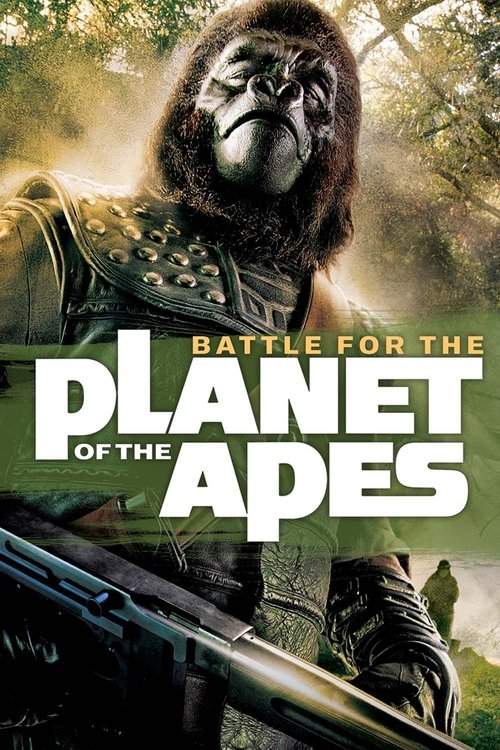
Battle for the Planet of the Apes (1973)
Directed by J. Lee Thompson
No — Battle for the Planet of the Apes is not woke, scoring 16 out of 100 on our wokeness meter.
Battle for the Planet of the Apes arrives as the fifth and final entry in the original series, a 1973 production that Fox released with the weariness of a franchise counting its remaining change.
Consciousness Markers
The film carries a genuine allegory about oppression and equality — apes as former slaves, the taboo on the word 'No' likened to a racial slur, and Caesar's realization that apes are 'no different than their former human slaveowners' — but it is 1973 allegory rather than modern racial consciousness.
The Lawgiver's framing and Caesar's closing plea for coexistence carry a mild moralizing tone, but the film delivers its message through allegory and action rather than preachy sermonizing.
Austin Stoker plays MacDonald, a Black human ally in a position of trust within Caesar's council, but this is natural 1973 ensemble casting rather than deliberate modern diversity programming.
Lisa, Caesar's wife, is a marginal figure with little agency; the film's power struggles are entirely among male apes and humans.
No LGBTQ+ characters, themes, or subtext of any kind appear in the film.
The post-apocalyptic setting stems from nuclear war, not climate change; no environmental crusade is present.
No critique of capitalism, wealth, or class exploitation appears; the conflict is tribal and military.
No body-positivity themes or messaging are present.
No neurodivergent characters or themes are depicted.
The film is speculative science fiction set in a fictional future, not a revisionist retelling of real historical events.
Why it received this score
Battle for the Planet of the Apes arrives as the fifth and final entry in the original series, a 1973 production that Fox released with the weariness of a franchise counting its remaining change. J. Lee Thompson directs a story of Caesar attempting to hold a fragile peace between apes and humans after nuclear war has done its work. The film is small, shabby in places, and critics at the time treated it as a last gasp. The tear that falls from the Caesar statue in the final shot suggests the filmmakers believed they were saying something. They were, though not in the volume they imagined.
The picture carries a genuine allegory about oppression. Apes were slaves, the word "No" is forbidden among them, and a human teacher who utters it is attacked. The critic John Dooley has compared that taboo to a racial slur, and the comparison holds. MacDonald, played by Austin Stoker, sits in Caesar's council as a trusted human, a Black man among apes and mutants, and the casting reads as ordinary 1973 ensemble work instead of a statement. Lisa, Caesar's wife, stands at the edge of the frame and speaks little. The power struggles belong to Caesar, Aldo, and Kolp.
The moral arrives through allegory and battle, not through a podium. Caesar's admission that apes behave no differently from their former human slaveowners lands with some weight, and the Lawgiver's framing device adds a gentle sermon at the edges. There is no environmental crusade here, no economic grievance, no reckoning with the body or the mind's variety. The apocalypse came from bombs, and the argument is tribal. What remains is a modest, melancholy fable about coexistence, delivered with the fatigue of a series that has run out of ideas and still, somehow, finds a tear for the finale.
Analysis generated by our Consciousness Algorithm
Part of


Synopsis
The fifth and final episode in the Planet of the Apes series. After the collapse of human civilization, a community of intelligent apes led by Caesar lives in harmony with a group of humans. Gorilla General Aldo tries to cause an ape civil war and a community of human mutants who live beneath a destroyed city try to conquer those whom they perceive as enemies. All leading to the finale.
Questions about Battle for the Planet of the Apes
Is Battle for the Planet of the Apes woke?
No — Battle for the Planet of the Apes is not woke, scoring 16 out of 100 on our wokeness meter. That earns it a verdict of Ultra Based.
Does Battle for the Planet of the Apes have any woke elements?
1 of the 10 markers register at 30 or above, led by Racial Consciousness (30). On Racial Consciousness: The film carries a genuine allegory about oppression and equality — apes as former slaves, the taboo on the word 'No' likened to a racial slur, and Caesar's realization that apes are 'no different than their former human slaveowners' — but it is 1973 allegory rather than modern racial consciousness.
How does Battle for the Planet of the Apes compare to other 1973 movies?
It ranks #10 of the 32 films from 1973 we've scored; their average is 11. The wokest is Soylent Green (39).
Is Battle for the Planet of the Apes the most woke Planet of the Apes (Original) movie?
No. It ranks #2 of the 5 Planet of the Apes (Original) films we've scored; the wokest is Conquest of the Planet of the Apes (29).