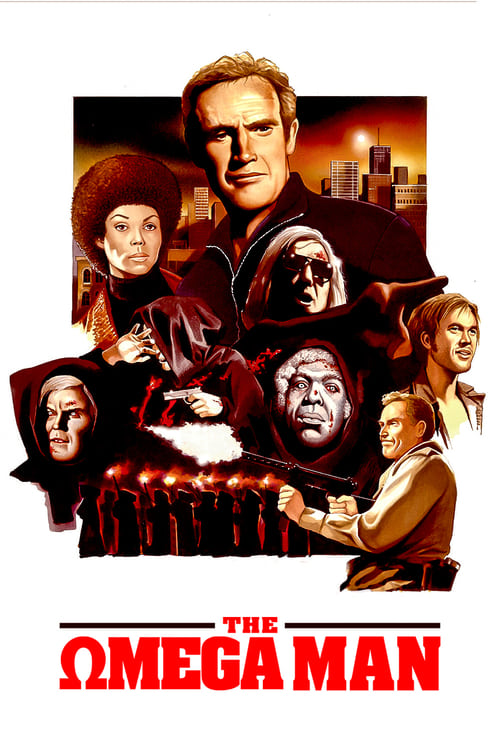
The Omega Man (1971)
Directed by Boris Sagal
No — The Omega Man is not woke, scoring 13 out of 100 on our wokeness meter.
The Omega Man arrives from 1971 with the weary confidence of a film that has seen the end of the world and found it manageable.
Consciousness Markers
The inclusion of an interracial romance between Charlton Heston and Rosalind Cash was a notable, if uncritical, moment for 1971 cinema.
The film attempts to address racial dynamics through its interracial romance and the character's creation, which was noted as being influenced by the Black Power movement of the era.
As a scientist, Neville provides exposition regarding the plague and his vaccine, though the film is primarily action-driven.
Lisa serves as a romantic interest and a survivor, but her agency is secondary to Neville's scientific mission and survival arc.
There are no discernible LGBTQ+ themes or characters present in the narrative.
The apocalypse is caused by biological warfare, not environmental collapse or climate change.
The conflict is framed as science versus fanaticism, not as a critique of modern economic structures or corporate power.
The 'mutants' are depicted as deformed and psychotic threats, serving a horror function rather than a commentary on body image.
No characters are presented with modern, self-aware neurodivergent traits.
The film is a work of speculative fiction and does not attempt to re-examine a specific historical event.
Why it received this score
The Omega Man arrives from 1971 with the weary confidence of a film that has seen the end of the world and found it manageable. Boris Sagal's adaptation of Richard Matheson's I Am Legend trades the novel's bacterial vampirism for biological warfare, leaving Charlton Heston to patrol an emptied Los Angeles in a convertible while a cult of nocturnal albinos hurls spears at his fortified apartment. The conflict is science against fanaticism, and the film has no interest in economic critique or ecological dread. Its apocalypse comes from a Sino-Soviet border skirmish, not from a warming planet, and the villains are not corporations but a former news anchor with a grudge against technology.
The film's claim to cultural memory rests on a single kiss. Rosalind Cash, in her first leading role, plays Lisa, and her romance with Heston's Colonel Neville was a genuine novelty for mainstream Hollywood in 1971. Screenwriter Joyce Corrington has said the character was shaped by the Black Power movement of the era. The gesture is real, and it is also uncritical, offered as texture instead of argument. Lisa survives, treats her brother, and dies weakened and compliant, her agency subordinate to Neville's serum and his martyrdom. Elsewhere the ledger is thin. There are no queer characters, no body-image commentary in the albino mutants, no neurodivergent interiority, no revisionist reckoning with history.
The lecture energy on offer belongs to Neville's scientific exposition, delivered between gunfights. The film prefers action to sermonizing, and it ends with a spear, a fountain, and a flask of blood handed to a younger man. We classify it as a mild case, culturally alert in one respect and incurious in most others.
Analysis generated by our Consciousness Algorithm


Synopsis
Due to an experimental vaccine, Dr. Robert Neville is the only human survivor of an apocalyptic war waged with biological weapons. Besides him, only a few hundred deformed, nocturnal people remain; sensitive to light, and homicidally psychotic.
Questions about The Omega Man
Is The Omega Man woke?
No — The Omega Man is not woke, scoring 13 out of 100 on our wokeness meter. That earns it a verdict of Ultra Based.
Does The Omega Man have any woke elements?
Very few. None of the 10 markers reaches 30, the level where a marker counts as present; the highest is Representation Casting at 20.
How does The Omega Man compare to other 1971 movies?
It ranks #7 of the 30 films from 1971 we've scored; their average is 10. The wokest is Death in Venice (60).
How is the Woke Score calculated?
An AI-assisted process researches the film and its reception, scores it 0–100 on ten markers, then combines those into one 0–100 Woke Score. It measures a specific set of 2020s cultural themes, not film quality.