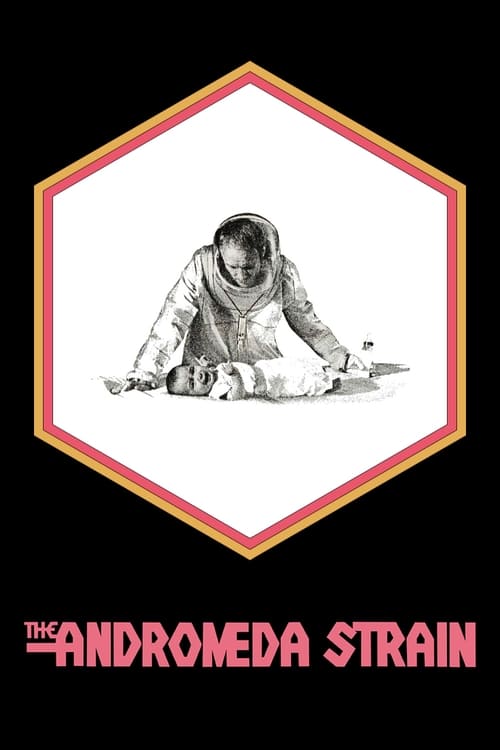
The Andromeda Strain (1971)
Directed by Robert Wise
No — The Andromeda Strain is not woke, scoring 13 out of 100 on our wokeness meter.
The Andromeda Strain arrives from 1971 with the sober demeanor of a laboratory report and the pacing of a decontamination sequence.
Consciousness Markers
Dr. Leavitt was deliberately gender-swapped from male to female in the novel, and she is portrayed as a competent scientist, though the film also includes the explicitly male-centric 'odd-man hypothesis'.
The cast includes Paula Kelly, a Black actress, in a supporting scientific role, and Kate Reid plays a female scientist, but these choices are not framed as modern representation politics.
The film has a methodical, cautionary scientific tone and a Senate testimony framing, but it does not deliver modern social-justice lectures.
No LGBTQ+ characters, themes, or subtext are present.
The film contains no exploration of racial identity, racism, or racial justice themes.
The threat is an extraterrestrial microbe, not climate change or environmental collapse.
There is no critique of capitalism, wealth inequality, or corporate power.
No body positivity themes or diverse body representation are present.
Dr. Leavitt has epilepsy, but the film treats it as a medical liability rather than as neurodivergence in the modern cultural sense.
The film is a fictional science-fiction thriller and does not revise or reinterpret historical events.
Why it received this score
The Andromeda Strain arrives from 1971 with the sober demeanor of a laboratory report and the pacing of a decontamination sequence. Robert Wise directs Michael Crichton's tale of an extraterrestrial microbe that wipes out a New Mexico town, and the film's primary interest is procedure: how scientists isolate a pathogen, how a secret underground facility seals itself, how a nuclear self-destruct device counts down while men in jumpsuits argue about blood pH. This is not a film eager to lecture us about contemporary social arrangements. It is too busy autoclaving.
Still, there are faint signals of cultural awareness. The novel's Dr. Peter Leavitt becomes Dr. Ruth Leavitt, played by Kate Reid, and she is allowed to be a capable, irritable scientist. Paula Kelly appears in a supporting scientific role, a Black actress in a genre that often reserved such spaces for white men. Neither choice is announced as a statement. The film also gives us the odd-man hypothesis, which entrusts the nuclear key to an unmarried male because he is assumed to be the most dispassionate. That is a very 1971 piece of gender logic, and it sits alongside Leavitt's epilepsy, which the plot treats as a medical liability, not as a window into neurodivergence. No LGBTQ themes surface. No racial consciousness. No climate crusade. No anti-capitalist fury. No body positivity. No revisionist history. The film's lecture energy is limited to scientific caution and a Senate hearing, which is a far cry from a modern social sermon.
The result is a cold, methodical thriller that earns respect for its accuracy and its dread, not for its politics. It is a sommelier's vintage of procedural anxiety: dry, precise, and faintly dusty. We are left with a film more interested in blood pH than in the politics of blood. Its progressive sensibilities are embryonic at best, and mostly it just wants to contain the organism before the countdown ends. A modest artifact of pre-identity-era science fiction, and all the more fascinating for it.
Analysis generated by our Consciousness Algorithm


Synopsis
When virtually all of the residents of Piedmont, New Mexico are found dead after the return to Earth of a space satellite, the head of the US Air Force's Project Scoop declares an emergency. A group of eminent scientists led by Dr. Jeremy Stone scrambles to a secure laboratory and tries first to isolate the life form while determining why two people from Piedmont - an old alcoholic and a six-month-old baby - survived. The scientists methodically study the alien life form, unaware that it has already mutated and presents a far greater danger in the lab, which is equipped with a nuclear self-destruct device designed to prevent the escape of dangerous biological agents.
Questions about The Andromeda Strain
Is The Andromeda Strain woke?
No — The Andromeda Strain is not woke, scoring 13 out of 100 on our wokeness meter. That earns it a verdict of Ultra Based.
Does The Andromeda Strain have any woke elements?
Very few. None of the 10 markers reaches 30, the level where a marker counts as present; the highest is Feminist Agenda at 25.
How does The Andromeda Strain compare to other 1971 movies?
It ranks #7 of the 30 films from 1971 we've scored; their average is 10. The wokest is Death in Venice (60).
How is the Woke Score calculated?
An AI-assisted process researches the film and its reception, scores it 0–100 on ten markers, then combines those into one 0–100 Woke Score. It measures a specific set of 2020s cultural themes, not film quality.