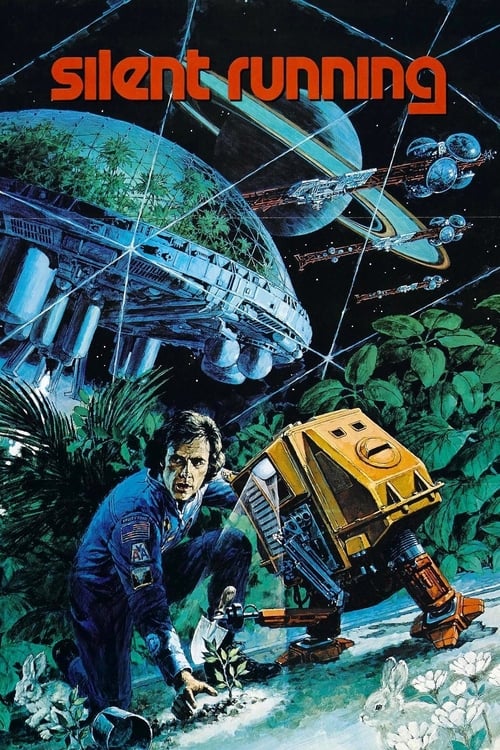
Silent Running (1972)
Directed by Douglas Trumbull
Yes — Silent Running is woke, scoring 69 out of 100 on our wokeness meter.
Douglas Trumbull's 1972 debut arrives with its ecological conscience fully formed, which is a polite way of saying the film has exactly one thing on its mind and pursues it with the grim patience of a man watering plants that are already dead.
Consciousness Markers
The entire plot is driven by ecological catastrophe and the preservation of Earth's last forests, making environmentalism the film's central concern.
The destruction of the domes is ordered to return the freighters to commercial service, framing corporate profit as the enemy of ecological survival.
The film carries an overt environmentalist message, but it is delivered through melancholic science fiction rather than modern preachy exposition.
The cast is entirely white and male, with no meaningful representation of marginalized groups in the narrative. The use of amputee actors inside robot suits is a production curiosity, not a representation-casting statement.
No LGBTQ+ characters, relationships, or themes appear in the film.
There are no significant female characters and no feminist themes or critiques of patriarchy.
The film does not engage with racial identity, racism, or racial justice in any explicit or implicit way.
No body-positive themes, diverse body types, or critiques of beauty standards are present.
Lowell's isolation and attachment to robots are not framed as neurodivergence or a neurodiversity theme.
The film is not based on historical events and does not revise or reinterpret history.
Why it received this score
Douglas Trumbull's 1972 debut arrives with its ecological conscience fully formed, which is a polite way of saying the film has exactly one thing on its mind and pursues it with the grim patience of a man watering plants that are already dead. Earth's flora is gone, the last forests ride in geodesic domes bolted to commercial freighters near Saturn, and Freeman Lowell tends them like a monk who has forgotten the difference between devotion and diagnosis. When the order comes down to jettison the domes and put the ships back to work hauling cargo, the film states its grievance plainly. Profit wants the greenhouse gone. The greenhouse is the point.
The environmental argument is not subtext. It is the load-bearing wall, and Trumbull builds the entire structure around it, letting the melancholy do the shouting. The corporate calculus that condemns the forest is delivered without a villain twirling anything, which is the film's quietest and most effective move. Lowell kills a man, hijacks a ship, reprograms three drones into a family, and the movie never once doubts he is right. Joan Baez sings over the end credits about rejoicing in the sun. The sermon lands, but it lands softly, in the register of grief instead of instruction, and that restraint is the only reason it still works.
Everything else on the ledger comes up empty. The crew is white and male, the robots are robots, and the decision to cast bilateral amputees inside the drone suits is a piece of production trivia, not a statement about anything. There is no racial reckoning here, no feminist reading to extract, no body politics, no neurodivergent framing for Lowell's solitude. What remains is a lonely man, a dying garden, and a robot holding a watering can at the edge of the solar system. That image has outlived the argument around it, which is more than most message pictures can claim.
Analysis generated by our Consciousness Algorithm
Part of


Synopsis
After the entire flora goes extinct, ecologist Lowell maintains a greenhouse aboard a space station for the future with his android companions. However, he rebels after being ordered to destroy the greenhouse in favor of carrying cargo, a decision that puts him at odds with everyone but his mechanical companions.
Questions about Silent Running
Is Silent Running woke?
Yes — Silent Running is woke, scoring 69 out of 100 on our wokeness meter. That earns it a verdict of Woke.
What makes Silent Running woke?
3 of the 10 markers register at 30 or above, led by Climate Crusade (85), Eat the Rich (60) and Lecture Energy (40). On Climate Crusade: The entire plot is driven by ecological catastrophe and the preservation of Earth's last forests, making environmentalism the film's central concern.
How does Silent Running compare to other 1972 movies?
It is the wokest of the 24 films from 1972 we've scored; their average is 14.
How is the Woke Score calculated?
An AI-assisted process researches the film and its reception, scores it 0–100 on ten markers, then combines those into one 0–100 Woke Score. It measures a specific set of 2020s cultural themes, not film quality.