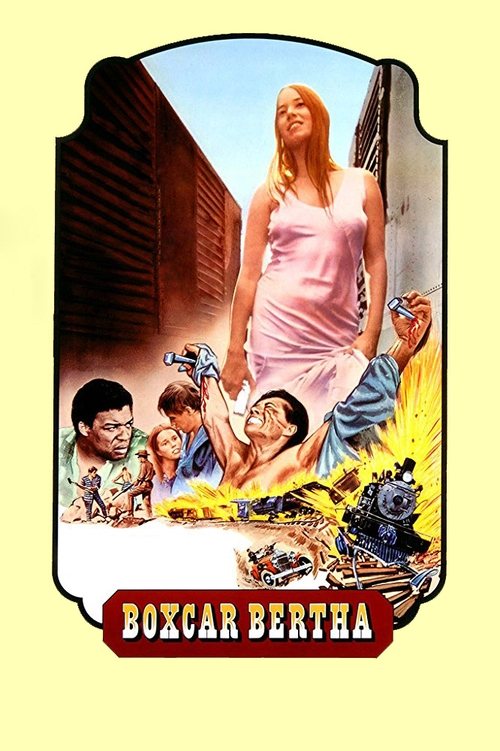
Boxcar Bertha (1972)
Directed by Martin Scorsese
No · Based
How we score movies →Consciousness Markers
The film explicitly centers on union organizing and violence against corrupt railroad management, with clear anti-establishment and anti-corporate themes.
Barbara Hershey leads the film and Bernie Casey appears in the cast, showing some diversity for 1972, though this reflects period casting rather than modern representation politics.
While the protagonist is female, the film treats her as part of a conventional action narrative rather than exploring feminist consciousness or modern gender politics.
While set during the Great Depression with union themes, the film is a straightforward genre piece rather than a contemporary revisionist reframing of history.
Bernie Casey's presence in the cast provides some diversity, but the film shows no evidence of exploring racial themes or consciousness.
The film is an action-driven narrative focused on plot and violence rather than preachy messaging or moral sermonizing.
No LGBTQ+ themes or characters present in the film.
No climate-related themes or messaging in the film.
No body positivity messaging or representation in the film.
No neurodivergence representation or themes in the film.


Synopsis
"Boxcar" Bertha Thompson, a transient woman in Arkansas during the violence-filled Depression of the early '30s, meets up with rabble-rousing union man "Big" Bill Shelly and the two team up to fight the corrupt railroad establishment.
Why it received this score
Boxcar Bertha stands as a curious artifact of 1970s cinema, a period when leftist sentiment flowed through independent filmmaking like steam through the titular trains. This early Scorsese effort, directed on assignment for producer Roger Corman with a minuscule budget and compressed schedule, concerns itself with the proper concerns of its moment: labor organizing, railroad monopolies, and the violent redistribution of ill-gotten gains. The film's anti-capitalist bones are genuine, if unremarkable for an era when such themes were hardly controversial in art cinema. Barbara Hershey and David Carradine navigate the Depression-era landscape as criminals motivated by class consciousness, and the narrative treats their rebellion as justified response to systemic corruption. One observes this with the detachment of a zoologist studying a fascinating but extinct creature.
The film's relationship to modern progressive sensibility, however, is merely coincidental. Its representation of diverse casting reflects the practical realities of low-budget production rather than any deliberate engagement with contemporary identity politics. The female protagonist exists within a conventional action framework, not as an explicit statement about gender or female agency. The union themes, while genuinely radical for mainstream cinema in certain decades, predate the specific constellation of concerns that define 2020s cultural consciousness by several generations. We are watching a film that happened to be leftist in the manner of its era, not one that was constructed with current cultural markers in mind.
Boxcar Bertha deserves recognition as a competent B-movie and an interesting footnote in Scorsese's career, not as a particularly prescient statement about modern progressive values. Its social consciousness belongs to an older vocabulary of class struggle and labor organizing, which, while admirable in its own context, registers as historically distant from the contemporary cultural moment this index seeks to measure.
Analysis generated by our Consciousness Algorithm
Critic Reviews
“The thoughtful, ironic script by Joyce H. Corrington and John William Corrington thins only toward the middle and the whole thing has been beautifully directed by Mar tin Scorsese, who really comes into his own here.”
“Superior formula stuff, injected with a rare degree of life by enthusiastic direction that occasionally tries for virtuosity and succeeds, and by a neat performance from Hershey that avoids the yawning traps in the script (built-in sex sequences, the she-loved-her-man theme in general).”
“Boxcar Bertha is a weirdly interesting movie and not really the sleazy exploitation film the ads promise.”
“Performances are dull. Whatever sociological, political or dramatic motivations may once have existed in the story have been ruthlessly stripped from the plot, leaving all characters bereft of empathy or sympathy. There’s hardly a pretense toward justifying the carnage”