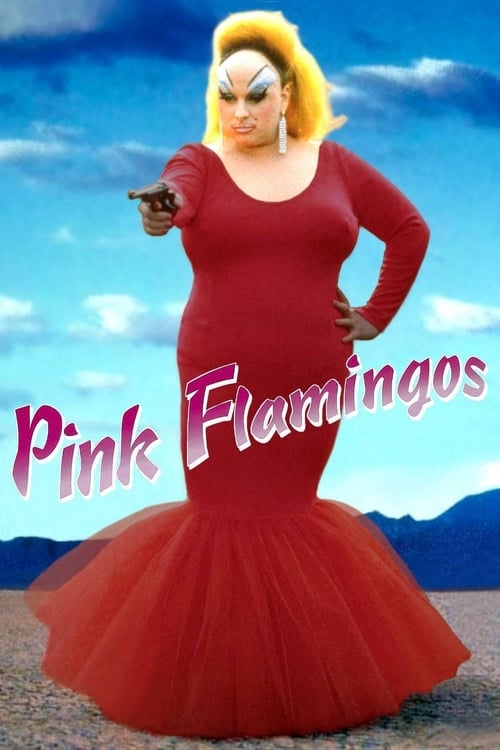
Pink Flamingos (1972)
Directed by John Waters
No — Pink Flamingos is not woke, scoring 15 out of 100 on our wokeness meter.
Pink Flamingos arrives from 1972 with a tagline promising an exercise in poor taste, and it delivers with a commitment bordering on the devotional.
Consciousness Markers
Queer and drag culture are central, including a trans woman character who exposes herself to thwart Raymond, but the treatment is shock-driven rather than advocacy-oriented.
A drag queen (Divine) headlines and the cast is drawn from Waters' countercultural Baltimore troupe, but this is transgressive underground casting rather than modern inclusion-driven representation.
The film revels in non-normative and grotesque bodies (notably Edith Massey), but as abject spectacle rather than a body-positivity message.
Divine is a commanding figure, but the film has no feminist thesis; its gender play is anarchic provocation, not a gender-equity argument.
The Marbles run a baby-trafficking and heroin ring, but this is grotesque villainy for shock value, not an eat-the-rich economic critique.
The film pointedly refuses to moralize or lecture, offering pure transgression with no didactic message.
No engagement with racial politics or consciousness whatsoever.
No environmental or climate themes present.
No depiction or discussion of neurodivergence.
No historical revisionism; the film is deliberately amoral and ahistorical.
Why it received this score
Pink Flamingos arrives from 1972 with a tagline promising an exercise in poor taste, and it delivers with a commitment bordering on the devotional. Divine presides over a trailer outside Phoenix, Maryland, trading insults and worse with the Marbles, a couple whose income comes from a baby ring and heroin sales to schoolchildren. The transgressions are catalogued at length: the chicken, the eggs, the birthday party, the final act with the small dog. John Waters built this on twelve thousand dollars and a cast of Baltimore friends, and the result remains a landmark of abject art, preserved by the Library of Congress for reasons the institution has never had to explain aloud.
Judged by contemporary social metrics, the film is an odd specimen. Its queerness is genuine and central, with a drag queen in the lead and a trans woman who defeats Raymond's exhibitionism by revealing more than he bargained for. Yet the intent is provocation, not advocacy. There is no thesis about gender equity, no argument about economic justice, no environmental conscience, no engagement with racial politics at all. The Marbles are villains because villainy is funnier than virtue, not because the screenplay has opinions about capital. Bodies here are grotesque spectacle, not affirmations. Edith Massey is deployed as an object of fascination, and the film asks no one to feel good about it.
The most striking absence is the sermon. Waters refuses to tell us what any of this means, and the refusal is total. There is no lesson, no moral, no closing address about how to behave. For a modern viewer accustomed to being instructed, the experience is disorienting. The film simply ends, having proven its point about filth and nothing else. We are left to classify it ourselves, which is the only work it asks of us.
Analysis generated by our Consciousness Algorithm
Synopsis
Notorious Baltimore criminal and underground figure Divine goes up against Connie & Raymond Marble, a sleazy married couple who make a passionate attempt to humiliate her and seize her tabloid-given title as "The Filthiest Person Alive".
Questions about Pink Flamingos
Is Pink Flamingos woke?
No — Pink Flamingos is not woke, scoring 15 out of 100 on our wokeness meter. That earns it a verdict of Ultra Based.
Does Pink Flamingos have any woke elements?
1 of the 10 markers register at 30 or above, led by LGBTQ+ Themes (40). On LGBTQ+ Themes: Queer and drag culture are central, including a trans woman character who exposes herself to thwart Raymond, but the treatment is shock-driven rather than advocacy-oriented.
How does Pink Flamingos compare to other 1972 movies?
It ranks #8 of the 24 films from 1972 we've scored; their average is 14. The wokest is Silent Running (69).
How is the Woke Score calculated?
An AI-assisted process researches the film and its reception, scores it 0–100 on ten markers, then combines those into one 0–100 Woke Score. It measures a specific set of 2020s cultural themes, not film quality.