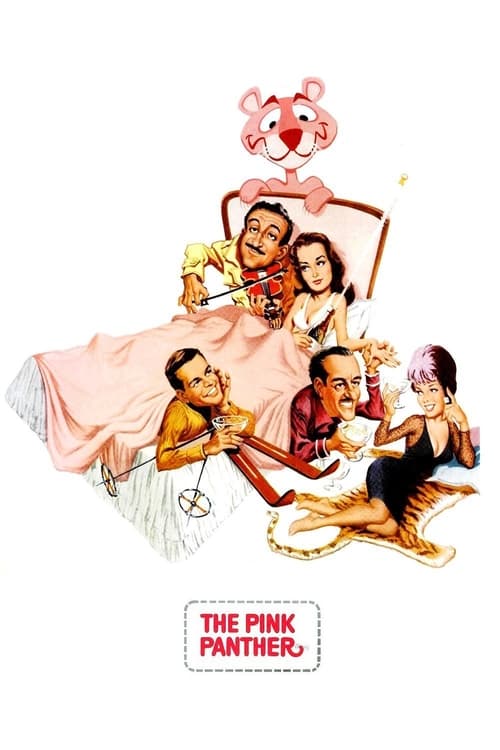
The Pink Panther (1963)
Directed by Blake Edwards
No — The Pink Panther is not woke, scoring 1 out of 100 on our wokeness meter.
The Pink Panther arrives from 1963, a caper comedy assembled by Blake Edwards around a diamond, a ski resort, and Peter Sellers toppling over furniture with the grim determination of a man late for a train.
Consciousness Markers
Simone operates as a cunning fence and Princess Dala outmaneuvers the thieves, but the women function as romantic and comedic foils within a conventional farce, not as vehicles for a feminist argument.
The cast is a predominantly white European and American ensemble; Claudia Cardinale's Princess Dala is the only non-Anglo lead and her casting reflects 1960s continental glamour rather than any deliberate representation agenda.
No LGBTQ+ characters, themes, or subtext appear anywhere in this 1963 caper comedy.
The fictional kingdom of Lugash and its exiled princess provide exotic set dressing, not any commentary on race or racial justice.
No environmental themes or climate concerns are present.
The film is a lighthearted caper about wealthy aristocrats, playboys, and jewel thieves; it offers no critique of wealth or capitalism.
No body positivity themes; the film trades in conventional glamour and physical slapstick.
Clouseau's clumsiness is played purely for slapstick laughs, with no framing as neurodivergence.
The film is a contemporary-set comedy with no historical revisionism of any kind.
The film is pure farce with no didactic messaging or moral instruction directed at the audience.
Why it received this score
The Pink Panther arrives from 1963, a caper comedy assembled by Blake Edwards around a diamond, a ski resort, and Peter Sellers toppling over furniture with the grim determination of a man late for a train. The plot concerns wealthy people attempting to steal from other wealthy people while on holiday, and a score by Henry Mancini that has comfortably outlived every performance inside the frame. It was nominated for an Academy Award for that score, lost, and has since been preserved by the Library of Congress for being culturally significant, which is the sort of honor a film earns by being the template for everything that followed it.
On the matter of representation, the ensemble is a predominantly white European and American affair, and Claudia Cardinale's exiled princess registers as 1960s continental glamour, not any deliberate agenda. The women are plainly the most competent people on screen: Capucine's Simone runs a fencing operation under her husband's nose, and the Princess outmaneuvers two generations of thieves by hiding the jewel where nobody thinks to look. That earns a faint nod for female cunning. It does not constitute an argument about anything. The film has no interest in persuasion. It wants the audience to laugh at a man walking into a door.
Beyond that, the ledger is blank. No LGBTQ+ currents. No commentary on race, with the fictional kingdom of Lugash serving as exotic set dressing and nothing more. No climate anxiety, no indictment of the idle rich who populate every frame, no body positivity, no framing of Clouseau's clumsiness as anything but slapstick. History goes unrevised. Nobody lectures the viewer. The closest the film comes to moral instruction is a traffic warden beneath the wheels of a police car, and even he gets back up.
A cleaner specimen of pure farce would be difficult to locate, and we should say so plainly, without romance. Its cultural awareness is nil. Its timing remains immaculate.
Analysis generated by our Consciousness Algorithm
Part of


Synopsis
The trademark of The Phantom, a renowned jewel thief, is a glove left at the scene of the crime. Inspector Clouseau, an expert on The Phantom's exploits, feels sure that he knows where The Phantom will strike next and leaves Paris for the Tyrolean Alps, where the famous Lugashi jewel 'The Pink Panther' is going to be. However, he does not know who The Phantom really is, or for that matter who anyone else really is...
Questions about The Pink Panther
Is The Pink Panther woke?
No — The Pink Panther is not woke, scoring 1 out of 100 on our wokeness meter. That earns it a verdict of Ultra Based.
Does The Pink Panther have any woke elements?
Very few. None of the 10 markers reaches 30, the level where a marker counts as present; the highest is Feminist Agenda at 5.
How does The Pink Panther compare to other 1963 movies?
It ranks #15 of the 16 films from 1963 we've scored; their average is 7. The wokest is High and Low (28).
Is The Pink Panther the most woke The Pink Panther (Original) movie?
No. It ranks #3 of the 4 The Pink Panther (Original) films we've scored; the wokest is The Pink Panther Strikes Again (5).