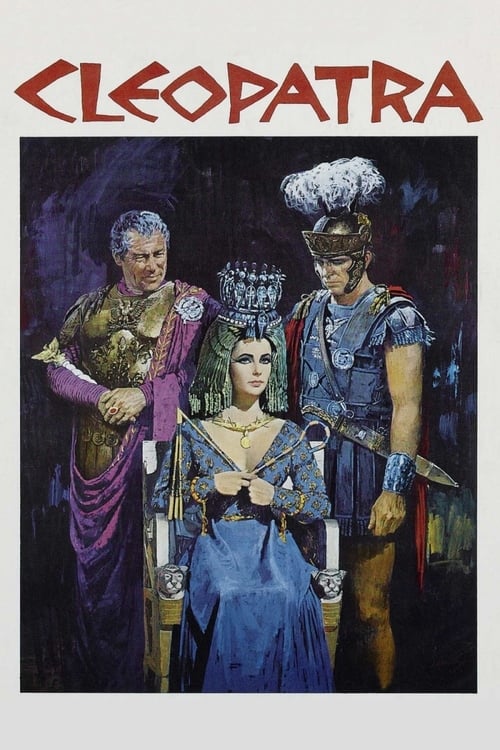
Cleopatra (1963)
Directed by Joseph L. Mankiewicz
No — Cleopatra is not woke, scoring 15 out of 100 on our wokeness meter.
Cleopatra is a monument to old Hollywood excess: Elizabeth Taylor as queen, Rex Harrison as Caesar, Richard Burton as Antony.
Consciousness Markers
Cleopatra is a powerful female ruler who navigates a male-dominated political world, but the film frames her primarily through romance and seduction rather than a modern feminist critique.
The cast is overwhelmingly white, with Elizabeth Taylor, a British-American actress, playing the Egyptian queen Cleopatra. The film does not engage with inclusive or diverse casting practices.
No LGBTQ+ characters, relationships, or themes are present in the film.
The film does not explore racial identity, systemic racism, or racial consciousness; Cleopatra's ethnicity is not addressed.
No environmental or climate-related themes appear in the film.
The film contains no critique of capitalism, wealth inequality, or class struggle.
No body-positive themes or diverse body representations are present.
No neurodivergent characters or themes are depicted.
The film follows traditional historical sources and does not offer a modern revisionist reinterpretation of history.
The film is a historical epic and does not contain preachy or lecture-like messaging.
Why it received this score
Cleopatra is a monument to old Hollywood excess: Elizabeth Taylor as queen, Rex Harrison as Caesar, Richard Burton as Antony. It tells an ancient power struggle with romance. The film's social consciousness is minimal. Its casting practices are of their time; a British-American actress leads as an Egyptian queen, and the surrounding court is overwhelmingly white. No effort is made toward inclusive representation. The film does not treat Cleopatra's ethnicity as a subject. It simply uses history as a backdrop for imperial intrigue and tragic love.
The one area with mild modern resonance is its central female ruler. Cleopatra commands armies, negotiates with emperors, and schemes for power. Yet the screenplay keeps returning to seduction and romance as her primary tools. Her authority is real but filtered through the desires of Caesar and Antony. That gives a faint feminist charge, though it is not a modern feminist critique. The film has no interest in systemic gender analysis. It wants spectacle and heartbreak. No LGBTQ themes appear. No body-positive message. No neurodivergent characters. No environmental concerns. No critique of wealth or class. Rome and Egypt are simply rich, and the film enjoys their riches.
Nothing here lectures the audience about contemporary morality. The film follows familiar historical sources and does not revise them for modern tastes. It does not interrogate race, capitalism, climate, or identity. It is a long, expensive, beautifully designed pageant about ambition and downfall. Its progressive sensibilities are limited to allowing a woman to hold the screen as a political force, and even that is wrapped in mid-century ideas about female power as personal allure. For a viewer seeking the cultural signals of a later era, this one offers mostly sand, gold, and exhaustion. That is not a criticism. It is a classification. The film remains a historical artifact, not a manifesto.
Analysis generated by our Consciousness Algorithm


Synopsis
Determined to hold on to the throne, Cleopatra seduces the Roman emperor Julius Caesar. When Caesar is murdered, she redirects her attentions to his general, Marc Antony, who vows to take power—but Caesar’s successor has other plans.
Questions about Cleopatra
Is Cleopatra woke?
No — Cleopatra is not woke, scoring 15 out of 100 on our wokeness meter. That earns it a verdict of Ultra Based.
Does Cleopatra have any woke elements?
Very few. None of the 10 markers reaches 30, the level where a marker counts as present; the highest is Feminist Agenda at 25.
How does Cleopatra compare to other 1963 movies?
It ranks #2 of the 16 films from 1963 we've scored; their average is 7. The wokest is High and Low (28).
How is the Woke Score calculated?
An AI-assisted process researches the film and its reception, scores it 0–100 on ten markers, then combines those into one 0–100 Woke Score. It measures a specific set of 2020s cultural themes, not film quality.