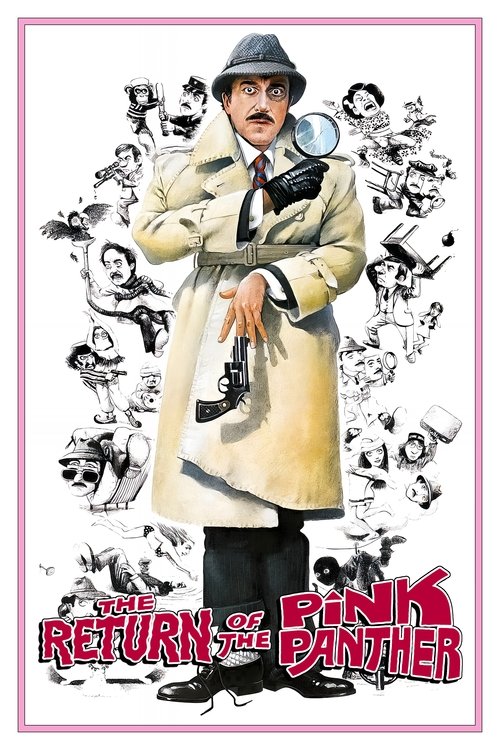
The Return of the Pink Panther (1975)
Directed by Blake Edwards
No · Ultra Based
How we score movies →Consciousness Markers
The film features an all-white principal cast with Asian characters relegated to servile roles. No apparent effort toward inclusive casting or meaningful representation.
Female characters exist primarily as romantic interests and plot devices. Catherine Schell's role is decorative rather than substantive.
The film relies heavily on ethnic caricature, particularly the Kato character as a stereotypical Asian servant. No critical awareness of these dynamics.
No LGBTQ+ themes or characters present in the film. Heterosexual romance is the only relational dynamic explored.
No climate-related themes or messaging present. The film is entirely unconcerned with environmental issues.
The narrative centers on the theft of a luxury jewel and police work. No critique of wealth or capitalism.
No body-positive themes. Physical comedy relies on conventional attractiveness standards of the era.
No representation of neurodivergent characters. Clouseau's incompetence is played for laughs, not as a neurodivergent identity.
The film contains no historical narrative or revisionist elements. It is a contemporary comedy.
The film makes no attempt to educate or lecture the audience on social issues. It is a straightforward entertainment product.


Synopsis
The famous Pink Panther jewel has once again been stolen and Inspector Clouseau is called in to catch the thief. The Inspector is convinced that 'The Phantom' has returned and utilises all of his resources – himself and his Asian manservant – to reveal the identity of 'The Phantom'.
Why it received this score
The Return of the Pink Panther exists in a curious temporal pocket, a 1975 comedy that wears its era's attitudes like an ill-fitting suit, unselfconsciously and with complete confidence. Peter Sellers returns as the bumbling Inspector Clouseau to investigate another theft of the titular jewel, a plot that serves mainly as scaffolding for slapstick and verbal comedy. The film is, by any measure unrelated to contemporary sensibilities, a competently executed farce that understands the mechanics of physical humor and the power of a good accent deployed with precision.
Yet here we confront the film's most conspicuous liability: the character of Kato, Clouseau's "Asian manservant," who functions primarily as a prop for the Inspector's incompetence and as a repository for dated stereotyping. The role exists in a framework that treats Asian representation as interchangeable with servitude and exoticism, a fact that no amount of comedic timing can retroactively remedy. The film makes no apparent effort to interrogate this dynamic or to grant the character any interior life beyond his function as a foil. Additionally, the humor derives substantially from Clouseau's cultural obtuseness and linguistic garbling, which, while presented as the inspector's personal failing, nonetheless relies on the audience's comfort with ethnic caricature as comedic fodder.
The film is a product of its moment, lacking any discernible engagement with questions of representation or power dynamics. Female characters exist as romantic interests and plot mechanics. The racial makeup of the cast reflects no conscious effort toward inclusion, merely the default casting practices of mid-1970s studio filmmaking. Viewed through the lens of contemporary cultural expectations, it registers as a museum piece, interesting primarily for what it reveals about the assumptions that governed entertainment in its era.
Analysis generated by our Consciousness Algorithm
Critic Reviews
“The comic heart of the movie lies in the absolute aplomb and imperturbable self-confidence with which Sellers, as Clouseau, confronts the catastrophes of his own making. [21 July 1975, p.66]”
“All hands seem to be having a ball, especially Schell, whose unabashed amusement at Clouseau’s seduction attempts often matches an audience’s hilarity.”
“The screenplay is funny but even better are the sight gags that are a kind of inventory of everything Clouseau has been unable to master in his long, irrelevant career.”
“The Return of The Pink Panther is so devoid of life that NASA wouldn't bother to send probes to investigate it.”