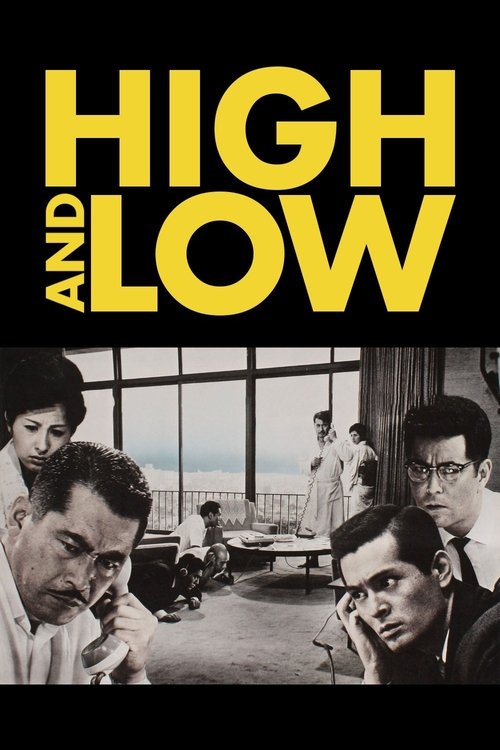
High and Low (1963)
Directed by Akira Kurosawa
No · Based
How we score movies →Consciousness Markers
The film explores class inequality and the brutality of poverty with considerable moral weight. However, it does not advocate for dismantling capitalism or propose systemic alternatives, instead focusing on individual moral choice.
Kurosawa's visual metaphors (penthouse versus slums) are direct and somewhat preachy, though the film trusts the viewer to draw conclusions. The social commentary is present but embedded in dramatic action rather than explicit dialogue.
The cast is exclusively Japanese and reflects the social composition of 1963 Yokohama without deliberate attention to contemporary diversity metrics. This is natural representation, not conscious casting strategy.
While the film depicts post-war Japan and modernization, it does not revisit historical events through a contemporary ideological lens. It reflects its era's understanding of recent history.
Women appear primarily in supporting roles as wives and mothers. The female characters are sympathetic but lack agency in the central conflict, which is entirely male-driven.
No LGBTQ+ themes or characters appear in the film. The narrative is entirely heteronormative and reflects the social reality of its era without commentary.
The film does not engage with racial themes or consciousness. Race is not a category in the narrative, which reflects the demographic homogeneity of 1963 Japan.
No environmental or climate themes appear in this urban crime drama. The film shows modernist architecture and urban development without ecological critique.
No body positivity themes exist in the film. Characters are portrayed according to conventional aesthetic standards without commentary on bodies or appearance.
The film does not engage with neurodivergence or mental disability as a category of analysis. Characters are assumed neurotypical without representation or discussion.


Synopsis
A Yokohama shoe executive faces a wrenching choice when kidnappers mistakenly seize his chauffeur's son but demand the ransom anyway.
Why it received this score
Kurosawa's "High and Low" presents a rigorous examination of class stratification in post-war Japan, structured as a kidnapping thriller that gradually reveals itself as social anatomy. The narrative deliberately contrasts the sterile, modernist architecture of the executive's penthouse with the sprawling slums below, a visual metaphor so blunt it borders on the pedagogical. Yet the film operates primarily as a crime drama, not as a sermon. The kidnappers are portrayed as individual criminals motivated by personal grievance rather than as products of systemic oppression requiring structural remedy. This is class consciousness of the old school, concerned with moral choice and individual destiny, not with dismantling hierarchies.
The film's engagement with economic inequality feels more like classical humanist concern than contemporary progressive sensibility. Kurosawa shows us poverty and desperation without suggesting that the wealthy are inherently corrupt or that capitalism itself requires revolutionary transformation. The shoe executive is not vilified for his wealth. Instead, the drama turns on whether he will sacrifice his fortune to save a child who is not his own, a question of personal virtue rather than systemic justice. This framing, though sympathetic to the poor, treats class as a tragic fact of human existence rather than a problem awaiting ideological correction.
Where the film most clearly exceeds the expectations of its era is in its refusal to demonize the criminal underclass or to suggest that poverty justifies crime. The investigation sequences treat poor suspects with the same investigative rigor as anyone else. Yet this is basic procedural fairness, not the identity-conscious examination that contemporary progressive cinema would bring to such material. The film remains a masterwork of its time, but it speaks to an older moral vocabulary, one concerned with honor and choice rather than representation and systemic critique.
Analysis generated by our Consciousness Algorithm
Critic Reviews
“A sizzling, artistic crackerjack and a model of its genre, pegged on a harassed man's moral decision, laced with firm characterizations and tingling detail and finally attaining an incredibly colorful crescendo of microscopic police sleuthing. ”
“Miraculously, High And Low turns the mundane follow-through of police work into the stuff of white-knuckle suspense.”
“Superb crime thriller. [07 Sep 1998, p.1N]”
“In HIGH AND LOW Kurosawa succeeds in developing a highly visual structural style within the wide-screen format. ”