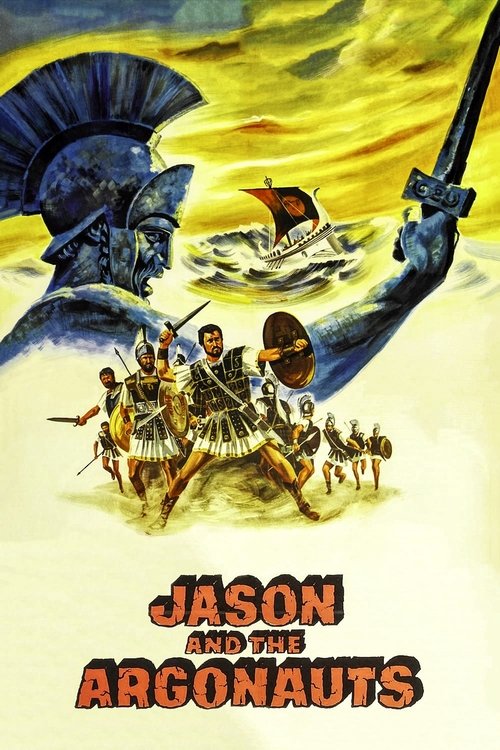
Jason and the Argonauts (1963)
Directed by Don Chaffey
No — Jason and the Argonauts is not woke, scoring 9 out of 100 on our wokeness meter.
Jason and the Argonauts arrives from 1963 with a golden fleece, a bronze giant, and seven skeletons born of dragon's teeth, and it asks nothing of its audience beyond a willingness to be thrilled.
Consciousness Markers
Medea is a high priestess who aids and heals Jason, giving her some narrative agency, but she remains largely a romantic plot device in a 1963 adventure framework.
Greek gods dispense a few moral lessons about virtue and obedience, but the film is an adventure spectacle with no preaching or didactic social message.
The all-white British/American cast plays Greek mythological figures with no ethnic diversity whatsoever, and no thought is given to casting representation.
No LGBTQ+ characters, subtext, or themes of any kind appear in the film.
The film engages no racial themes; its concerns are mythological heroism and adventure.
No environmental or climate messaging is present.
The film contains no economic critique or anti-wealth commentary.
No body-positivity themes or messaging appear.
No neurodivergence themes or characters are present.
The film freely departs from the classical Argonautica (Talos, the Clashing Rocks, the Hydra, the skeleton battle), but this is mythic adaptation for spectacle, not a modern revisionist-history reframing.
Why it received this score
Jason and the Argonauts arrives from 1963 with a golden fleece, a bronze giant, and seven skeletons born of dragon's teeth, and it asks nothing of its audience beyond a willingness to be thrilled. Don Chaffey directs with brisk economy, Ray Harryhausen animates his creatures one painstaking frame at a time, and Bernard Herrmann supplies a score with no strings at all, just brass, percussion, and heroic fanfare. The concerns here are heroism, prophecy, and the correct way to open a plug in a giant's heel. The film is a product of its era in the most literal sense: an all-white British and American cast stands in for the heroes of Greek myth, and nobody involved appears to have given the matter a moment's thought. This is not a failing so much as a historical fact, like the painted backdrops and the matte lines.
Medea, played by Nancy Kovack, is a high priestess of Hecate who heals the wounded and springs Jason from a dungeon, which grants her a measure of agency rare for the period. She is also a romantic attachment and a plot device, won over by the hero and useful chiefly for her access to the fleece. That earns the film a modest nod and no more. Elsewhere the ledger is stark. No racial themes, no economic critique, no environmental sermon, no interest in the body or in the mind's varied wiring. The gods on Olympus dispense the occasional lesson about virtue and obedience, but these are the moral reflexes of myth, not the pointed instruction of a lecture.
To watch the picture now is to watch an adventure with no pretensions, as the critics said at the time, and the phrase holds up. The skeleton battle remains a marvel of patience and craft, seven warriors clattering against three men on a rocky shore, and it carries no argument and no thesis. The film wants to entertain children on a bank holiday, and it does. We classify it accordingly, with respect and without alarm.",
Analysis generated by our Consciousness Algorithm


Synopsis
Jason, a fearless sailor and explorer, returns to his home land of Thessaly after a long voyage to claim his rightful throne. He learns, however, that he must first find the magical Golden Fleece. To do so, he must embark on an epic quest fraught with fantastic monsters and terrible perils.
Questions about Jason and the Argonauts
Is Jason and the Argonauts woke?
No — Jason and the Argonauts is not woke, scoring 9 out of 100 on our wokeness meter. That earns it a verdict of Ultra Based.
Does Jason and the Argonauts have any woke elements?
Very few. None of the 10 markers reaches 30, the level where a marker counts as present; the highest is Feminist Agenda at 15.
How does Jason and the Argonauts compare to other 1963 movies?
It ranks #3 of the 16 films from 1963 we've scored; their average is 7. The wokest is High and Low (28).
How is the Woke Score calculated?
An AI-assisted process researches the film and its reception, scores it 0–100 on ten markers, then combines those into one 0–100 Woke Score. It measures a specific set of 2020s cultural themes, not film quality.