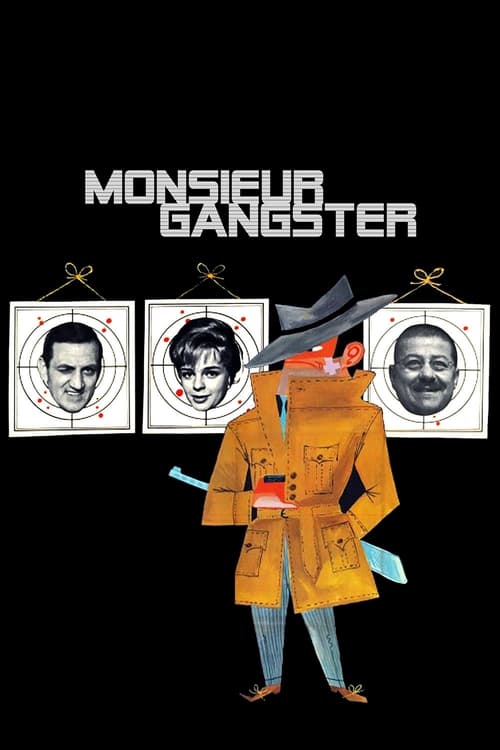
Crooks in Clover (1963)
Directed by Georges Lautner
No — Crooks in Clover is not woke, scoring 7 out of 100 on our wokeness meter.
Les Tontons flingueurs, released in English as Crooks in Clover, is a 1963 French-Italian-West German crime comedy adapted from Albert Simonin's novel and the final installment of the Max le Menteur trilogy.
Consciousness Markers
A 1963 Franco-Italian-German ensemble of almost entirely white European actors; women appear as a brothel madam and a wayward daughter but the casting reflects the period's defaults with no representational intent.
Patricia is a free-spirited 'modern' teenager and Madame Mado runs a brothel, but these are comic fixtures of the gangster genre rather than any feminist argument or rebalancing.
The film treats gangster enterprise — brothels, gambling dens, distilleries — as farce, with no critique of wealth, class, or capitalism in any form.
No LGBTQ+ characters, subtext, or themes of any kind appear in the film.
Race is simply not a subject of the film; the criminal underworld depicted is uniformly white and no racial commentary is offered.
No environmental content whatsoever; the illegal distillery is a plot device, not an ecological statement.
No body image themes or body-diversity messaging present.
No neurodivergent characters or themes are depicted or implied.
A fictional crime comedy adapted from a novel; it makes no revisionist claims about historical events.
Aimless, slang-drunk farce built around a kitchen scene of gangsters getting soused; whatever it has to say it says through insults, not sermons.
Why it received this score
Les Tontons flingueurs, released in English as Crooks in Clover, is a 1963 French-Italian-West German crime comedy adapted from Albert Simonin's novel and the final installment of the Max le Menteur trilogy. Its pleasures are specific and durable: Lino Ventura's weary gravity, Michel Audiard's slang-drunk dialogue, a kitchen scene where gangsters get soused on illegal whisky, and a wedding ambush resolved by a car exploding into a blazing wreck. As a cultural artifact, it sits squarely in its period. The ensemble is almost entirely white European, with no representational intent. Women appear as Patricia, the free-spirited daughter, and Madame Mado, the brothel manager, both comic fixtures of the genre. There is no feminist argument here, only the familiar furniture of a gangster farce. LGBTQ characters, subtext, and themes are entirely absent. Race is not a subject. The criminal underworld is uniformly white, and no racial commentary is offered.
Environmental concerns are likewise absent. The illegal distillery is a plot device, not an ecological statement. The film treats gangster enterprise, brothels, gambling dens, distilleries, as farce, and it offers no critique of wealth, class, or capitalism. The inherited fortune is a comic inconvenience, not a target. Body image themes do not appear. Neurodivergent characters and themes are neither depicted nor implied. The story makes no revisionist claims about historical events. It is a fictional crime comedy adapted from a novel, content to let its crooks be crooks.
Lecture energy is zero. This is an aimless, slang-drunk farce built around insults, hangovers, and a sub-machine gun. Whatever social instruction it might contain arrives through jokes and punches, not sermons. Its progressive quotient is negligible, not because the film is reactionary, but because it is indifferent to the categories we now use to audit culture. A cult classic of drunken kitchen diplomacy, it remains a period piece with no roadmap for contemporary virtue and no apparent anxiety about that omission.
Analysis generated by our Consciousness Algorithm
Synopsis
An aging gangster, Fernand Naudin is hoping for a quiet retirement when he suddenly inherits a fortune from an old friend, a former gangster supremo known as the Mexican. If he is ambivalent about his new found wealth, Fernand is positively nonplussed to discover that he has also inherited his benefactor’s daughter, Patricia. Unfortunately, not only does Fernand have to put up with the thoroughly modern Patricia and her nauseating boyfriend, but he also had to contend with the Mexican’s trigger-happy former employees, who are determined to make a claim.
Questions about Crooks in Clover
Is Crooks in Clover woke?
No — Crooks in Clover is not woke, scoring 7 out of 100 on our wokeness meter. That earns it a verdict of Ultra Based.
Does Crooks in Clover have any woke elements?
Very few. None of the 10 markers reaches 30, the level where a marker counts as present; the highest is Representation Casting at 15.
How does Crooks in Clover compare to other 1963 movies?
It ranks #6 of the 16 films from 1963 we've scored; their average is 7. The wokest is High and Low (28).
How is the Woke Score calculated?
An AI-assisted process researches the film and its reception, scores it 0–100 on ten markers, then combines those into one 0–100 Woke Score. It measures a specific set of 2020s cultural themes, not film quality.