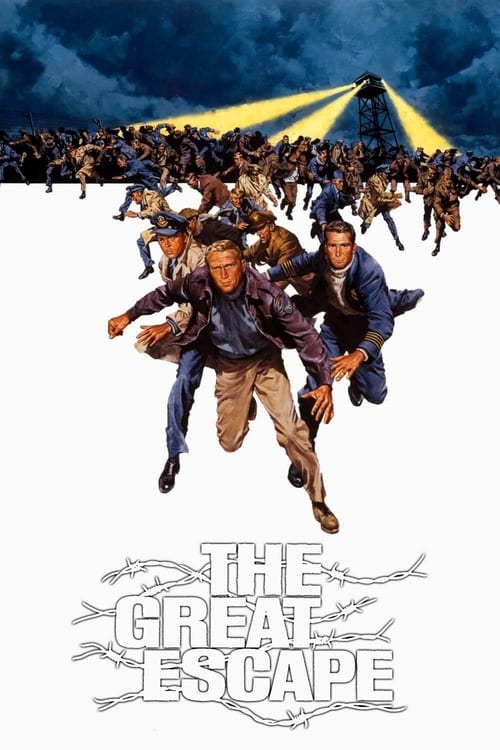
The Great Escape (1963)
Directed by John Sturges
No — The Great Escape is not woke, scoring 6 out of 100 on our wokeness meter.
The Great Escape arrives from 1963, a year in which a war picture could still be simply a war picture.
Consciousness Markers
Welinski's claustrophobia is depicted as a genuine, sympathetic condition he must manage with a comrade's help, and Blythe's progressive myopia is a plot point — a mild, non-ideological depiction of psychological/physical difference.
The cast is an all-white ensemble of British and American officers; the film's notable 'diversity' controversy is the opposite of inclusive — it inflated American involvement for commercial appeal. No meaningful representation casting.
No LGBTQ+ characters, themes, or subtext whatsoever in this 1963 POW adventure.
There are effectively no women in the film; it is a story of men in a prison camp with no feminist framing or commentary.
No engagement with race or racial consciousness; the film's historical omissions concern nationality (Canadians), not racial themes.
No environmental or climate themes present.
A WWII escape thriller with no class critique or anti-capitalist messaging.
No body positivity themes; the film does not engage with body image at all.
The film heavily fictionalizes history (inflating American involvement, omitting the Canadian role), but this is commercial revisionism for audience appeal, not the modern progressive reframing the marker denotes.
A rousing adventure film that ends on a somber note questioning the cost of the escape; it dramatizes rather than preaches and carries no modern moralizing.
Why it received this score
The Great Escape arrives from 1963, a year in which a war picture could still be simply a war picture. John Sturges assembles an all-white ensemble of British and American officers, sets them digging three tunnels beneath a Luftwaffe camp, and lets the machinery run for nearly three hours. It is a well-oiled machine. The motorcycle chase remains a marvel of second-unit work, and the ending, in which fifty recaptured men are shot in cold blood, lands with genuine weight. Nothing here is arranged to instruct us.
On the standard indices of contemporary social consciousness, the film is a wasteland, and it makes no apology for it. There are no women to speak of. There is no engagement with race, class, sexuality, the environment, or body image. The cast is uniformly white, and the production's most famous act of demographic tampering runs in the opposite direction: American characters were invented whole cloth to flatter a domestic audience, while the Canadian sappers who did much of the real digging were written out. That is commercial revisionism, not ideological reframing, and it belongs in a different ledger.
If the film registers anything of modern sensibility, it is faint and incidental. Welinski's claustrophobia is treated as a real condition, one he manages with a comrade's steadying hand, and Blythe's failing eyesight is a plot mechanism handled with quiet sympathy. These are humane touches, not a program. The picture dramatizes instead of sermonizing, and its final question, whether the cost was worth the havoc, is asked by a character, not delivered to the audience. A sommelier would call this vintage clean. Score accordingly.
Analysis generated by our Consciousness Algorithm


Synopsis
The Nazis, exasperated at the number of escapes from their prison camps by a relatively small number of Allied prisoners, relocate them to a high-security 'escape-proof' camp to sit out the remainder of the war. Undaunted, the prisoners plan one of the most ambitious escape attempts of World War II. Based on a true story.
Questions about The Great Escape
Is The Great Escape woke?
No — The Great Escape is not woke, scoring 6 out of 100 on our wokeness meter. That earns it a verdict of Ultra Based.
Does The Great Escape have any woke elements?
Very few. None of the 10 markers reaches 30, the level where a marker counts as present; the highest is Neurodivergence at 10.
How does The Great Escape compare to other 1963 movies?
It ranks #7 of the 16 films from 1963 we've scored; their average is 7. The wokest is High and Low (28).
How is the Woke Score calculated?
An AI-assisted process researches the film and its reception, scores it 0–100 on ten markers, then combines those into one 0–100 Woke Score. It measures a specific set of 2020s cultural themes, not film quality.