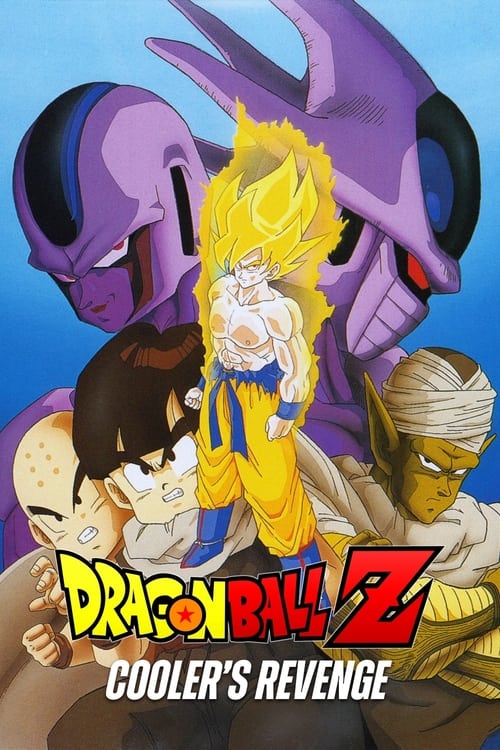
Dragon Ball Z: Cooler's Revenge (1991)
Directed by Mitsuo Hashimoto
No — Dragon Ball Z: Cooler's Revenge is not woke, scoring 0 out of 100 on our wokeness meter.
Dragon Ball Z: Cooler's Revenge arrives from 1991 as the fifth theatrical feature in the Dragon Ball Z line, a brisk exercise in alien vengeance, camping disruption, and escalating punches.
Consciousness Markers
No evidence of deliberate representation casting; the cast is a standard Japanese voice ensemble for a 1991 anime film.
No LGBTQ+ themes or characters are present.
No feminist agenda or gender-focused commentary appears in the film.
No racial consciousness or commentary on race and systemic injustice is present.
No climate change or environmentalist messaging appears.
No anti-capitalist or eat-the-rich themes are present.
No body positivity themes or messaging are present.
No neurodivergence themes or representation are present.
No revisionist history or reimagining of historical events is present.
No lecture energy or preachy social messaging is present; the film is a straightforward martial arts action story.
Why it received this score
Dragon Ball Z: Cooler's Revenge arrives from 1991 as the fifth theatrical feature in the Dragon Ball Z line, a brisk exercise in alien vengeance, camping disruption, and escalating punches. Cooler, the estranged brother of Frieza, travels to Earth to settle a family account, and Goku, Gohan, Krillin, and Piccolo absorb the consequences. The film is animated with the period's usual efficiency and scored with the period's usual enthusiasm. It does not pause to explain itself, and it does not pause to improve anyone.
The story's concerns are honor, revenge, fatherhood, and the reliable pleasure of a villain discovering he has miscalculated. No identity-based casting program is visible. No LGBTQ narrative appears. Gender is not examined. Race is not examined. Climate is not examined. Capitalism is not examined. Bodies are not discussed as political sites; they are discussed as objects that can be thrown through mountains. Neurodivergence is absent as a theme. History is not revised. The film's only transformation is biological and violent, which is the sort of transformation this franchise prefers.
There is no sermon here. The film has no lesson, no plea for social reform. Its ethical system is direct: protect your son, heal your father, kill the tyrant. When Cooler is launched into the sun, the moment is not framed as a critique of empire or extraction. It is framed as a win. Audiences looking for contemporary cultural instruction will find none here. Audiences looking for a Super Saiyan will find one. The classification is clean, the vintage is 1991, and the film remains what it always was: a loud, unpretentious martial arts cartoon about family honor and solar incineration.
Analysis generated by our Consciousness Algorithm
Part of


Synopsis
After defeating Frieza, Goku returns to Earth and goes on a camping trip with Gohan and Krillin. Everything is normal until Cooler - Frieza's brother - sends three henchmen after Goku. A long fight ensues between our heroes and Cooler, in which he transforms into the fourth stage of his evolution and has the edge in the fight... until Goku transforms into a Super Saiyan.
Questions about Dragon Ball Z: Cooler's Revenge
Is Dragon Ball Z: Cooler's Revenge woke?
No — Dragon Ball Z: Cooler's Revenge is not woke, scoring 0 out of 100 on our wokeness meter. That earns it a verdict of Ultra Based.
Does Dragon Ball Z: Cooler's Revenge have any woke elements?
No. All 10 markers score zero.
How does Dragon Ball Z: Cooler's Revenge compare to other 1991 movies?
It ranks #61 of the 68 films from 1991 we've scored; their average is 14. The wokest is Paris Is Burning (77).
Is Dragon Ball Z: Cooler's Revenge the most woke Dragon Ball Z movie?
No. It ranks #3 of the 15 Dragon Ball Z films we've scored; the wokest is Dragon Ball Z: The Return of Cooler (2).