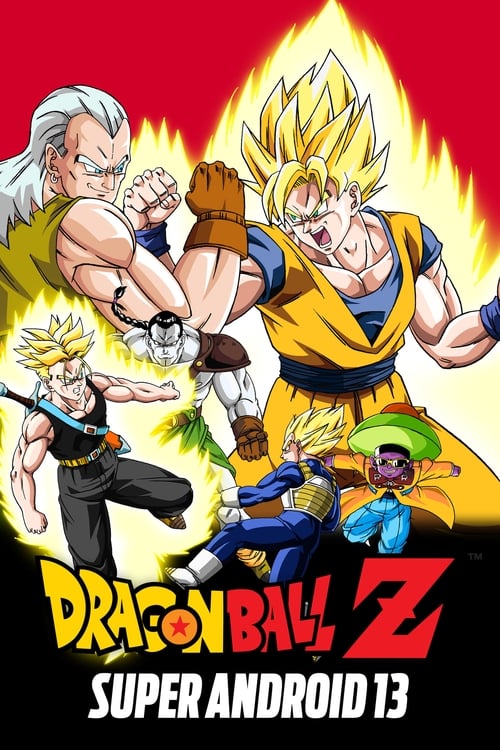
Dragon Ball Z: Super Android 13! (1992)
Directed by Daisuke Nishio
No — Dragon Ball Z: Super Android 13! is not woke, scoring 0 out of 100 on our wokeness meter.
The seventh Dragon Ball Z feature arrives from the summer of 1992 with the serenity of a franchise that long ago stopped asking questions of itself.
Consciousness Markers
The cast is entirely Japanese voice actors performing established Japanese characters; no diversity-driven casting agenda is present or relevant to this 1992 anime film.
There are no LGBTQ+ characters, themes, or subtext anywhere in the story.
Chi-Chi appears only in a domestic cameo; the film offers no feminist themes or commentary.
The film contains no engagement with race, racism, or racial identity.
There is no environmental or climate-themed content; the conflict is purely about combat.
No economic critique or anti-capitalist messaging; the villain is a revenge-driven android, not a system.
No body-positivity themes or messaging are present.
No neurodivergence themes or characters are present.
The film is an original fictional story with no historical revisionism.
This is a straightforward martial-arts action film with no preaching or moral instruction.
Why it received this score
The seventh Dragon Ball Z feature arrives from the summer of 1992 with the serenity of a franchise that long ago stopped asking questions of itself. Dr. Gero, murdered by his own creations, has copied his consciousness into an underground supercomputer, which activates three new androids and points them at a shopping mall. Goku is eating lunch. The androids want him dead. That is the plot, complete and sufficient, and the film treats it with a straight face.
For those of us who tabulate cultural instruction, the ledger here is startlingly clean. Chi-Chi appears, occupies a domestic frame, and vanishes without complaint. Master Roshi leers and receives no lecture. The single scrap of moral guidance comes when Goku asks his attackers to move the fight out of the city so that bystanders are not crushed, which is less a sermon than a matter of urban planning. Nobody in the film is corrected, educated, or improved by the narrative. The villain is a revenge-driven machine, not a system, and the resolution is a fist through the abdomen.
The craft is workmanlike. The animation does what a mid-tier Toei production of the era did, and the dubbing history (three English versions, one produced in Malaysia with a cast no one can name) suggests a long afterlife in living rooms. What lingers is the closing image: Piccolo and Vegeta on an iceberg, apart from the celebration, two proud men declining the group hug. It is the only moment of real interiority in the picture, and it lasts perhaps eight seconds. A clean specimen. Nothing to flag, nothing to confiscate.
Analysis generated by our Consciousness Algorithm
Part of


Synopsis
Dr. Gero's Androids #13, #14, and #15 are awakened by the laboratory computers and immediately head to the mall where Goku is shopping. After Goku, Trunks, and Vegeta defeat #14 and #15, #13 absorbs their inner computers and becomes a super being greater than the original three separately were. Now it is up to Goku to stop him.
Questions about Dragon Ball Z: Super Android 13!
Is Dragon Ball Z: Super Android 13! woke?
No — Dragon Ball Z: Super Android 13! is not woke, scoring 0 out of 100 on our wokeness meter. That earns it a verdict of Ultra Based.
Does Dragon Ball Z: Super Android 13! have any woke elements?
No. All 10 markers score zero.
How does Dragon Ball Z: Super Android 13! compare to other 1992 movies?
It ranks #65 of the 74 films from 1992 we've scored; their average is 12. The wokest is The Crying Game (62).
Is Dragon Ball Z: Super Android 13! the most woke Dragon Ball Z movie?
No. It ranks #3 of the 15 Dragon Ball Z films we've scored; the wokest is Dragon Ball Z: The Return of Cooler (2).