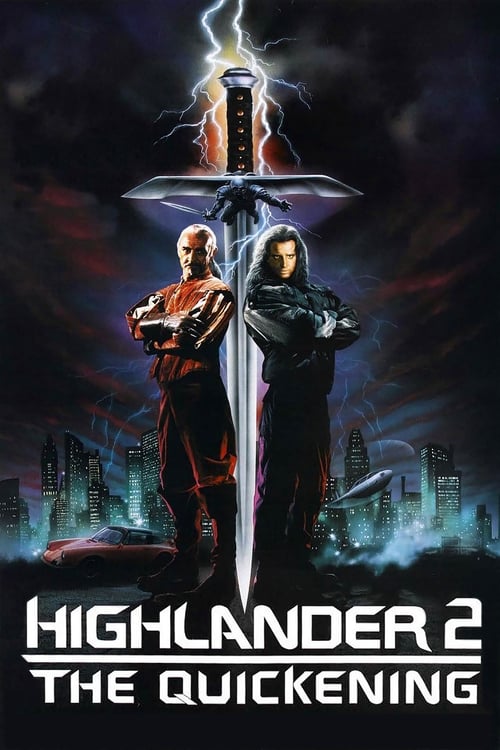
Highlander II: The Quickening (1991)
Directed by Russell Mulcahy
No — Highlander II: The Quickening is not especially woke, scoring 34 out of 100 on our wokeness meter.
Highlander II: The Quickening arrives from 1991 with a plot so mangled that its own franchise later disowned it.
Consciousness Markers
The entire plot hinges on a devastated ozone layer, industrial pollution, and a corporation maintaining an artificial shield; the heroes literally restore Earth's atmosphere, making environmental catastrophe the film's central crisis.
The villain is the Shield Corporation, which extorts nations with protection fees and conceals that the ozone has recovered to preserve its revenue—a fairly explicit corporate-greed parable.
The environmental and corporate-greed themes are present but delivered through pulpy action plotting rather than preachy sermonizing; the film is too incoherent to lecture effectively.
Louise Marcus is a female resistance leader with some agency, but she is largely a romantic sidekick and the film offers no feminist critique or agenda.
The cast is overwhelmingly white and male, with Virginia Madsen as the lone prominent woman; no meaningful diverse casting or commentary on representation.
No LGBTQ+ characters, themes, or subtext of any kind appear in the film.
The film engages no racial themes whatsoever; its conflict is entirely about immortals, aliens, and a corporate shield.
No body-positivity themes or messaging are present.
No neurodivergent characters or themes appear.
The film retcons its own franchise mythology (immortals as aliens from Zeist), but this is fictional continuity revision, not the ideological rewriting of real history the marker denotes.
Why it received this score
Highlander II: The Quickening arrives from 1991 with a plot so mangled that its own franchise later disowned it. Immortals are now aliens from Zeist, Connor MacLeod is an old man, and Earth is smothered by a failing ozone layer. The film's most sincere conviction is environmental. Industrial pollution has killed millions, an artificial shield keeps the planet in hot darkness, and the heroes eventually restore the atmosphere. That is not subtext. It is the plot. The villain is the Shield Corporation, which charges nations protection fees and hides the fact that the ozone has recovered so its revenue stream survives. This gives the film a genuine anti-capitalist pulse, though it is delivered through sword fights, flying blades, and Michael Ironside shouting.
The sermonizing stays low because the movie cannot organize its thoughts long enough to preach. It is too chaotic, too compromised by its own production history, too busy being a legendary mess. The environmental and corporate-greed themes are present as pulp, not sermon. Elsewhere, the social record is bare. The film has no interest in race, queerness, body image, or neurodivergence. Its revisionism concerns fictional continuity, not real history. Representation is standard early 1990s action: a white male ensemble, with Virginia Madsen as the lone prominent woman.
Louise Marcus leads an anti-shield group and has a plan, which counts for something. The film still reduces her to a romantic sidekick and a reward for the restored hero. No feminist critique follows. What remains is a fascinating artifact of early 1990s anxiety about the sky, wrapped in incoherence. It is remembered among the worst films ever made, and that reputation is earned. Yet the ozone crisis and the Shield Corporation give it a recognizable cultural preoccupation. We can acknowledge that without pretending the film has anything coherent to say. The rest is noise, swords, and Sean Connery wandering into a performance of Hamlet.
Analysis generated by our Consciousness Algorithm


Synopsis
The Prize has been won. Connor MacLeod is mortal... Now an old man on the verge of death, memories of his past on the planet Zeist resurface, where a vengeful enemy, General Katana, plots to destroy him once and for all.
Questions about Highlander II: The Quickening
Is Highlander II: The Quickening woke?
No — Highlander II: The Quickening is not especially woke, scoring 34 out of 100 on our wokeness meter. That earns it a verdict of Based.
Does Highlander II: The Quickening have any woke elements?
2 of the 10 markers register at 30 or above, led by Climate Crusade (70) and Eat the Rich (60). On Climate Crusade: The entire plot hinges on a devastated ozone layer, industrial pollution, and a corporation maintaining an artificial shield; the heroes literally restore Earth's atmosphere, making environmental catastrophe the film's central crisis.
How does Highlander II: The Quickening compare to other 1991 movies?
It ranks #8 of the 68 films from 1991 we've scored; their average is 14. The wokest is Paris Is Burning (77).
Is Highlander II: The Quickening the most woke Highlander movie?
Yes. It scores highest of the 3 Highlander films we've scored.