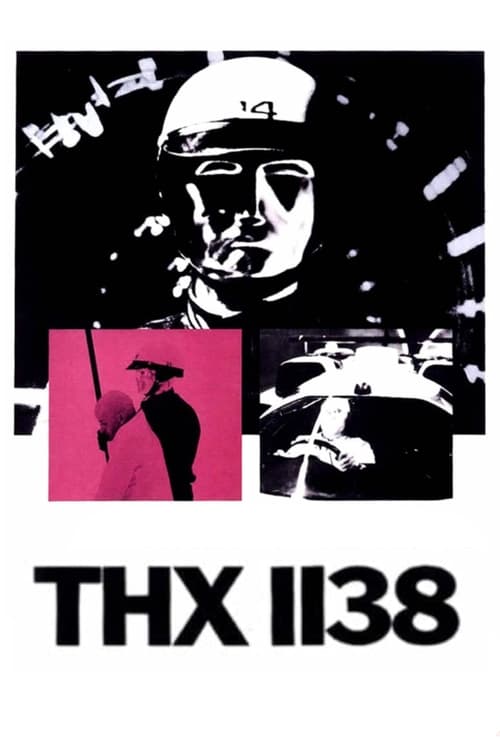
THX 1138 (1971)
Directed by George Lucas
No — THX 1138 is not woke, scoring 7 out of 100 on our wokeness meter.
George Lucas made his feature debut with a film that has aged into an artifact of unusual purity.
Consciousness Markers
The film critiques a controlled-consumption society and includes a pointed gag in which the state abandons THX's pursuit because the cost exceeds the allocated budget, but this is anti-totalitarian and anti-bureaucratic rather than a modern eat-the-rich polemic.
Don Pedro Colley, a Black actor, plays the hologram SRT 5752 in a substantial supporting role, but the cast is otherwise uniformly white and the casting reflects 1971 norms rather than any deliberate diversity agenda.
The film is a moody, atmospheric dystopian vision that shows rather than tells; its social critique is embedded in imagery and sound design rather than delivered as a sermon.
LUH 3417 is a functional character whose rebellion drives the plot, but the film offers no feminist critique of gender roles or patriarchy; she exists largely as a plot device.
No LGBTQ+ characters, themes, or subtext appear anywhere in the film.
The dystopia is racially unmarked and the film engages no themes of race, racism, or racial identity.
The film's underground city is a product of totalitarian control, not environmental collapse; no climate or ecological themes are present.
No body-positivity themes; the film's uniform, shaven-headed aesthetic is about enforced conformity, not body acceptance.
No neurodivergence themes; the drug-induced emotional awakening is a political metaphor, not a depiction of neurodivergent identity.
The film is set in an invented future and makes no revisionist claims about historical events.
Why it received this score
George Lucas made his feature debut with a film that has aged into an artifact of unusual purity. THX 1138 presents an underground city of white corridors, shaven heads, mandatory sedatives, and android police, and it does so with the patience of a director who has not yet learned to sell anything. The performances are subdued to the point of sedation, which is the point. Robert Duvall walks through his own life as a man discovering that he has one. The sound design, assembled by Walter Murch, hums and mutters and never explains itself. For a picture so often filed under dystopian science fiction, it carries remarkably little argument.
The social content is real but ancestral. The state here is totalitarian, bureaucratic, and cheap: when THX flees toward the city's edge, the android pursuers are recalled because the cost of his capture exceeds the allocated budget for him. That is a joke about administration, not about wealth. There are no plutocrats to eat and no climate to mourn; the city sits underground because the authorities prefer it there. Don Pedro Colley appears as the hologram actor SRT 5752, a substantial supporting turn in an otherwise uniformly pale cast, a piece of casting that reflects the era's ordinary practice instead of any deliberate design. Maggie McOmie's LUH 3417 drives the plot and is then consumed by it, a figure of function, not of critique.
What the film declines to do is lecture. It offers no sermon on gender, no meditation on race, no ecological lament, no celebration of the body, no vocabulary for neurodivergence. Its rebellion is a man climbing a ladder toward a sunset, and the camera refuses to tell us what to think about it. We are left with imagery, sound, and a young director's confidence that atmosphere can carry meaning without a spokesperson. As a specimen of modern social consciousness, it is inert. As a document of 1971, it is nearly perfect, and that is its own quiet verdict.
Analysis generated by our Consciousness Algorithm
Part of


Synopsis
People in the future live in a totalitarian society. A technician named THX 1138 lives a mundane life between work and taking a controlled consumption of drugs that the government uses to make puppets out of people. As THX is without drugs for the first time he has feelings for a woman and they start a secret relationship.
Questions about THX 1138
Is THX 1138 woke?
No — THX 1138 is not woke, scoring 7 out of 100 on our wokeness meter. That earns it a verdict of Ultra Based.
Does THX 1138 have any woke elements?
Very few. None of the 10 markers reaches 30, the level where a marker counts as present; the highest is Eat the Rich at 15.
How does THX 1138 compare to other 1971 movies?
It ranks #16 of the 30 films from 1971 we've scored; their average is 10. The wokest is Death in Venice (60).
How is the Woke Score calculated?
An AI-assisted process researches the film and its reception, scores it 0–100 on ten markers, then combines those into one 0–100 Woke Score. It measures a specific set of 2020s cultural themes, not film quality.