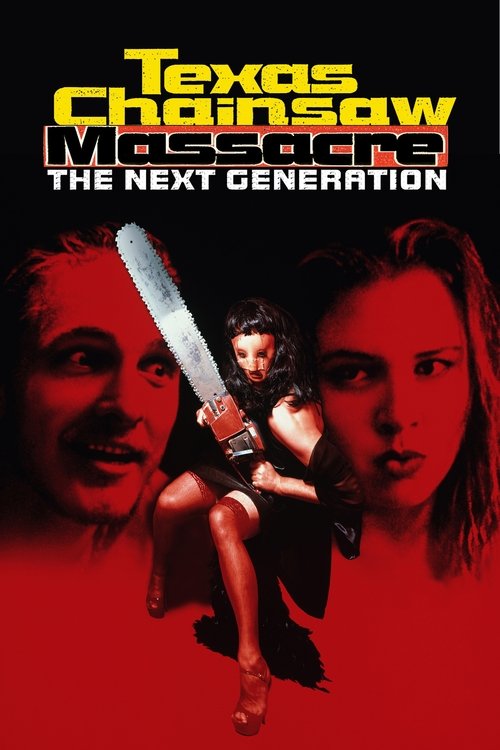
The Return of the Texas Chainsaw Massacre (1995)
Directed by Kim Henkel
No — The Return of the Texas Chainsaw Massacre is not especially woke, scoring 21 out of 100 on our wokeness meter.
The fourth entry in the Texas Chainsaw cycle arrives with a curious pedigree.
Consciousness Markers
Director Kim Henkel explicitly wrote Jenny as a female-empowerment figure who refuses to be silenced or victimized, though the film remains an exploitation slasher with a conventional final-girl arc.
The cast is uniformly white, with no meaningful racial or ethnic representation; the film's Texas setting and 1995 production offer no diversity casting agenda.
No LGBTQ+ characters, themes, or subtext; the 'cross dressing' keyword refers to Leatherface's grotesque costuming, not queer identity.
No engagement with race, racism, or racial identity; the story is entirely focused on backwoods cannibal horror.
No environmental or climate themes whatsoever.
The secret-society subplot gestures at elite manipulation, but it is not an economic critique or eat-the-rich narrative.
No body-positive themes; the film uses bodily mutilation and grotesque corpses for horror.
Mental illness and neurodivergence are not explored; the killers are simply presented as insane psychopaths.
No historical revisionism; the film is a fictional slasher sequel with no real historical subject.
Themes of empowerment and spiritual torment are buried in subtext and exposition, not delivered as a social lecture.
Why it received this score
The fourth entry in the Texas Chainsaw cycle arrives with a curious pedigree. Kim Henkel, who wrote the 1974 original, took the director's chair for this 1995 prom-night outing, shot on a modest budget in and around Pflugerville with a largely Austin-based cast. Among the players were a then-unknown Renee Zellweger and a then-unknown Matthew McConaughey, both of whom would go on to better things. The film's ambitions are modest and its cultural footprint smaller still. It is a slasher picture about teenagers wandering into a farmhouse, and it makes no effort to address the demographics of its audience, the climate, or the economy. The cast is uniformly white, which is a fact of the production, not a statement of any kind.
There is one faint signal worth recording. Henkel has said he wrote Jenny as a figure of female empowerment, a young woman who refuses to be silenced or victimized and emerges self-realized. That intent registers, barely, in the final act, where she fights her way out of the dinner table and into a limousine. The machinery surrounding her is pure exploitation: meat hooks, sledgehammers, a corpse in the bathtub. The empowerment is asserted in interviews more than dramatized on screen, and it never hardens into a sermon. A viewer hoping to be lectured will leave disappointed.
The rest of the checklist yields nothing. The secret society that employs the killers gestures at elite manipulation, but it is a plot device about spiritual torment, not an economic critique. Race, climate, body image, neurodivergence: none of it appears, and none of it is asked for. It remains a strange, sweaty cult object, memorable chiefly for McConaughey's audition and its own incoherence.
Analysis generated by our Consciousness Algorithm
Part of


Synopsis
A group of teenagers get into a car crash in the Texas woods on prom night, and then wander into an old farmhouse that is home to Leatherface and his insane family of cannibalistic psychopaths.
Questions about The Return of the Texas Chainsaw Massacre
Is The Return of the Texas Chainsaw Massacre woke?
No — The Return of the Texas Chainsaw Massacre is not especially woke, scoring 21 out of 100 on our wokeness meter. That earns it a verdict of Based.
Does The Return of the Texas Chainsaw Massacre have any woke elements?
1 of the 10 markers register at 30 or above, led by Feminist Agenda (35). On Feminist Agenda: Director Kim Henkel explicitly wrote Jenny as a female-empowerment figure who refuses to be silenced or victimized, though the film remains an exploitation slasher with a conventional final-girl arc.
How does The Return of the Texas Chainsaw Massacre compare to other 1995 movies?
It ranks #16 of the 108 films from 1995 we've scored; their average is 12. The wokest is Total Eclipse (60).
Is The Return of the Texas Chainsaw Massacre the most woke Texas Chainsaw Massacre movie?
Yes. It scores highest of the 7 Texas Chainsaw Massacre films we've scored.