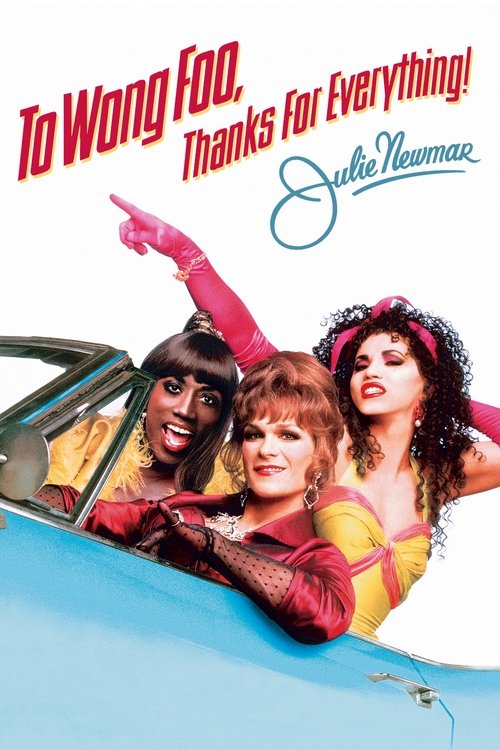
To Wong Foo, Thanks for Everything! Julie Newmar (1995)
Directed by Beeban Kidron
Yes — To Wong Foo, Thanks for Everything! Julie Newmar is woke, scoring 60 out of 100 on our wokeness meter.
This 1995 production presents a curiously gentle exploration of non-binary performance and roadside cultural awareness.
Consciousness Markers
The entire premise is drag queens on a road trip, with homophobia, coming out, and LGBTQ+ community as central themes. It became a cult favorite in the LGBTQ+ community and was inspired by an anti-gay propaganda film.
A major studio film centered on three drag queens, featuring dozens of real New York drag performers (RuPaul, Lady Bunny, Candis Cayne, etc.) in supporting roles. The leads are straight actors, but the film put drag culture front and center for a mainstream 1995 audience.
Directed by a woman (Beeban Kidron), and features a subplot in which Vida intervenes to beat and eject Carol Ann's abusive husband, plus a makeover/empowerment arc for the town's women. The feminism is present but subordinate to the drag-culture narrative.
A deliberately multiracial trio (Black, Latino, white) anchors the film, and Sheriff Dollard hurls racial slurs during the assault scene. Race is acknowledged but not interrogated as a theme.
The film is widely noted for tiptoeing around controversy and delivering its acceptance message through gentle comedy rather than preaching. Its themes of individuality and tolerance are present but soft-pedaled.
No environmental or climate themes appear in the film.
No anti-capitalist or class-warfare message; the film even features prominent Coca-Cola product placement.
No body-positivity theme; the film's aesthetic is glamour and pageantry rather than body acceptance.
No neurodivergence themes or characters.
No historical revisionism; the film is a contemporary fictional road comedy.
Why it received this score
This 1995 production presents a curiously gentle exploration of non-binary performance and roadside cultural awareness. We find ourselves watching three drag queens traverse the American landscape, a journey framed by an earnest desire to elevate the lives of strangers through flamboyant spectacle. The film succeeds in making its central premise—the road trip of costuming and identity—entirely engaging for a mainstream audience. The lead casting, featuring diverse performers in both primary and supporting roles, provides a significant anchor for the film's progressive sensibilities. Its handling of LGBTQ+ themes is certainly front and center, making the narrative a compelling piece of popular culture. However, the film maintains a deliberate soft touch when tackling more complex social issues. The representation is broad, yet the message remains highly polished and easily digestible, which may be why the overall impact feels so safely mediated.
The director maintains a level of social consciousness without ever descending into heavy-handed sermonizing. The progressive elements, such as the feminist intervention into domestic abuse and the acknowledgment of racial tension during a highway stop, are woven into the comedic fabric. They function as narrative set pieces rather than deeply interrogated thematic arcs. The attempt at a multiracial dynamic anchors the story, though the film relies on surface-level acknowledgment of these identities. It is a film that celebrates individuality with a broad, comforting sweep.
Ultimately, the narrative functions more as a vibrant, entertaining pageant than a challenging cultural text. It offers a vibrant glimpse into a specific era of American cinema, prioritizing high glamour and charm over the kind of uncompromising progressive critique we see in later years. This remains a beloved piece of genre cinema for its charm, rather than its groundbreaking social commentary.
Analysis generated by our Consciousness Algorithm
Part of


Synopsis
Veteran drag queens Vida Boheme and Noxeema Jackson take novice Chi-Chi Rodriguez under their wing on a madcap road trip across the country to compete in the Drag Queen of America pageant in Los Angeles.
Questions about To Wong Foo, Thanks for Everything! Julie Newmar
Is To Wong Foo, Thanks for Everything! Julie Newmar woke?
Yes — To Wong Foo, Thanks for Everything! Julie Newmar is woke, scoring 60 out of 100 on our wokeness meter. That earns it a verdict of Woke.
What makes To Wong Foo, Thanks for Everything! Julie Newmar woke?
4 of the 10 markers register at 30 or above, led by LGBTQ+ Themes (92), Representation Casting (78) and Feminist Agenda (48). On LGBTQ+ Themes: The entire premise is drag queens on a road trip, with homophobia, coming out, and LGBTQ+ community as central themes.
How does To Wong Foo, Thanks for Everything! Julie Newmar compare to other 1995 movies?
It is the wokest of the 108 films from 1995 we've scored; their average is 12.
How is the Woke Score calculated?
An AI-assisted process researches the film and its reception, scores it 0–100 on ten markers, then combines those into one 0–100 Woke Score. It measures a specific set of 2020s cultural themes, not film quality.