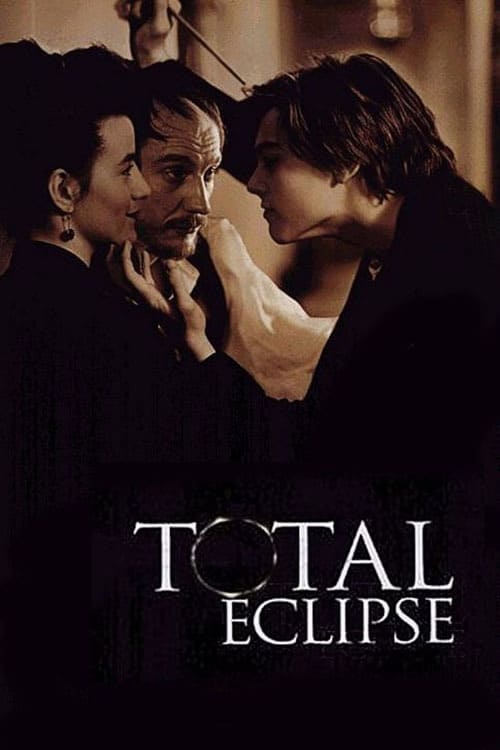
Total Eclipse (1995)
Directed by Agnieszka Holland
Yes — Total Eclipse is woke, scoring 60 out of 100 on our wokeness meter.
Total Eclipse arrives from 1995 carrying the full weight of a serious literary adaptation, and it carries that weight with a grimace.
Consciousness Markers
The film's central subject is the fierce, forbidden same-sex romance between poets Rimbaud and Verlaine, making queer desire the narrative core rather than a subplot.
Directed by Agnieszka Holland and offering a somewhat sympathetic view of Verlaine's abandoned young wife Mathilde, though the film is not organized around a feminist thesis.
Rimbaud's deliberate scandalizing of Verlaine's pretentious bourgeois in-laws carries a mild anti-bourgeois, anti-respectability charge, but it is aesthetic rebellion rather than economic critique.
The film is a moody, destructive character drama rather than a preachy one, with little direct moral instruction to the audience.
The cast is entirely white European, reflecting the historical French setting with no deliberate diversity casting.
No engagement with race or racial politics; the story is confined to 19th-century white European bohemia.
No environmental or climate themes whatsoever.
No body-positivity themes present.
No neurodivergence themes; Rimbaud's wildness is framed as artistic temperament, not a condition.
The film presents itself as a historically accurate account drawn from letters and poems, not a revisionist reframing of the past.
Why it received this score
Total Eclipse arrives from 1995 carrying the full weight of a serious literary adaptation, and it carries that weight with a grimace. Agnieszka Holland directs Christopher Hampton's adaptation of his own 1967 play, and the result is a film about two French poets behaving atrociously toward each other for two hours, which is to say it is a film about love. Leonardo DiCaprio, at the age when the cheekbones were doing most of the acting, plays Arthur Rimbaud as a provincial brat who arrives in Paris to dismantle a marriage. David Thewlis plays Paul Verlaine as the marriage. The attraction is intellectual, physical, and ruinous, and the film never pretends otherwise.
On the matter of social consciousness, the film is unusually forthright for its era. The romance between Rimbaud and Verlaine is not a subplot, a suggestion, or a discreet hand resting on a shoulder. It is the engine, and the film follows it through seduction, violence, a gunshot in Brussels, and a prison term for sodomy without flinching or apologizing. That is a substantial commitment for a mid-nineties studio picture, and it earns the film a place in any honest accounting of queer cinema from the period. Elsewhere the ledger is thinner. Rimbaud's gleeful assault on Verlaine's pompous in-laws registers as a young man's contempt for respectability, not an economic argument. Mathilde, the abandoned pregnant wife, is granted a few moments of genuine dignity by Holland's camera, though the film is not built around her grievance.
What the film declines to do is instruct. There are no speeches about the age gap, no narrator arriving to contextualize the sodomy statutes, no montage explaining that the nineteenth century was unkind. It trusts the audience to locate the cruelty on its own, and mostly the cruelty is the point. The result is moody, humid, occasionally tedious, and entirely free of sermonizing. A viewer hoping for a moral will have to bring one along.
A note on taxonomy: this is a true story, drawn from letters and poems, and it is not a sequel, a remake, a superhero outing, or a box office champion, nor did it trouble the Academy. It simply exists, and it watches you back.
Analysis generated by our Consciousness Algorithm
Synopsis
Young, wild poet Arthur Rimbaud and his mentor Paul Verlaine engage in a fierce, forbidden romance while feeling the effects of a hellish artistic lifestyle.
Questions about Total Eclipse
Is Total Eclipse woke?
Yes — Total Eclipse is woke, scoring 60 out of 100 on our wokeness meter. That earns it a verdict of Woke.
What makes Total Eclipse woke?
1 of the 10 markers register at 30 or above, led by LGBTQ+ Themes (85). On LGBTQ+ Themes: The film's central subject is the fierce, forbidden same-sex romance between poets Rimbaud and Verlaine, making queer desire the narrative core rather than a subplot.
How does Total Eclipse compare to other 1995 movies?
It is the wokest of the 108 films from 1995 we've scored; their average is 12.
How is the Woke Score calculated?
An AI-assisted process researches the film and its reception, scores it 0–100 on ten markers, then combines those into one 0–100 Woke Score. It measures a specific set of 2020s cultural themes, not film quality.