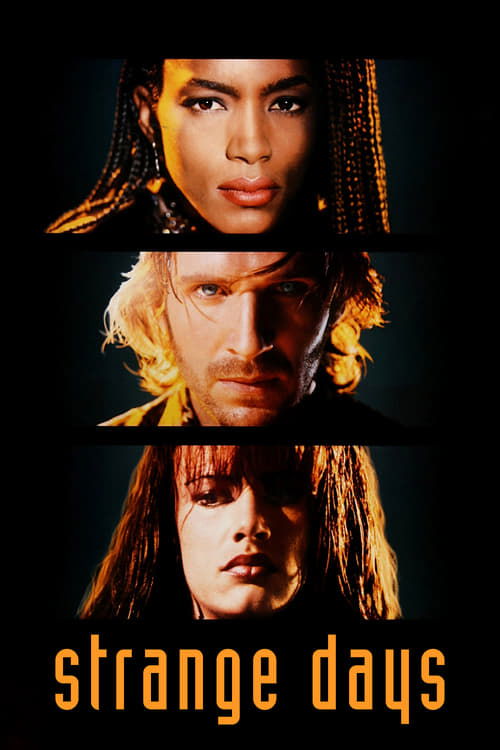
Strange Days (1995)
Directed by Kathryn Bigelow
Partly — Strange Days is somewhat woke, scoring 55 out of 100 on our wokeness meter.
Kathryn Bigelow's Strange Days arrives at the end of 1995 with a great deal on its mind and a budget it could not recoup.
Consciousness Markers
The plot is explicitly built around police brutality against Black men, with the murder of the rapper Jeriko One for his anti-police activism directly inspired by Rodney King and the 1992 LA riots, culminating in a riot over police accountability.
Angela Bassett co-leads as Mace, a physically formidable Black female bodyguard who effectively functions as the film's moral and action center, a strikingly progressive casting choice for a 1995 studio sci-fi thriller.
Directed by Kathryn Bigelow and anchored by Bassett's capable, self-possessed Mace, the film offers a woman who repeatedly rescues the male lead and physically subdues armed officers, though its feminist content is largely implicit rather than programmatic.
The dystopia is framed by economic disparity, and the climax targets a party of the city's wealthy elite, with a corrupt music mogul surveilling his own artists, though the critique remains atmospheric rather than a sustained thesis.
Political content about police violence and media corruption is present but dramatized through noir plotting rather than delivered as direct moral instruction.
The film folds real early-1990s events like the Rodney King beating and LA riots into a fictional near-future dystopia, but it does not rewrite or reinterpret actual history so much as borrow its imagery.
No LGBTQ+ characters, relationships, or themes appear anywhere in the narrative.
No environmental or climate themes are present in the film.
No body-positivity themes or messaging are present.
No neurodivergence themes or characters are present.
Why it received this score
Kathryn Bigelow's Strange Days arrives at the end of 1995 with a great deal on its mind and a budget it could not recoup. Los Angeles, 1999, days from the millennium, is a war zone of curbside commerce and police helicopters. Lenny Nero (Ralph Fiennes) peddles SQUID discs, recorded memories that let paying customers wear another person's skin for a few minutes. The premise is a noir engine, greased with voyeurism and dread, and the film never lets us forget that the product being sold is other people's suffering. That is a bleak piece of social observation, and it lands.
The film's political spine is racial, and it is unmissable. The murdered rapper Jeriko One was killed by two officers for lyrics that stirred protests, a plot line lifted from the Rodney King beating and the 1992 uprising that followed. Bigelow has said she worked the downtown cleanup and felt the anger and the disparity firsthand. Her film converts that into a conspiracy reaching the deputy police commissioner's office, and it ends with a crowd on the verge of riot and two officers arrested, one dead by his own hand. The class critique runs alongside: a music mogul keeps his own artists under surveillance, and the climax unfolds at a party for the city's wealthy elite. The anger is atmospheric, not argued.
Angela Bassett's Mace does the heavy lifting, a bodyguard who pulls Lenny from burning cars and later puts down two armed officers with a baton and a taser. She is the film's moral center and its muscle, and casting a Black woman in that role for a 1995 studio science fiction picture was a deliberate choice. Elsewhere the ledger is thin. There is no queer content of any kind, no environmental anxiety, no body-positive messaging, no neurodivergent character. The political material arrives through plot instead of sermon, which keeps the preaching modest. A serious film, then, and a commercially doomed one, which is its own kind of review.
Analysis generated by our Consciousness Algorithm


Synopsis
In the last days of 1999, ex-cop turned street hustler Lenny Nero receives a disc which contains the memories of the murder of a prostitute. With the help of bodyguard Mace, he starts to investigate and is pulled deeper and deeper in a whirl of murder, blackmail and intrigue.
Questions about Strange Days
Is Strange Days woke?
Partly — Strange Days is somewhat woke, scoring 55 out of 100 on our wokeness meter. That earns it a verdict of Woke-Adjacent.
What makes Strange Days woke?
5 of the 10 markers register at 30 or above, led by Racial Consciousness (78), Representation Casting (65) and Feminist Agenda (45). On Racial Consciousness: The plot is explicitly built around police brutality against Black men, with the murder of the rapper Jeriko One for his anti-police activism directly inspired by Rodney King and the 1992 LA riots, culminating in a riot over police accountability.
How does Strange Days compare to other 1995 movies?
It ranks #4 of the 108 films from 1995 we've scored; their average is 12. The wokest is Total Eclipse (60).
How is the Woke Score calculated?
An AI-assisted process researches the film and its reception, scores it 0–100 on ten markers, then combines those into one 0–100 Woke Score. It measures a specific set of 2020s cultural themes, not film quality.