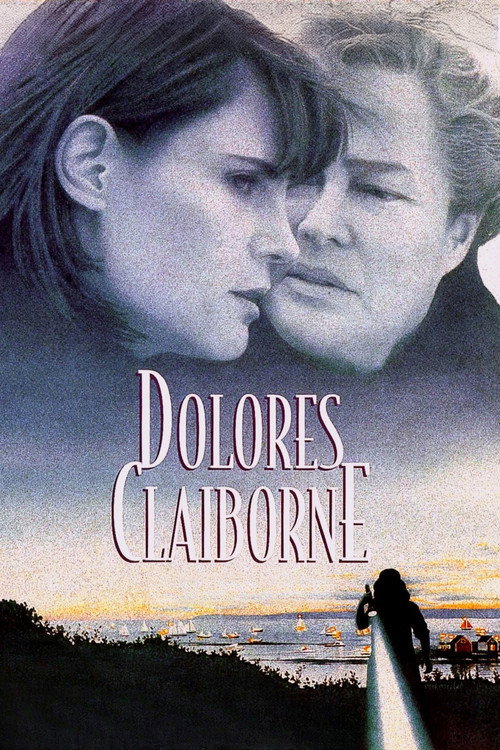
Dolores Claiborne (1995)
Directed by Taylor Hackford
Partly — Dolores Claiborne is somewhat woke, scoring 42 out of 100 on our wokeness meter.
Taylor Hackford's 1995 adaptation of Stephen King's novel arrives as a moody, salt-air chamber piece.
Consciousness Markers
The film centers three complex women and has been read by scholars as a 'self-consciously feminist' work about women forced into compromises by a patriarchal world, culminating in Dolores taking violent control of her own situation. The recurring 'sometimes being a bitch is the only thing a woman has left to hold on to' motif is a genuine feminist statement, though it predates the modern activist framing.
The film is a patient, character-driven thriller that dramatizes abuse and survival rather than delivering explicit moral instruction to the audience. Any thematic weight is embedded in story rather than sermon.
The principal cast is entirely white, with no meaningful racial or ethnic diversity in the ensemble. Casting reflects standard mid-1990s Hollywood norms with no representational intent.
There are no LGBTQ+ characters, relationships, or themes anywhere in the narrative. The story is entirely concerned with heterosexual family dynamics and abuse.
Race is entirely absent as a theme; the story is set in an all-white Maine island community with no engagement with racial dynamics or consciousness.
There is no environmental or climate content whatsoever in the film.
The film touches on stolen money and a servant's economic precarity, but these serve the abuse plot rather than any critique of capitalism or class warfare.
No body-positive themes or messaging are present; the film does not engage with body image or size acceptance.
Selena's depression and substance abuse are depicted as trauma responses rather than framed through a neurodivergence lens. No autism, ADHD, or neurodiversity themes are present.
The film is a contemporary psychological thriller with no historical subject matter to revise.
Why it received this score
Taylor Hackford's 1995 adaptation of Stephen King's novel arrives as a moody, salt-air chamber piece. Kathy Bates plays Dolores with granite patience, and Jennifer Jason Leigh gives Selena a jittery, wounded glamour. The film is a patient thriller about abuse, memory, and a mother's long con of survival. Scholars have called it self-consciously feminist, and that reading holds. The central triad of women, Dolores, Selena, and Vera, each negotiate a patriarchal world that offers them few exits. The recurring line about being a bitch as the only thing a woman has left is the film's thesis, delivered without a soapbox. This is a 1990s feminist consciousness, embedded in genre, not a modern activist checklist.
What the film does not do is carry the contemporary social agenda. Its Maine island is white, insular, and unconcerned with racial dynamics. There are no LGBTQ threads, no climate sermons, no body-positive arcs, no neurodivergence framing. Selena's depression and drinking are trauma responses, not identity categories. The wealthy Vera and her servant Dolores share a bond of mutual recognition, but the movie never becomes a treatise on class war. The money is a plot device, a stolen escape fund, not a critique of capital. The past is personal, not historical, so there is no revisionist project. This is not a defect. It is simply a different era's storytelling.
The film rarely lectures. It dramatizes the abuse, the eclipse, the well, the ferry memory. It does not stop to instruct. The horror is domestic and ordinary, as Roger Ebert noted. The final reconciliation on the wharf lands because the movie has earned it through character, not sermon. As a cultural artifact, Dolores Claiborne sits in a curious middle: ahead of its time in its serious treatment of incest and domestic violence through women's perspectives, yet free of the later vocabulary that would make such a film a battleground. It remains a somber, effective piece of work. The sommelier would note a dry finish, with notes of Maine granite and unresolved rage.
Analysis generated by our Consciousness Algorithm


Synopsis
Dolores Claiborne was accused of killing her abusive husband twenty years ago, but the court's findings were inconclusive and she was allowed to walk free. Now she has been accused of killing her employer, Vera Donovan, and this time there is a witness who can place her at the scene of the crime. Things look bad for Dolores when her daughter Selena, a successful Manhattan magazine writer, returns to cover the story.
Questions about Dolores Claiborne
Is Dolores Claiborne woke?
Partly — Dolores Claiborne is somewhat woke, scoring 42 out of 100 on our wokeness meter. That earns it a verdict of Woke-Adjacent.
What makes Dolores Claiborne woke?
1 of the 10 markers register at 30 or above, led by Feminist Agenda (58). On Feminist Agenda: The film centers three complex women and has been read by scholars as a 'self-consciously feminist' work about women forced into compromises by a patriarchal world, culminating in Dolores taking violent control of her own situation.
How does Dolores Claiborne compare to other 1995 movies?
It ranks #5 of the 108 films from 1995 we've scored; their average is 12. The wokest is Total Eclipse (60).
How is the Woke Score calculated?
An AI-assisted process researches the film and its reception, scores it 0–100 on ten markers, then combines those into one 0–100 Woke Score. It measures a specific set of 2020s cultural themes, not film quality.