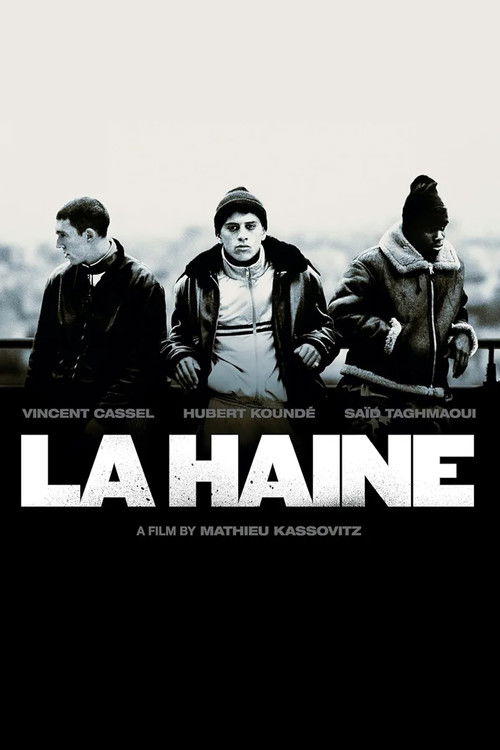
La Haine (1995)
Directed by Mathieu Kassovitz
No — La Haine is not especially woke, scoring 37 out of 100 on our wokeness meter.
Mathieu Kassovitz's La Haine arrives as a single day and night in the lives of three young men from a housing project outside Paris, and it wastes no time on explanation.
Consciousness Markers
Racism, xenophobia, and the marginalization of immigrant communities in the Parisian banlieue are the film's central subject, dramatized through police brutality and social exclusion.
The film authentically casts Afro-French and North African actors as its three leads, centering immigrant and minority protagonists in a way that was notable for 1995 French cinema.
The film critiques state neglect, poverty, and the social abandonment of the housing projects, though its anger is aimed more at police and the establishment than at capitalism as such.
The film is a raw slice-of-life social thriller that shows rather than preaches; its political content emerges from lived experience rather than explicit moralizing.
No LGBTQ+ characters or themes appear anywhere in the film.
The narrative is entirely built around three young men; women are essentially absent and no feminist themes are engaged.
No environmental or climate themes are present.
No body positivity themes are present.
No neurodivergence themes are present.
The film is a fictional day-in-the-life narrative, not a revisionist retelling of historical events.
Why it received this score
Mathieu Kassovitz's La Haine arrives as a single day and night in the lives of three young men from a housing project outside Paris, and it wastes no time on explanation. The camera simply follows Vinz, Hubert, and Saïd as they drift, argue, and wait for word on a friend beaten into a coma by police. The black and white photography gives the banlieue a stark, unglamorous dignity. This is a film that understands its territory from the inside, having been shot there with residents and non-professionals standing alongside the trained cast. The title comes from a line about hatred breeding hatred, and the film earns it without ever saying so twice.
The social consciousness on display is specific and rooted. Casting Afro-French and North African actors as the three leads was a statement in 1995 French cinema, and the film's racial and ethnic consciousness is not decoration; xenophobia, police brutality, and the abandonment of immigrant communities are the engine of the plot. There is an economic anger here too, aimed at a state that has left these buildings to rot, though the target is the establishment and its police more than capital itself.
What the film declines to do is lecture. It shows a police interrogation, a rooftop party raided without cause, a man humiliated in custody, and it lets the audience draw conclusions. There is no feminist thread, no queer presence, no environmental sermon, no body-positive subplot, no neurodivergent arc, and no revisionist rewriting of history. The anger is lived, not announced. Three decades on, the restraint still lands harder than any speech.
Analysis generated by our Consciousness Algorithm


Synopsis
After a chaotic night of rioting in a marginal suburb of Paris, three young friends, Vinz, Hubert and Saïd, wander around unoccupied waiting for news about the state of health of a mutual friend who has been seriously injured when confronting the police.
Questions about La Haine
Is La Haine woke?
No — La Haine is not especially woke, scoring 37 out of 100 on our wokeness meter. That earns it a verdict of Based.
Does La Haine have any woke elements?
3 of the 10 markers register at 30 or above, led by Racial Consciousness (75), Representation Casting (65) and Eat the Rich (35). On Racial Consciousness: Racism, xenophobia, and the marginalization of immigrant communities in the Parisian banlieue are the film's central subject, dramatized through police brutality and social exclusion.
How does La Haine compare to other 1995 movies?
It ranks #8 of the 108 films from 1995 we've scored; their average is 12. The wokest is Total Eclipse (60).
How is the Woke Score calculated?
An AI-assisted process researches the film and its reception, scores it 0–100 on ten markers, then combines those into one 0–100 Woke Score. It measures a specific set of 2020s cultural themes, not film quality.