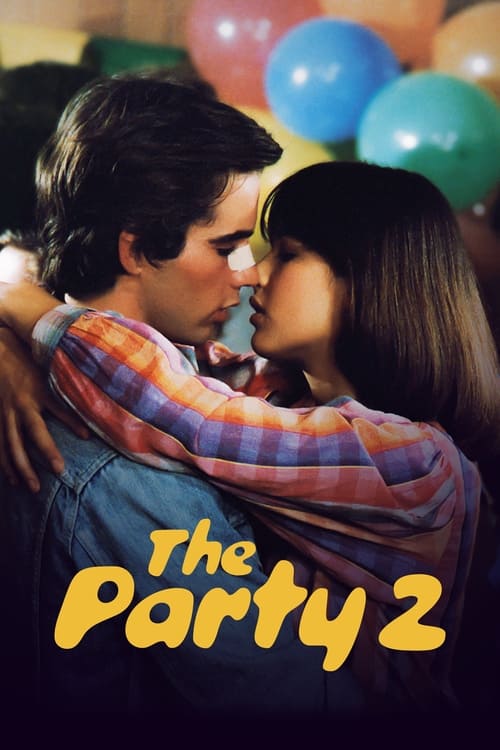
The Party 2 (1982)
Directed by Claude Pinoteau
No — The Party 2 is not woke, scoring 6 out of 100 on our wokeness meter.
La Boum 2 arrives in 1982 as the continuation of a French franchise about a teenager named Vic, played by Sophie Marceau, who here is fifteen, boyfriendless, and quietly panicked about it.
Consciousness Markers
The story centers on a teenage girl's romantic and sexual coming-of-age, but it treats this as conventional teen comedy rather than a feminist critique or agenda.
The cast is entirely white and French, with no meaningful racial or ethnic diversity. There is no evident attempt at inclusive or representative casting.
The film contains no LGBTQ+ characters, themes, or subtext. Romance and sexuality are presented exclusively through heterosexual teen relationships.
There is no engagement with race, racism, or racial identity. The film's social world is uniformly white and unconcerned with racial dynamics.
No environmental or climate-related themes appear in the film. The plot is focused on family, romance, and teenage social life.
The film does not critique capitalism, wealth inequality, or class structures. It is a mainstream romantic teen comedy with no economic polemic.
While the film touches on puberty and first sexual experiences, it does not promote body positivity as a modern social theme. There is no body-diverse or fat-acceptance messaging.
No neurodivergent characters or themes are present. The film does not explore autism, ADHD, or other neurological differences.
The film is a contemporary 1980s teen story and does not reinterpret historical events or figures. There is no revisionist historical narrative.
The film does not lecture the audience on social or political issues. It aims for light entertainment and romantic drama rather than moral instruction.
Why it received this score
La Boum 2 arrives in 1982 as the continuation of a French franchise about a teenager named Vic, played by Sophie Marceau, who here is fifteen, boyfriendless, and quietly panicked about it. The plot concerns a boy named Philippe, a summer holiday, a great-grandmother contemplating marriage, and the looming question of whether Vic will make love for the first time. It is a comedy of manners set among comfortably white Parisian families, and it has no interest in instructing anyone about anything.
The single flicker of social consciousness in this picture is structural. The camera stays with Vic, takes her anxieties seriously, and lets a girl's interior life carry the emotional weight of a mainstream commercial release. That is a modest thing, and the film treats it as a modest thing. It is a teen comedy with a female protagonist, not a manifesto. The coming-of-age material is handled with warmth and a little embarrassment, which is the correct register for a story about a fifteen-year-old and a boy with nice hair. We can credit the film with a faint feminist pulse without pretending it is arguing a case.
Every other category we are obliged to measure comes back empty, and the film seems untroubled by this. The cast is uniformly white and French. Nobody is queer, nobody is reckoning with race, nobody is worried about the planet, nobody is poor enough to resent the rich, and nobody is here to be taught a lesson. The picture wants to sell soundtrack singles and make you feel wistful about your own adolescence. It succeeds at both, and it never once tells you how to vote. Some vintages are simply light, and this one knows exactly what it is: a pleasant glass of nothing, served at room temperature, with a César for the young lead as its only garnish. A sommelier could do worse on a Tuesday. The cellar remains undisturbed, and the palate, for better or worse, is left clean. It is a sequel, and it behaves like one, content to repeat a formula that worked the first time and to ask nothing more of the audience than a willingness to hum along. That, in the end, is the entire proposition, and there is a certain honesty in a film that makes no promises it cannot keep. The classification stands. Nothing here requires a warning label, and nothing here requires praise beyond the ordinary kind owed to competent entertainment.
We are left, then, with a document of a particular moment in European commercial cinema, pleasant and weightless, and entirely innocent of the cultural battles that would come later. It is not a failure of nerve. It is simply a film from another era, doing what films from that era did, and doing it well enough to fill four million seats in France. The ledger closes clean and unremarkable, which is its own kind of verdict.
Analysis generated by our Consciousness Algorithm


Synopsis
After moving to a new city, a young French teenage girl falls in love with a boy and thinks of having sex with him, since her girl friends have already done it.
Questions about The Party 2
Is The Party 2 woke?
No — The Party 2 is not woke, scoring 6 out of 100 on our wokeness meter. That earns it a verdict of Ultra Based.
Does The Party 2 have any woke elements?
Very few. None of the 10 markers reaches 30, the level where a marker counts as present; the highest is Feminist Agenda at 10.
How does The Party 2 compare to other 1982 movies?
It ranks #20 of the 41 films from 1982 we've scored; their average is 7. The wokest is Gandhi (42).
How is the Woke Score calculated?
An AI-assisted process researches the film and its reception, scores it 0–100 on ten markers, then combines those into one 0–100 Woke Score. It measures a specific set of 2020s cultural themes, not film quality.