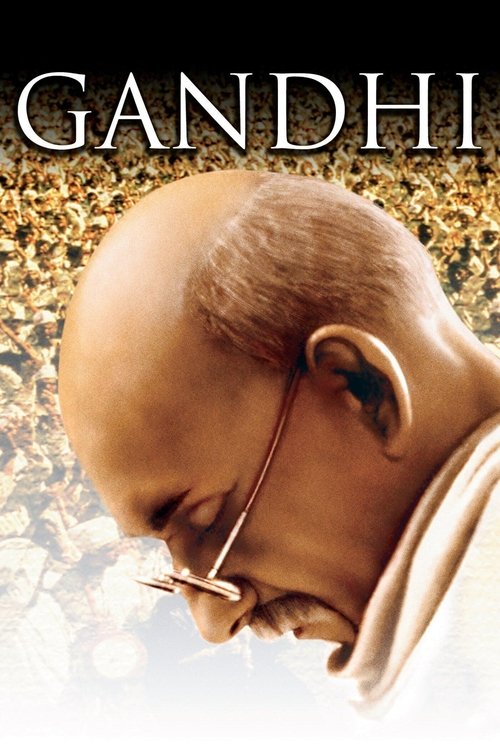
Gandhi (1982)
Directed by Richard Attenborough
Partly — Gandhi is somewhat woke, scoring 42 out of 100 on our wokeness meter.
The film is a three-hour cathedral of a biopic, eight Academy Awards, 300,000 extras at the funeral, a scale no studio would greenlight now.
Consciousness Markers
The narrative is explicitly built around racial discrimination, colonial subjugation, and the Indian independence struggle, including the whites-only train incident and pass laws.
The film centers a largely Indian and South Asian cast, with Ben Kingsley (partly Indian heritage) as Gandhi, providing significant non-white representation for a 1982 epic, though this is historically inherent to the subject rather than a modern diversity mandate.
Gandhi's speeches and moral lessons about nonviolence and human dignity are didactic, but the film is more narrative biopic than modern social-justice lecture.
It critiques British colonial economic exploitation, notably the salt monopoly, but not in a modern anti-capitalist or eat-the-rich framework.
No LGBTQ+ themes or characters.
Women such as Kasturba and Mirabehn appear, but the film does not advance a feminist agenda or critique patriarchy.
No environmental or climate themes.
No body positivity themes.
No neurodivergence themes.
The film is a traditional hagiographic biopic with some historical inaccuracies, but it does not reinterpret history through a modern progressive lens.
Why it received this score
The film is a three-hour cathedral of a biopic, eight Academy Awards, 300,000 extras at the funeral, a scale no studio would greenlight now. Ben Kingsley, born Krishna Bhanji, plays Gandhi with a stillness that carries the whole enterprise. The cast is overwhelmingly South Asian, which for a 1982 British production is a genuine achievement, though the subject matter made it unavoidable. Nobody in this film is checking a box; the boxes were simply the historical record.
Racial consciousness is the engine here. The whites-only train carriage at Pietermaritzburg, the pass laws, the fingerprinting, the Jallianwala Bagh massacre. The film knows exactly what colonial subjugation looks like and shows it plainly. The salt monopoly gets a proper airing as economic extraction, though the film's anger is aimed at empire, not at markets as such. Women appear (Kasturba, Mirabehn) and are granted dignity and grief, but the camera never turns to interrogate the patriarchy around them. No such ambition exists in the screenplay. This is a nineteenth-century moral universe filmed in the twentieth.
Where the film leans hardest into sermonizing is Gandhi's own speeches, which arrive with the patience of a man who has already won the argument. Nonviolence is preached at length, and the audience is expected to sit still for it. That is moral instruction of a very old-fashioned kind, aimed at the human soul, not a modern grievance checklist. There is no climate anxiety, no body politics, no neurodivergent subplot, no reimagining of the past through a present-day lens. The result is hagiography, handsomely mounted and sincere, aged into something close to a museum piece. A long one.
Analysis generated by our Consciousness Algorithm


Synopsis
In the early years of the 20th century, Mohandas K. Gandhi, a British-trained lawyer, forsakes all worldly possessions to take up the cause of Indian independence. Faced with armed resistance from the British government, Gandhi adopts a policy of 'passive resistance', endeavouring to win freedom for his people without resorting to bloodshed.
Questions about Gandhi
Is Gandhi woke?
Partly — Gandhi is somewhat woke, scoring 42 out of 100 on our wokeness meter. That earns it a verdict of Woke-Adjacent.
What makes Gandhi woke?
2 of the 10 markers register at 30 or above, led by Racial Consciousness (60) and Representation Casting (55). On Racial Consciousness: The narrative is explicitly built around racial discrimination, colonial subjugation, and the Indian independence struggle, including the whites-only train incident and pass laws.
How does Gandhi compare to other 1982 movies?
It is the wokest of the 41 films from 1982 we've scored; their average is 7.
How is the Woke Score calculated?
An AI-assisted process researches the film and its reception, scores it 0–100 on ten markers, then combines those into one 0–100 Woke Score. It measures a specific set of 2020s cultural themes, not film quality.