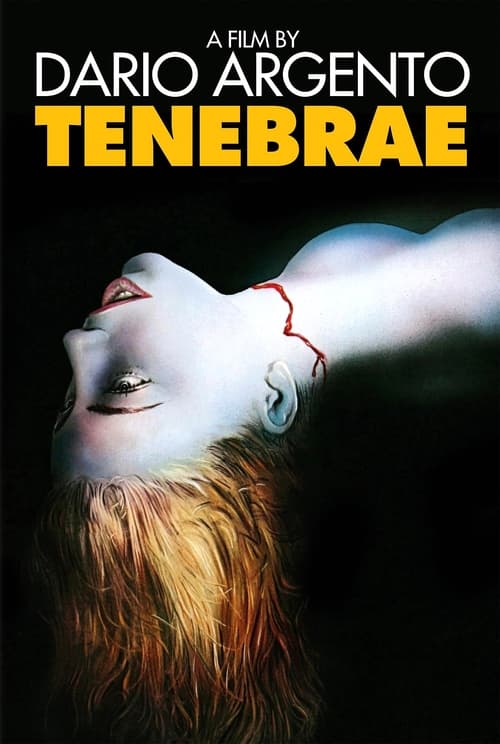
Tenebre (1982)
Directed by Dario Argento
No — Tenebre is not woke, scoring 10 out of 100 on our wokeness meter.
Tenebre arrives from 1982 as a sleek Roman giallo about an American novelist promoting a book while a razor killer enacts his fiction.
Consciousness Markers
The film stages a scene in which Tilde accuses Neal's novels of being 'sexist' and reducing women to victims and cyphers, but this is Argento's defensive self-commentary rather than an endorsed feminist agenda, and the film remains a giallo built on the spectacle of murdered women.
A lesbian journalist, Tilde, and her lover Marion appear and are murdered, but their sexuality is incidental giallo texture rather than any modern LGBTQ+ advocacy or thematic statement.
The film contains metafictional commentary on authorship, misogyny accusations, and the ethics of violent art, but it delivers these through genre play and shock rather than preachy moral instruction.
The cast is entirely white European and American performers with no deliberate diversity casting; the film predates any such casting sensibility by decades.
No engagement with race or racial politics whatsoever.
No environmental or climate themes present.
No economic critique or class-based commentary; the film is concerned with art, authorship, and violence.
No body-positivity themes; the film's treatment of bodies is squarely within horror's fetishization of violence and death.
The killer's psychology involves repressed trauma and psychosis framed as horror villainy, not any neurodivergence-affirming representation.
No historical revisionism; the film is a contemporary-set metafictional thriller.
Why it received this score
Tenebre arrives from 1982 as a sleek Roman giallo about an American novelist promoting a book while a razor killer enacts his fiction. Dario Argento's film has style, synths, and blood, but its cultural inventory is sparse. The cast is uniformly white European and American, assembled without modern diversity calculus. A lesbian journalist and her lover appear and are dispatched, yet their sexuality functions as giallo texture, not as advocacy or thematic argument. The film predates the casting and identity politics that later became standard.
The nearest brush with contemporary social criticism comes when Tilde calls Peter Neal's novels sexist and says they reduce women to victims and cyphers. That sounds like a thesis, but Argento stages it as self-defense. The film remains a machine for the spectacular murder of women, and it knows it. The accusation hangs in the air and then gets a razor through the throat. There is no endorsed feminist program here, only a director arguing with his critics through genre. Questions of race, climate, class economics, body image, and neurodivergence never enter the frame. The killer's repressed trauma and psychosis are framed as horror villainy, not as affirming representation. History is contemporary and unreal, so revisionism has no purchase. The metafictional layer about art and violence is real, but it arrives through shock and plot mechanics, not sermonizing.
The residue is a film culturally aware of one thing: its own reputation. Argento turns the accusation of misogyny into a hall of mirrors, then lets an art object kill the author. That is clever, cold, and of its moment. We can credit the film for self-scrutiny without inflating it into a progressive artifact. Tenebre is stylish, nasty, and historically specific. It does not perform modern virtue. It performs violence with the confidence of a director who has been accused and has decided to answer with an axe. A sommelier would note the absence of almost every contemporary marker, with only a faint, incidental trace of identity and a defensive nod to feminist criticism. That is the vintage. It is thin, but it is honest.
Analysis generated by our Consciousness Algorithm


Synopsis
A razor-wielding serial killer is on the loose, murdering those around Peter Neal, an American mystery author in Italy to promote his newest novel.
Questions about Tenebre
Is Tenebre woke?
No — Tenebre is not woke, scoring 10 out of 100 on our wokeness meter. That earns it a verdict of Ultra Based.
Does Tenebre have any woke elements?
Very few. None of the 10 markers reaches 30, the level where a marker counts as present; the highest is Feminist Agenda at 15.
How does Tenebre compare to other 1982 movies?
It ranks #8 of the 41 films from 1982 we've scored; their average is 7. The wokest is Gandhi (42).
How is the Woke Score calculated?
An AI-assisted process researches the film and its reception, scores it 0–100 on ten markers, then combines those into one 0–100 Woke Score. It measures a specific set of 2020s cultural themes, not film quality.