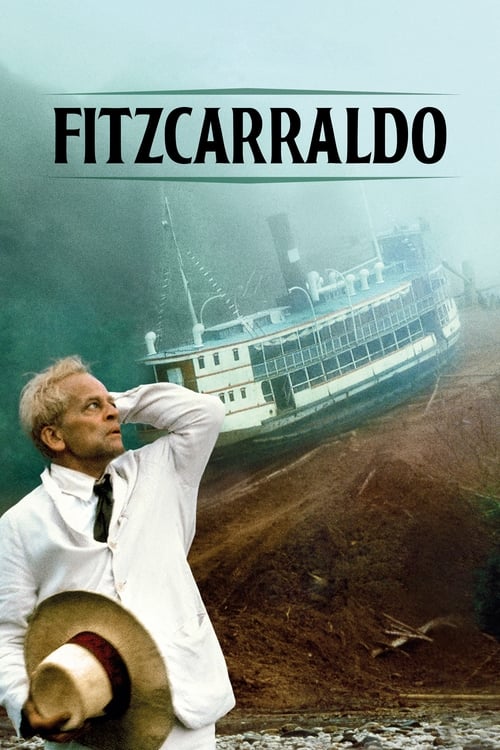
Fitzcarraldo (1982)
Directed by Werner Herzog
No — Fitzcarraldo is not woke, scoring 12 out of 100 on our wokeness meter.
Werner Herzog presents a cinematic vision of ambition that operates with a profound disregard for contemporary social awareness.
Consciousness Markers
The plot involves rubber extraction and a would-be rubber baron, allowing a reading of colonial capitalist obsession, but the film largely romanticizes its dreamer protagonist rather than preaching against capital.
The cast includes Brazilian and Peruvian performers and extensive Indigenous extras, but they function largely as collective background rather than developed representative roles.
The film depicts Indigenous Amazonian people and rubber-boom colonialism, but it frames them through a romanticized European gaze rather than an explicit racial-justice critique.
There are no LGBTQ+ themes or characters in the film.
Claudia Cardinale's Molly is a financier and brothel owner, but the film does not advance a feminist agenda or critique gender power structures.
The Amazon rainforest setting and rubber extraction are present, but the film has no environmentalist or climate-crusade message.
There is no body-positivity theme or representation in the film.
Fitzcarraldo is obsessive and eccentric, but the film does not frame this through neurodivergence or mental-health representation.
The film is inspired by Carlos Fitzcarrald and heavily fictionalizes his feat, but it does not offer a modern progressive revisionist-history argument.
Herzog's film is driven by spectacle and obsession rather than preachy or lecture-like messaging.
Why it received this score
Werner Herzog presents a cinematic vision of ambition that operates with a profound disregard for contemporary social awareness. We observe a dreamer fixated on an opera house, a goal that seems to serve only as a backdrop to a staggering exercise in physical absurdity. The film is an immense spectacle of man versus nature, yet it remains comfortably situated within a historical framework that resists any progressive commentary. It is an epic concerned with logistics and ego, not with the nuanced ethical dimensions of global resource extraction.
The cultural metrics suggest a pervasive lack of urgency regarding modern progressive sensibilities. While the film features Indigenous people and the mechanics of colonialism, it views these elements through a lens of romanticized struggle rather than critical scrutiny. The protagonist’s obsessive nature serves as the primary narrative engine, offering no platform for systemic critique or advanced cultural awareness. The production captures the grit of the rainforest and the sheer physical labor involved, but it chooses spectacle over social introspection.
Ultimately, the narrative provides a grand adventure without the requisite contemporary cultural scaffolding. We are left with a magnificent, if flawed, piece of cinema that treats its historical subjects with a grand, yet ultimately detached, reverence. It is a powerful study of individual will, but it fails to engage with the specific cultural dialogues of the twenty-first century.
Analysis generated by our Consciousness Algorithm


Synopsis
Fitzcarraldo is a dreamer who plans to build an opera house in Iquitos, in the Peruvian Amazon, so, in order to finance his project, he embarks on an epic adventure to collect rubber, a very profitable product, in a remote and unexplored region of the rainforest.
Questions about Fitzcarraldo
Is Fitzcarraldo woke?
No — Fitzcarraldo is not woke, scoring 12 out of 100 on our wokeness meter. That earns it a verdict of Ultra Based.
Does Fitzcarraldo have any woke elements?
Very few. None of the 10 markers reaches 30, the level where a marker counts as present; the highest is Eat the Rich at 25.
How does Fitzcarraldo compare to other 1982 movies?
It ranks #6 of the 41 films from 1982 we've scored; their average is 7. The wokest is Gandhi (42).
How is the Woke Score calculated?
An AI-assisted process researches the film and its reception, scores it 0–100 on ten markers, then combines those into one 0–100 Woke Score. It measures a specific set of 2020s cultural themes, not film quality.