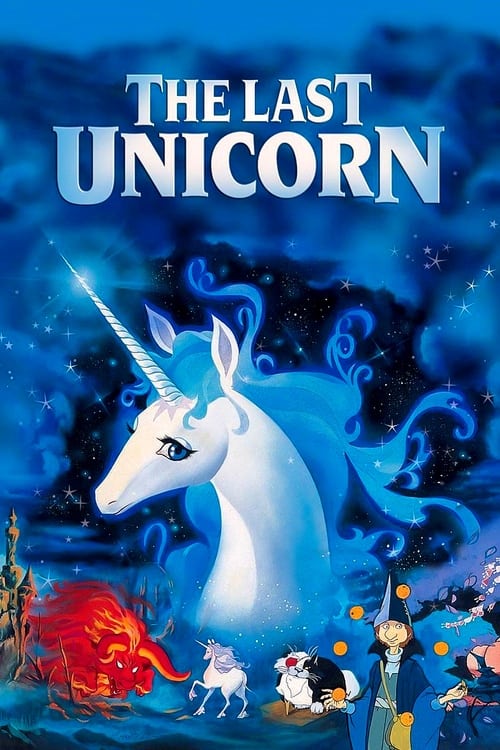
The Last Unicorn (1982)
Directed by Jules Bass
No — The Last Unicorn is not woke, scoring 11 out of 100 on our wokeness meter.
The Last Unicorn arrives from 1982 as a melancholy animated fantasy, adapted by Peter S. Beagle from his own novel.
Consciousness Markers
The protagonist is a female unicorn who drives the quest, and Molly Grue is a middle-aged woman with her own longing and agency, but this is organic fairy-tale characterization rather than a feminist statement.
The film meditates on regret, mortality, and love, but it delivers these themes through melancholy storytelling rather than preachy moralizing.
The voice cast is entirely white and drawn from a traditional 1982 Hollywood pool; no casting choices were made with representation in mind.
There are no LGBTQ+ characters, themes, or subtext anywhere in the film.
The film engages no racial themes or commentary whatsoever.
No environmental or climate messaging is present; the Red Bull is a magical antagonist, not an ecological metaphor.
King Haggard is a melancholy monarch, not a capitalist villain, and the film offers no economic critique.
No body-positivity themes or messaging appear in the film.
Schmendrick is an incompetent magician, but his failings are comedic plot devices, not a depiction of neurodivergence.
The film is a pure fantasy with no historical subject matter to revise.
Why it received this score
The Last Unicorn arrives from 1982 as a melancholy animated fantasy, adapted by Peter S. Beagle from his own novel. It concerns a unicorn, a failed magician, and a middle-aged woman on a quest. The film has a cult following and an unusual tenderness. None of this should be mistaken for contemporary social programming. It is a fairy tale with regrets. Its pleasures are modest, its sadness genuine, and its cultural vocabulary belongs to an earlier era.
The female protagonist and Molly Grue have agency and longing, but the film treats them as characters in a story, not as a thesis. There is no racial commentary, no environmental allegory, no economic critique of King Haggard's castle. The villain is a sad monarch who collects unicorns for his own viewing pleasure, not a stand-in for capital. The voice cast is drawn from the standard 1982 Hollywood pool. No LGBTQ themes. No body positivity. Schmendrick's incompetence is a comic device, not a study in neurodivergence. The film has no historical subject to revise.
The film leaves us with an affecting story about mortality, love, and regret, delivered through melancholy instead of sermon. The moral weight sits in the ending, where a unicorn learns what it means to be mortal and a prince learns what it means to love something that cannot stay. The film does not lecture. It mourns. That is a rarer and more durable achievement than any number of preachy animated features. This is not a failure of the film. It is simply a different vintage.
Analysis generated by our Consciousness Algorithm


Synopsis
A unicorn learns from a riddle-speaking butterfly that she is supposedly the last of her kind, all the others having been herded away by the monstrous Red Bull. The unicorn sets out to discover the truth behind the butterfly's words. She is eventually joined on her quest by Schmendrick, a second-rate magician, and Molly Grue, a middle-aged woman who dreamed all her life of seeing a unicorn. Their journey leads them far from home, all the way to the castle of King Haggard.
Questions about The Last Unicorn
Is The Last Unicorn woke?
No — The Last Unicorn is not woke, scoring 11 out of 100 on our wokeness meter. That earns it a verdict of Ultra Based.
Does The Last Unicorn have any woke elements?
Very few. None of the 10 markers reaches 30, the level where a marker counts as present; the highest is Feminist Agenda at 15.
How does The Last Unicorn compare to other 1982 movies?
It ranks #7 of the 41 films from 1982 we've scored; their average is 7. The wokest is Gandhi (42).
How is the Woke Score calculated?
An AI-assisted process researches the film and its reception, scores it 0–100 on ten markers, then combines those into one 0–100 Woke Score. It measures a specific set of 2020s cultural themes, not film quality.