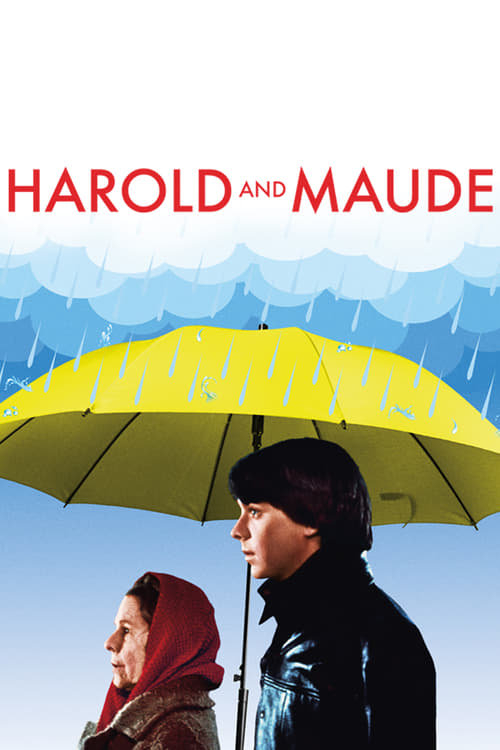
Harold and Maude (1971)
Directed by Hal Ashby
No — Harold and Maude is not woke, scoring 13 out of 100 on our wokeness meter.
Hal Ashby's 1971 romance of a death-obsessed young man and a 79-year-old free spirit arrives from a distant cultural era, and the classification reflects that distance.
Consciousness Markers
Maude is an independent free spirit and a former radical suffragette who fought police with her umbrella, and the film centers a 79-year-old woman as a romantic lead. This is a genuine, if pre-modern, feminist gesture rather than a contemporary agenda.
The film satirizes Harold's wealthy, materialistic socialite mother and the empty conformity of inherited money, the military, and arranged marriage. It is a critique of bourgeois emptiness rather than a systemic eat-the-rich polemic.
Maude uproots an ailing city tree to replant it in the forest, a concrete pro-nature gesture, but the film makes no climate or environmental argument beyond this incidental act.
The life-affirming message ('make the most of your time on earth') is delivered through character and fable rather than explicit lecturing, keeping the didacticism gentle.
The cast is almost entirely white, with no meaningful racial or ethnic diversity in the ensemble. A 1971 production with no representation-conscious casting.
No LGBTQ+ characters, themes, or subtext are present in the film.
No racial themes or commentary. Maude's concentration camp tattoo is a Holocaust reference, not a racial-consciousness statement.
No body-positivity themes or messaging are present.
Harold's death obsession and staged suicides are framed as existential malaise and depression, not as neurodivergence in any modern sense.
No historical revisionism. The film is a contemporary fable with no reworking of historical record.
Why it received this score
Hal Ashby's 1971 romance of a death-obsessed young man and a 79-year-old free spirit arrives from a distant cultural era, and the classification reflects that distance. Harold stages elaborate suicides, attends strangers' funerals, and drives a hearse. Maude steals cars, plays the banjo, and uproots an ailing street tree to replant it in the forest. The film's pleasures are existential and fable-like, and most of the modern markers we are obliged to tally simply are not present. The cast is uniformly white. There are no queer themes, no body-positivity messaging, no racial commentary, and no reworking of the historical record. Harold's morbidity reads as depression and adolescent despair, not as a neurodivergent identity.
Two markers do register, faintly. Maude is a genuine feminist creation: a former radical suffragette who once fought constables with her umbrella, and a woman of seventy-nine positioned as a romantic lead, which in 1971 was an act of quiet nerve. The film also carries a mild anti-materialist streak, mocking the mother's opulent socialite world, the arranged bride interviews, the military uncle, and the Jaguar bought to replace a beloved hearse. It is a critique of bourgeois emptiness, not a systemic polemic. The tree transplant gestures at nature without mounting an environmental argument.
The life-affirming message, make the most of your time on earth, arrives through character and incident instead of sermon. Maude's concentration camp tattoo lands as a Holocaust reference, not a statement of racial consciousness. The remainder is a gentle, strange fable about learning to live, preserved in the National Film Registry and beloved by a cult that outlasted its hostile first reviews. We classify it as a period piece with two faint pulses of social awareness and very little else to log.
Analysis generated by our Consciousness Algorithm
Part of


Synopsis
A deadpan young man obsessed with death meets an eccentric septuagenarian who teaches him to live life to the fullest.
Questions about Harold and Maude
Is Harold and Maude woke?
No — Harold and Maude is not woke, scoring 13 out of 100 on our wokeness meter. That earns it a verdict of Ultra Based.
Does Harold and Maude have any woke elements?
Very few. None of the 10 markers reaches 30, the level where a marker counts as present; the highest is Eat the Rich at 20.
How does Harold and Maude compare to other 1971 movies?
It ranks #7 of the 30 films from 1971 we've scored; their average is 10. The wokest is Death in Venice (60).
How is the Woke Score calculated?
An AI-assisted process researches the film and its reception, scores it 0–100 on ten markers, then combines those into one 0–100 Woke Score. It measures a specific set of 2020s cultural themes, not film quality.