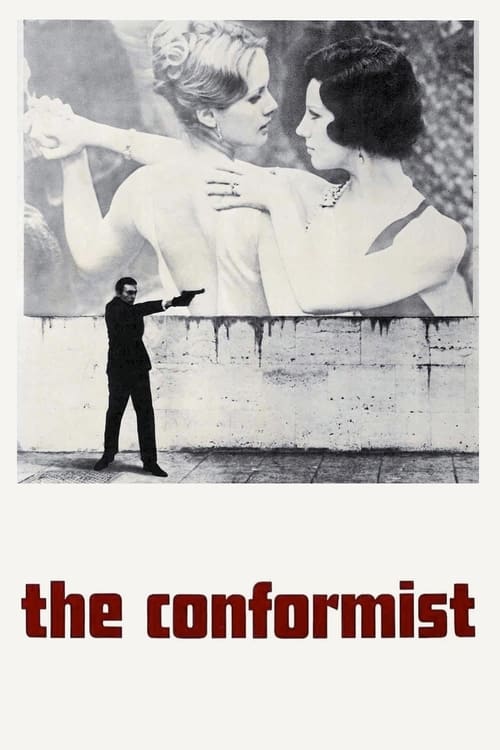
The Conformist (1971)
Directed by Bernardo Bertolucci
No — The Conformist is not woke, scoring 11 out of 100 on our wokeness meter.
Bernardo Bertolucci's The Conformist arrives from 1970 wearing its reputation like a tailored suit, and the tailoring holds up.
Consciousness Markers
Queer desire and homosexuality appear as subtext and plot elements—Lino's assault, Anna's advances toward Giulia—but not as a modern LGBTQ+ advocacy framework.
It engages political themes of fascism and conformism, but through artful drama rather than modern preachy lecturing.
Female characters have moments of sexual agency, but the film remains male-centered and does not advance a feminist agenda.
The cast is entirely white European, with no evident modern representation-casting agenda.
The film contains no racial themes or racial-consciousness commentary.
There is no climate or environmental theme in the film.
The film critiques fascism and conformity, not capitalism or economic inequality.
There is no body-positivity theme or related messaging.
Marcello's psychology is framed through trauma, repression, and conformity, not neurodivergence.
The film is a period political drama based on a novel, not a work of modern revisionist history.
Why it received this score
Bernardo Bertolucci's The Conformist arrives from 1970 wearing its reputation like a tailored suit, and the tailoring holds up. A mid-level Fascist functionary, played by Jean-Louis Trintignant with the expression of a man who has swallowed a secret and cannot remember which one, is dispatched to Paris to kill his old professor. The film is beautiful in the way that expensive furniture is beautiful, and it says something bleak about how a person will trade his soul for the appearance of normality. We have seen this story many times since. We will see it again.
The picture's social consciousness is of an older vintage, the kind that predates the current vocabulary. Queer desire surfaces as subtext and plot: a chauffeur's assault on a boy, a wife's advances toward another wife, a whispered proposition on a Rome street. These register as psychology and provocation, not as advocacy, and the film's women possess a certain sexual agency without the film ever organizing itself around their liberation. There is political material here, fascism and its seductions, delivered through drama and shadow instead of a lecture. The camera does the arguing. The screenplay trusts us to keep up.
On the whole, this is a canonized European art film from a decade that had not yet invented the vocabulary we now apply to such things. Its concerns are conformity, cowardice, and the erotic charge of belonging. Whatever modern markers we might go looking for, most are simply absent, and their absence is not a failure. It is a date stamp. We file it accordingly, with respect and a faint sigh.
Analysis generated by our Consciousness Algorithm


Synopsis
A weak-willed Italian man becomes a fascist flunky who goes abroad to arrange the assassination of his old teacher, now a political dissident.
Questions about The Conformist
Is The Conformist woke?
No — The Conformist is not woke, scoring 11 out of 100 on our wokeness meter. That earns it a verdict of Ultra Based.
Does The Conformist have any woke elements?
Very few. None of the 10 markers reaches 30, the level where a marker counts as present; the highest is LGBTQ+ Themes at 20.
How does The Conformist compare to other 1971 movies?
It ranks #12 of the 30 films from 1971 we've scored; their average is 10. The wokest is Death in Venice (60).
How is the Woke Score calculated?
An AI-assisted process researches the film and its reception, scores it 0–100 on ten markers, then combines those into one 0–100 Woke Score. It measures a specific set of 2020s cultural themes, not film quality.