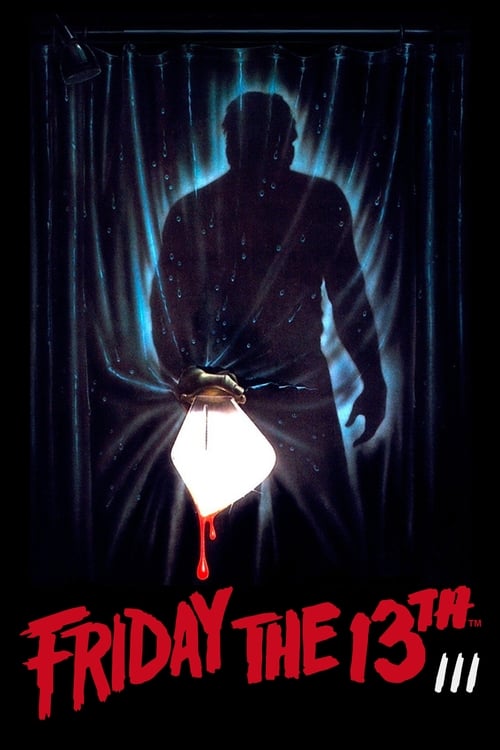
Friday the 13th Part III (1982)
Directed by Steve Miner
No — Friday the 13th Part III is not woke, scoring 0 out of 100 on our wokeness meter.
Friday the 13th Part III arrives in 1982 with a hockey mask, a leased 3-Depix camera rig, and a mandate to terrify teenagers in three dimensions.
Consciousness Markers
The cast is overwhelmingly white and the film makes no effort toward inclusive or diverse representation.
There are no LGBTQ+ characters, themes, or subtext in the film.
The film features a final girl and trauma backstory, but it does not advance a feminist agenda or critique patriarchal structures.
Race is not addressed or thematized; the film has no racial consciousness.
There is no environmental or climate-related messaging.
The film contains no critique of capitalism, wealth inequality, or economic systems.
There is no body-positive messaging; the film uses conventional slasher imagery and ableist horror tropes.
Neurodivergence is not explored or represented in any meaningful way.
The film is a fictional slasher sequel and does not engage in historical revisionism.
The film is a straightforward horror sequel with no preachy or didactic messaging.
Why it received this score
Friday the 13th Part III arrives in 1982 with a hockey mask, a leased 3-Depix camera rig, and a mandate to terrify teenagers in three dimensions. Steve Miner directs a cast of young people who were, by the screenwriter's own admission, chosen for looks. They wander a homestead near Crystal Lake, meet a man named Abel who warns them to turn back, and are then dispatched by pitchfork, speargun, machete, and fire poker. The film's enduring contribution to civilization is the Detroit Red Wings goaltender mask that Jason Voorhees puts on during a lighting check. That is the legacy. A piece of sporting equipment became an icon.
On the ledger of modern social consciousness, this installment is a blank page, and it seems content to remain so. Chris Higgins carries a trauma from an earlier attack, and the final girl survives through endurance, but the film offers no argument about gender, power, or anything else. Race goes unremarked. The cast is uniformly white and the screenplay has no interest in the matter. There is no economic critique, no environmental sermon, no meditation on bodies or minds. The bikers get killed for trespassing. The stoners get killed for being stoned. The moral universe here is a fuse box and a hammock.
We are left, then, with a document that predates the entire apparatus of contemporary messaging by decades and makes no attempt to anticipate it. Nobody in this film is trying to teach us anything. Jason simply arrives, does his work, and lies down in the barn. There is a kind of purity in that. The picture wants only to sell tickets, and it succeeded, briefly dethroning a far gentler story about a boy and his alien. It is a slasher sequel, nothing more, and it never pretends otherwise.
Analysis generated by our Consciousness Algorithm
Part of


Synopsis
An idyllic summer turns into a nightmare of unspeakable terror for yet another group of naïve friends. Ignoring Camp Crystal Lake's bloody legacy, one by one they fall victim to the maniacal Jason, who stalks them at every turn...
Questions about Friday the 13th Part III
Is Friday the 13th Part III woke?
No — Friday the 13th Part III is not woke, scoring 0 out of 100 on our wokeness meter. That earns it a verdict of Ultra Based.
Does Friday the 13th Part III have any woke elements?
No. All 10 markers score zero.
How does Friday the 13th Part III compare to other 1982 movies?
It ranks #35 of the 41 films from 1982 we've scored; their average is 7. The wokest is Gandhi (42).
Is Friday the 13th Part III the most woke Friday the 13th movie?
No. It ranks #8 of the 11 Friday the 13th films we've scored; the wokest is Friday the 13th Part VIII: Jason Takes Manhattan (8).