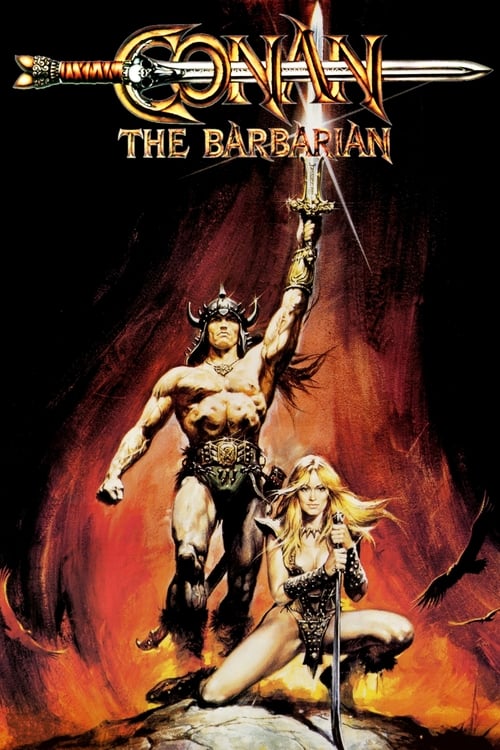
Conan the Barbarian (1982)
Directed by John Milius
No — Conan the Barbarian is not woke, scoring 8 out of 100 on our wokeness meter.
John Milius's Conan the Barbarian is a sword-and-sorcery vengeance picture built from pulp, sweat, and Frank Frazetta silhouettes.
Consciousness Markers
James Earl Jones and Mako appear in prominent supporting roles, but their casting is organic to the pulp source material and never framed as a representational statement. No deliberate diversity agenda is present.
Valeria is a capable warrior who matches Conan in battle, but she is ultimately defined by her love for him and her self-sacrifice, a classic 'tamed Amazon' archetype rather than a feminist statement.
Thulsa Doom delivers a monologue on the power of flesh over steel, but it is a villain's philosophical taunt rather than a social-issue sermon.
No LGBTQ+ characters, themes, or subtext of any kind appear in the film.
The film is a Northern European mythic fantasy with no engagement with race, racism, or racial identity as themes.
No environmental or climate themes are present.
Thulsa Doom's cult rhetoric about burning the world that oppressed them is a villain's cult-manipulation trope, not an economic critique.
The film celebrates the hyper-muscular physique as heroic ideal, which is the opposite of modern body-positivity messaging about diverse body acceptance.
No neurodivergent characters or themes are depicted.
The film is set in the fictional Hyborian Age and makes no claims about real historical events.
Why it received this score
John Milius's Conan the Barbarian is a sword-and-sorcery vengeance picture built from pulp, sweat, and Frank Frazetta silhouettes. It has no interest in the social questions that occupy modern audiences, and its cultural awareness is close to nonexistent. James Earl Jones and Mako appear in prominent supporting roles, yet the casting feels organic to the source material, not like a statement. Valeria can fight alongside Conan and even save him, but the film defines her through love and self-sacrifice, the tamed Amazon of an older cinematic tradition. Thulsa Doom's speech about flesh commanding steel is a villain's taunt, not a sermon on contemporary issues. The film's worship of the hyper-muscular body runs directly against current body-acceptance messaging, which is one of the few places where it registers at all, and only by inversion.
The rest is silence. There is no racial consciousness, no climate concern, no economic critique. Doom's call to burn the world that oppressed his followers is cult manipulation, not a manifesto about inequality. No LGBTQ themes surface. No neurodivergent characters appear. Revisionist history is irrelevant because the Hyborian Age is invented. The movie's moral universe is archaic and literal: slavery, crucifixion, snake cults, cannibal feasts, revenge. It never pauses to explain itself to a modern viewer. That refusal to lecture is almost its defining feature. The faintest flicker of progressive casting exists in the supporting players, but the film does not comment on it, build on it, or care.
Viewed as a candidate for contemporary classification, this is a low-yield vintage. It offers muscle, mysticism, and a brooding score, but almost no modern social consciousness. It is not preachy, not sermonizing, not an issue film. It belongs to a moment when a barbarian could be a barbarian without anyone asking him to check his privilege. The result is a relic, and a strangely restful one for anyone exhausted by cinema that treats every sword fight as a teachable moment.
Analysis generated by our Consciousness Algorithm


Synopsis
A horde of rampaging warriors massacre the parents of young Conan and enslave the young child for years on The Wheel of Pain. As the sole survivor of the childhood massacre, Conan is released from slavery and taught the ancient arts of fighting. Transforming himself into a killing machine, Conan travels into the wilderness to seek vengeance on Thulsa Doom, the man responsible for killing his family. In the wilderness, Conan takes up with the thieves Valeria and Subotai. The group comes upon King Osric, who wants the trio of warriors to help rescue his daughter who has joined Doom in the hills.
Questions about Conan the Barbarian
Is Conan the Barbarian woke?
No — Conan the Barbarian is not woke, scoring 8 out of 100 on our wokeness meter. That earns it a verdict of Ultra Based.
Does Conan the Barbarian have any woke elements?
Very few. None of the 10 markers reaches 30, the level where a marker counts as present; the highest is Representation Casting at 15.
How does Conan the Barbarian compare to other 1982 movies?
It ranks #12 of the 41 films from 1982 we've scored; their average is 7. The wokest is Gandhi (42).
How is the Woke Score calculated?
An AI-assisted process researches the film and its reception, scores it 0–100 on ten markers, then combines those into one 0–100 Woke Score. It measures a specific set of 2020s cultural themes, not film quality.