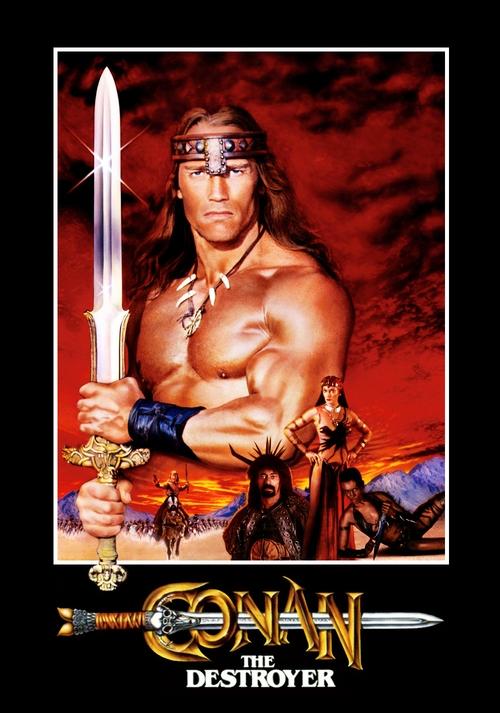
Conan the Destroyer (1984)
Directed by Richard Fleischer
No — Conan the Destroyer is not woke, scoring 9 out of 100 on our wokeness meter.
Conan the Destroyer arrives as a sequel with its predecessor's edges sanded down, recut to a PG so that a broader audience might be admitted.
Consciousness Markers
Grace Jones, Wilt Chamberlain, and Mako occupy prominent roles in a 1984 sword-and-sorcery film, providing a notably multiethnic ensemble for its era, though the casting is not framed as a progressive statement.
Zula is a capable warrior woman and Jehnna ends as queen, but the film remains a male-driven sword-and-sorcery adventure with women largely in supporting or romantic roles.
No LGBTQ+ characters, themes, or subtext are present.
No engagement with racial identity, inequality, or social justice themes.
No environmental or climate-related themes.
No critique of wealth, capitalism, or class structures.
No body-positive messaging or diverse body representation as a theme.
No neurodivergent characters or themes.
No historical revisionism; the film is set in a fictional sword-and-sorcery world.
The film does not lecture the audience on social or political issues.
Why it received this score
Conan the Destroyer arrives as a sequel with its predecessor's edges sanded down, recut to a PG so that a broader audience might be admitted. The violence is milder, the humor broader, and the entire enterprise carries the scent of a marketing committee. Richard Fleischer directs with competence and no conviction. The result plays like a comic book that has been filmed by real people, which is a strange thing to watch.
The casting is where the film shows a quiet, unremarked breadth for its era. Grace Jones, Wilt Chamberlain, and Mako hold prominent roles in a 1984 sword-and-sorcery picture, and the ensemble is notably multiethnic without anyone in the frame pausing to comment on it. Jones brings a genuine magnetism to Zula, a warrior woman who fights, joins the quest, and earns a captaincy by the end. Jehnna, the petulant princess, is crowned queen. These are gestures toward female capability, though the film never stops being a male-driven adventure, with its women serving the plot and the romance. The camera belongs to Schwarzenegger, and it stays there.
Beyond that, the film has no interest in instructing anyone about anything. There is no engagement with race as a subject, no environmental sermon, no critique of wealth, no meditation on the body, no neurodivergent character, and no revisionist reading of history, since its history is invented. The swords are for swinging. The wizards are for trickery. The quest is for a horn. A viewer searching for social consciousness will find a muscular man in a loincloth and a monster that must be killed by removing a jewel from its forehead. The film asks nothing of us but attention, and it is generous enough not to demand a lesson in return. That is a modest virtue, and in this genre it is not nothing.
{"thematic_tags": ["sequel"]}
Analysis generated by our Consciousness Algorithm


Synopsis
Conan is commissioned by the evil queen Taramis to safely escort a teen princess and her powerful bodyguard to a far away castle to retrieve the magic Horn of Dagoth. Unknown to Conan, the queen plans to sacrifice the princess when she returns and inherit her kingdom after the bodyguard kills Conan. The queen's plans fail to take into consideration Conan's strength and cunning and the abilities of his sidekicks: the eccentric wizard Akiro, the warrior woman Zula, and the inept Malak. Together the hero and his allies must defeat both mortal and supernatural foes in this voyage to sword-and-sorcery land.
Questions about Conan the Destroyer
Is Conan the Destroyer woke?
No — Conan the Destroyer is not woke, scoring 9 out of 100 on our wokeness meter. That earns it a verdict of Ultra Based.
Does Conan the Destroyer have any woke elements?
1 of the 10 markers register at 30 or above, led by Representation Casting (30). On Representation Casting: Grace Jones, Wilt Chamberlain, and Mako occupy prominent roles in a 1984 sword-and-sorcery film, providing a notably multiethnic ensemble for its era, though the casting is not framed as a progressive statement.
How does Conan the Destroyer compare to other 1984 movies?
It ranks #12 of the 51 films from 1984 we've scored; their average is 7. The wokest is Revenge of the Nerds (30).
How is the Woke Score calculated?
An AI-assisted process researches the film and its reception, scores it 0–100 on ten markers, then combines those into one 0–100 Woke Score. It measures a specific set of 2020s cultural themes, not film quality.