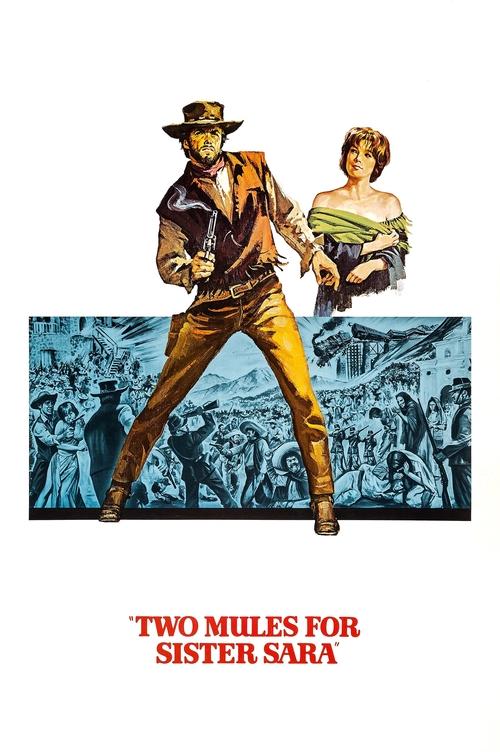
Two Mules for Sister Sara (1970)
Directed by Don Siegel
No — Two Mules for Sister Sara is not woke, scoring 10 out of 100 on our wokeness meter.
There is a moment in Don Siegel's 1970 Western when Clint Eastwood's mercenary, a man named Hogan, discovers that the nun he has been escorting across the Mexican plains is not a nun at all but a pistol-toting Juarista prostitute.
Consciousness Markers
The film employs a substantial cast of Mexican actors in supporting roles and was shot on location in Mexico, but the female lead, written as a Mexican character, was given to the pale-complexioned Shirley MacLaine — a whitewashing that undercuts any modern representation credit.
Sister Sara is a resourceful, gun-toting Juarista who climbs a trestle to plant charges and outwits the French, but the film remains framed around Eastwood's male mercenary and treats her chiefly as a romantic prize and a bawdy punchline.
The Mexican Revolution setting and Juarista rebels provide a non-white backdrop, but the story is filtered entirely through the perspective of an American gringo protagonist with no commentary on race or colonial power beyond generic anti-French sentiment.
The film is a sardonic, action-driven Western that preaches nothing; any thematic content is delivered through plot and banter rather than moral instruction.
No LGBTQ+ characters, themes, or subtext appear anywhere in this 1970 Western.
No environmental or climate themes of any kind.
Hogan's motivation is explicitly mercenary — he aids the revolutionaries for half the garrison's treasury — making the film's economic logic one of personal profit rather than any critique of capital.
No body-positivity themes; the film's treatment of its female lead is conventional for its era.
No neurodivergent characters or themes are present.
The film is a fictional adventure set against the real French intervention in Mexico, but it makes no attempt to revise or reinterpret the historical record.
Why it received this score
There is a moment in Don Siegel's 1970 Western when Clint Eastwood's mercenary, a man named Hogan, discovers that the nun he has been escorting across the Mexican plains is not a nun at all but a pistol-toting Juarista prostitute. The film treats this as a punchline, and it mostly works. Set during the French intervention in Mexico, the picture moves with the efficient, sardonic gait of a director who knew exactly what he was selling. Shirley MacLaine plays a character written as Mexican. She is not Mexican. The supporting cast is thick with Mexican performers, and the production shot on location near Tlayacapan, which earns the film a sliver of credit and then quietly forfeits it at the top of the call sheet.
Sister Sara proves genuinely capable. She climbs a trestle to set charges when Hogan's shoulder is too damaged to manage it. She solicits funds from villagers and brothel workers with equal ease. She has shot a French lieutenant and would do it again. And yet the camera belongs to Hogan, the plot resolves into a romantic pairing, and her competence is arranged around his arc like furniture in a rented room. The film has no interest in what she wants beyond the man standing in front of her.
The economics are mercenary in the literal sense. Hogan aids the revolution for half the garrison's treasury, which is the opposite of a critique of capital. There is no environmental conscience here, no meditation on the body, no neurodivergent interiority, no attempt to revise the historical record. The French are villains because the plot requires villains. Nothing is preached. Siegel reportedly told Budd Boetticher that it felt good to wake up knowing a check was in the mail, and that spirit animates every frame. A modest, well-oiled entertainment, and no more.
Analysis generated by our Consciousness Algorithm
Part of


Synopsis
When a wandering mercenary named Hogan rescues a nun called Sister Sara from the unwanted attentions of a band of rogues on the Mexican plains, he has no idea what he has let himself in for. Their chance encounter results in the blowing up of a train and a French garrison, as well as igniting a spark between them that survives a shocking discovery.
Questions about Two Mules for Sister Sara
Is Two Mules for Sister Sara woke?
No — Two Mules for Sister Sara is not woke, scoring 10 out of 100 on our wokeness meter. That earns it a verdict of Ultra Based.
Does Two Mules for Sister Sara have any woke elements?
Very few. None of the 10 markers reaches 30, the level where a marker counts as present; the highest is Representation Casting at 25.
How does Two Mules for Sister Sara compare to other 1970 movies?
It ranks #4 of the 23 films from 1970 we've scored; their average is 8. The wokest is Little Big Man (38).
How is the Woke Score calculated?
An AI-assisted process researches the film and its reception, scores it 0–100 on ten markers, then combines those into one 0–100 Woke Score. It measures a specific set of 2020s cultural themes, not film quality.