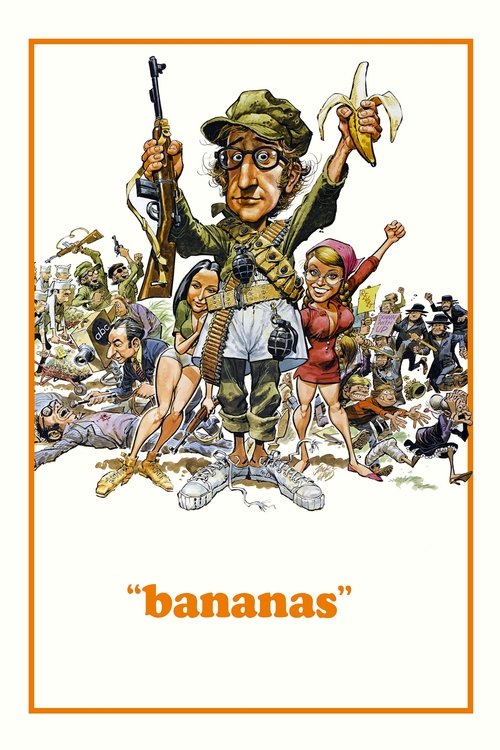
Bananas (1971)
Directed by Woody Allen
No — Bananas is not woke, scoring 12 out of 100 on our wokeness meter.
Bananas arrives from 1971, a Woody Allen farce about a neurotic New Yorker who loses his activist girlfriend and stumbles into a fictional Latin American revolution.
Consciousness Markers
The cast includes a number of Latin American actors (Carlos Montalbán, Nati Abascal, Jacobo Morales) playing Latin roles, and a Black woman appears as a witness, but this is 1971 ensemble comedy casting rather than any deliberate representation agenda.
The film mocks U.S. foreign aid to dictators and CIA intervention in a banana republic, a mild anti-establishment streak, but it is farce rather than an eat-the-rich economic critique.
The San Marcos revolution and CIA meddling are satirical targets, and a Black woman testifies as 'J. Edgar Hoover in disguise,' but these are absurdist gags rather than any racial consciousness.
The film is a scattershot gag comedy with no preachy messaging; any political content is delivered as punchline rather than sermon.
No LGBTQ+ characters, themes, or subtext of any kind.
Nancy is an activist girlfriend and a Miss America witness appears, but the film has no feminist argument or gendered critique; women are largely gag devices.
No environmental or climate content whatsoever.
No body positivity themes; the humor is largely at the expense of physical appearance and sexual inadequacy.
Fielding is 'neurotic' in the classic Woody Allen sense, but this is a comedic persona, not any modern neurodivergence representation.
The banana republic and its revolution are entirely fictional; no historical revisionism is attempted.
Why it received this score
Bananas arrives from 1971, a Woody Allen farce about a neurotic New Yorker who loses his activist girlfriend and stumbles into a fictional Latin American revolution. The film's politics are not a program. They are a whoopee cushion. It mocks American foreign aid to strongmen and CIA meddling in banana republics, which gives it a mild anti-establishment streak, but the target is absurdity itself. The jokes land wherever they please, often on the heads of the nearest bystander.
The cast includes Latin actors in Latin roles, and a Black woman appears in court to claim she is J. Edgar Hoover in disguise. These are casting and gag choices from a 1971 ensemble comedy, not a representation agenda. The film has no LGBTQ content, no feminist argument, no climate concern, no body positivity, no neurodivergence framework, and no revisionist history. The San Marcos revolution is invented, so it cannot revise any real record. Women exist mostly as punchlines or plot devices. There is no sermon to deliver. Political content arrives as setup and punchline, not as a lecture.
The film remains a scattershot comedy that treats revolution, marriage, and American bureaucracy as interchangeable sources of silliness. The humor can be corny, bawdy, and chaotic, and it often aims at physical appearance or sexual inadequacy, which places it outside contemporary sensitivity. Yet it is not cruel in a systematic way. It is too anarchic for that. We are left with a relic that occasionally brushes against social consciousness, then runs away before anyone can organize a meeting.
Analysis generated by our Consciousness Algorithm


Synopsis
When a bumbling New Yorker is dumped by his activist girlfriend, he travels to a tiny Latin American nation and becomes involved in its latest rebellion.
Questions about Bananas
Is Bananas woke?
No — Bananas is not woke, scoring 12 out of 100 on our wokeness meter. That earns it a verdict of Ultra Based.
Does Bananas have any woke elements?
Very few. None of the 10 markers reaches 30, the level where a marker counts as present; the highest is Eat the Rich at 20.
How does Bananas compare to other 1971 movies?
It ranks #10 of the 30 films from 1971 we've scored; their average is 10. The wokest is Death in Venice (60).
How is the Woke Score calculated?
An AI-assisted process researches the film and its reception, scores it 0–100 on ten markers, then combines those into one 0–100 Woke Score. It measures a specific set of 2020s cultural themes, not film quality.