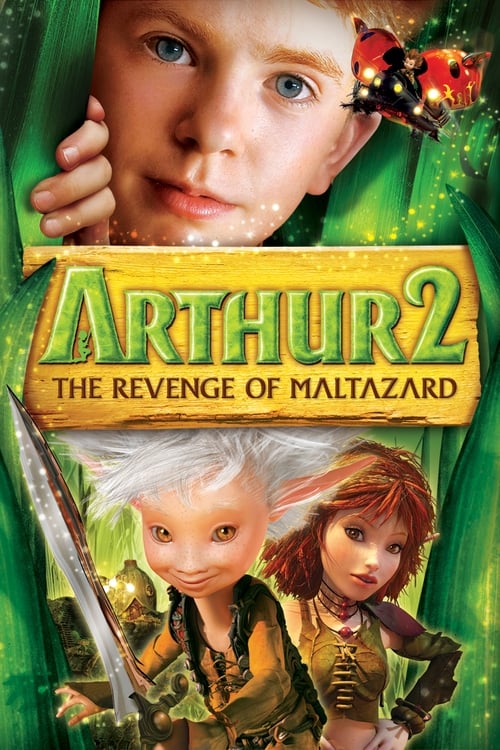
Arthur and the Revenge of Maltazard (2009)
Directed by Luc Besson
No — Arthur and the Revenge of Maltazard is not woke, scoring 0 out of 100 on our wokeness meter.
Arthur and the Revenge of Maltazard arrives as the second chapter in Luc Besson's adaptation of his own children's books, following a boy who answers a distress call from a princess held captive by a villain.
Consciousness Markers
The film has a diverse voice cast and a fictional African society, but these elements are not framed as a modern representation-casting statement.
No LGBTQ+ themes or characters are present.
Princess Selenia is a captive to be rescued, and the film does not advance a feminist agenda.
The Bogo Matassalai are a plot device, not a vehicle for modern racial consciousness or commentary.
A brief test of environmental nonviolence appears, but there is no climate crusade or ecological message.
No anti-capitalist or eat-the-rich themes are present.
No body positivity themes or messaging are present.
No neurodivergence themes or characters are present.
The film is a fantasy adventure and does not engage in revisionist history.
The film is a children's adventure and does not contain preachy or lecture-like messaging.
Why it received this score
Arthur and the Revenge of Maltazard arrives as the second chapter in Luc Besson's adaptation of his own children's books, following a boy who answers a distress call from a princess held captive by a villain. It is a live-action and animated hybrid from 2009, and it carries the unhurried confidence of a film with no argument to make beyond getting Arthur back into the tiny kingdom. The voice cast is a curious assembly of American pop figures: Snoop Dogg, will.i.am, Fergie, Selena Gomez, and Lou Reed, who replaced David Bowie as the villain. None of this is presented as a statement. The performers are hired for their voices, not for the demographic weight they might carry.
Princess Selenia spends the running time as a hostage, and the plot treats her rescue as the engine of the story, which places the film outside any modern feminist reading. The Bogo Matassalai, a fictitious African society, administer tests of camouflage and environmental nonviolence. This could be mistaken for ecological messaging, but it functions as a plot device, a way to move Arthur toward his transformation. The society exists to serve the hero's journey, not to comment on the world. There is no racial consciousness at work here, no climate crusade, no economic grievance, and no meditation on bodies, minds, or histories in need of revision.
What remains is a children's adventure with mixed critical reception and a troubled distribution history. It was a success in France and a loss almost everywhere else, edited together with its sequel for British audiences. The film asks nothing of its viewers except attention. In an era that rewards cinema for its positions, this one holds none. That is not a failure of nerve. It is simply a story about a boy who shrinks and a villain who grows, and it seems content to leave the culture untouched.
Analysis generated by our Consciousness Algorithm
Part of


Synopsis
Arthur answers a distress call from Princess Selenia, who is menaced by the nefarious Maltazard.
Questions about Arthur and the Revenge of Maltazard
Is Arthur and the Revenge of Maltazard woke?
No — Arthur and the Revenge of Maltazard is not woke, scoring 0 out of 100 on our wokeness meter. That earns it a verdict of Ultra Based.
Does Arthur and the Revenge of Maltazard have any woke elements?
No. All 10 markers score zero.
How does Arthur and the Revenge of Maltazard compare to other 2009 movies?
It ranks #208 of the 230 films from 2009 we've scored; their average is 14. The wokest is Home (79).
Is Arthur and the Revenge of Maltazard the most woke Arthur movie?
No. It ranks #4 of the 4 Arthur films we've scored; the wokest is Arthur and the Invisibles (12).