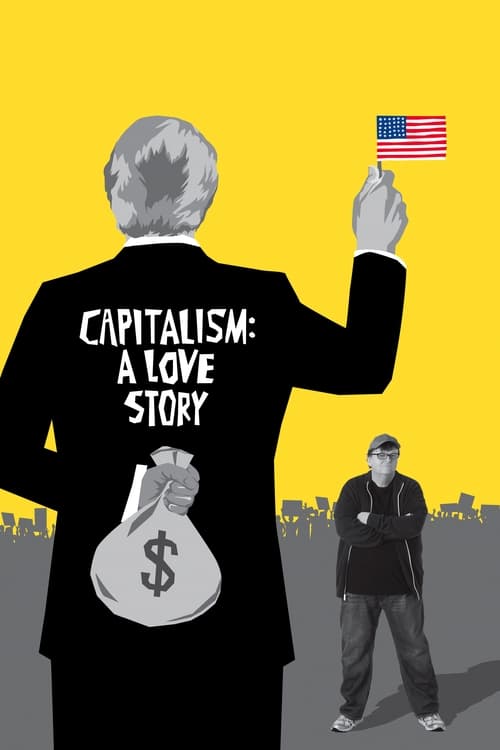
Capitalism: A Love Story (2009)
Directed by Michael Moore
Yes — Capitalism: A Love Story is woke, scoring 78 out of 100 on our wokeness meter.
Michael Moore returns to the subject that has sustained him across a career, and he does so with the zeal of a man who has found the last unexamined sin.
Consciousness Markers
This is the film's entire thesis: it indicts Wall Street, for-profit prisons, corporate-owned life insurance, and 'runaway greed,' and explicitly calls for capitalism to be eliminated and replaced with democracy.
A Michael Moore polemic is the archetype of the form: direct address, moral framing, religious argument, and a closing appeal to the viewer to act.
Moore reframes postwar American economic history — the 90% top tax rate, Reagan as a corporate 'spokesmodel,' the lost Roosevelt Second Bill of Rights footage — as a corrective counternarrative to conventional prosperity mythology.
The interview roster includes Black and female public figures (Elijah Cummings, Marcy Kaptur, Elizabeth Warren), but they appear as economic and political authorities, not as a deliberate diversity-casting gesture.
Moore's indictment is economic rather than racial; race surfaces only incidentally through class-based poverty and foreclosure stories, not as an analytical framework.
No LGBTQ+ content, characters, or themes appear anywhere in the film.
The film's critique is framed entirely around class and corporate power; gender is not a lens it employs.
Environmental concerns are absent; the film is concerned with finance, labor, and corporate power, not climate.
No engagement with body image or size acceptance.
No discussion of neurodivergence or mental health identity.
Why it received this score
Michael Moore returns to the subject that has sustained him across a career, and he does so with the zeal of a man who has found the last unexamined sin. The film's indictment is total: Wall Street's casino mentality, for-profit prisons, corporate-owned life insurance taken out on dead employees, the leaked Citigroup memo declaring democracy a formality. Moore does not stop at reform. He calls for capitalism to be eliminated and replaced with democracy, a closing appeal delivered straight into the camera with an invitation for the audience to finish the job. The interview roster includes Elijah Cummings, Marcy Kaptur, Bernie Sanders and Elizabeth Warren, presented as economic authorities. That is casting by expertise, not by demographic checklist, and the film treats them accordingly.
Where the picture earns its keep is in its historical counternarrative. Moore resurrects the 90 percent top marginal rate of the 1950s, recasts Reagan as a spokesmodel for banks, and unearths long-lost newsreel of Roosevelt's Second Bill of Rights. The prosperity mythology of the postwar decades gets a corrective reading, and the recovered footage does the arguing. He then hands the pulpit to Catholic priests who pronounce capitalism a sin, framing the whole affair as a matter of conscience. The direct address, the moral framing, the bullhorn stunts outside bank headquarters: this is the sermon form in its purest expression, and Moore preaches it without apology.
Elsewhere the film is pointedly narrow. Gender is not a lens it picks up. Climate does not enter the frame. Race surfaces only incidentally, through foreclosure stories and shuttered factories, never as an analytical instrument. There is no engagement with body politics or neurodivergence, and no LGBTQ content whatsoever. What remains is a class argument, delivered at volume, and a critic can only admire the single-mindedness while noting the silence everywhere else.
Analysis generated by our Consciousness Algorithm


Synopsis
Michael Moore comes home to the issue he's been examining throughout his career: the disastrous impact of corporate dominance on the everyday lives of Americans (and by default, the rest of the world).
Questions about Capitalism: A Love Story
Is Capitalism: A Love Story woke?
Yes — Capitalism: A Love Story is woke, scoring 78 out of 100 on our wokeness meter. That earns it a verdict of Woke.
What makes Capitalism: A Love Story woke?
3 of the 10 markers register at 30 or above, led by Eat the Rich (100), Lecture Energy (90) and Revisionist History (30). On Eat the Rich: This is the film's entire thesis: it indicts Wall Street, for-profit prisons, corporate-owned life insurance, and 'runaway greed,' and explicitly calls for capitalism to be eliminated and replaced with democracy.
How does Capitalism: A Love Story compare to other 2009 movies?
It ranks #2 of the 230 films from 2009 we've scored; their average is 14. The wokest is Home (79).
How is the Woke Score calculated?
An AI-assisted process researches the film and its reception, scores it 0–100 on ten markers, then combines those into one 0–100 Woke Score. It measures a specific set of 2020s cultural themes, not film quality.