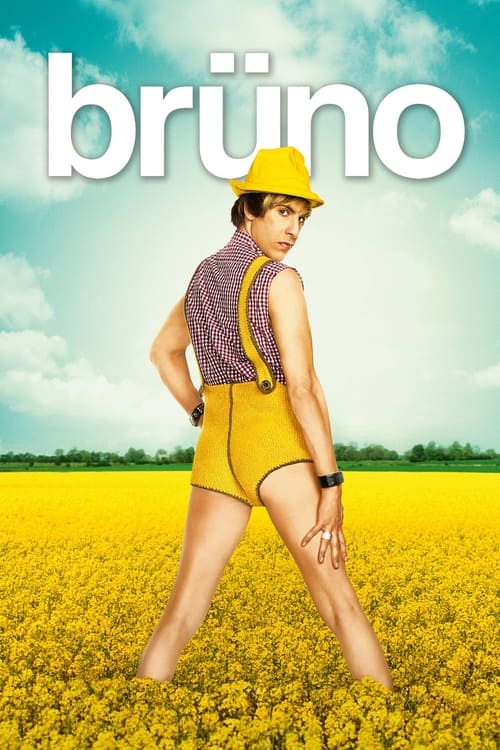
Brüno (2009)
Directed by Larry Charles
Yes — Brüno is woke, scoring 60 out of 100 on our wokeness meter.
Long before the culture wars settled into their current vocabulary, Brüno arrived with a mesh t-shirt and a tape of provocations, and it remains an artifact best examined with tongs.
Consciousness Markers
The entire film revolves around an openly gay protagonist and gay themes, using crude stereotypes and public provocation to expose homophobia; the LGBTQ+ content is abundant, though deployed as shock satire rather than affirmation.
The film skewers celebrity culture, fame obsession, and consumerist do-gooderism (a baby bought with a Product Red iPod, charity chosen purely for publicity), offering a genuine if crude critique of commodified humanitarianism.
The cast is dominated by Sacha Baron Cohen and largely white European performers, with Mexican day laborers and African American audience members appearing mainly as satirical props rather than as representative casting.
Race surfaces via the African baby 'O.J.' traded for an iPod, the African American talk-show audience, and Mexican workers used as furniture, but these are satirical shock devices rather than racial consciousness.
The film is satire that exposes prejudice through provocation rather than preaching, though the cage-fight finale and homophobia-baiting set pieces carry an implicit social point.
Nudity and varied body types appear throughout, but strictly for shock and comedy rather than any body-positive message.
There is no feminist framework here; women appear largely as interview subjects or objects of the character's absurd provocations, with no engagement of gender-equity themes.
No environmental or climate themes appear anywhere in the film.
No neurodivergence themes or characters are present.
The film makes no historical revisionist claims; its targets are contemporary fame and prejudice.
Why it received this score
Long before the culture wars settled into their current vocabulary, Brüno arrived with a mesh t-shirt and a tape of provocations, and it remains an artifact best examined with tongs. The film is a mockumentary in which Sacha Baron Cohen's Austrian fashion reporter travels to Los Angeles to become famous, and the engine of the enterprise is the willingness of ordinary Americans to reveal themselves when confronted with a man in hot pants. It is a stunt film. It is also, at intervals, an effective one.
The gay content is not incidental. It is the entire apparatus: the protagonist, his abandoned lover, the seduction that fails, the bondage that traps, the finale in which two men kiss in a cage while a paying crowd throws chairs. This is not affirmation. It is a battering ram, and the film is candid about that. Race arrives in the form of an African infant acquired for a U2 iPod and renamed O.J., and Mexican laborers arranged as furniture for a celebrity lunch. These are shock devices, and they function as such. Where the film has a genuine argument, it concerns the commodification of do-goodery: charity selected by consultants for its publicity value, a baby traded like a gadget, fame as the only moral category. That critique lands. The rest is spectacle.
There is no environmental theme, no neurodivergence, no historical revisionism. Women appear as interviewees and as furniture, which is to say the film has no gender argument to make and does not attempt one. Nudity is abundant and entirely punitive, deployed to unsettle instead of to celebrate any body. The sermonizing is absent by design; Baron Cohen prefers to let the audience convict themselves, which is a lower register of instruction. The film has aged into an odd document, less a comedy than a record of what people will say when they believe no one is keeping score.
Analysis generated by our Consciousness Algorithm


Synopsis
Flamboyantly gay Austrian television reporter Bruno stirs up trouble with unsuspecting guests and large crowds through brutally frank interviews and painfully hilarious public displays of homosexuality.
Questions about Brüno
Is Brüno woke?
Yes — Brüno is woke, scoring 60 out of 100 on our wokeness meter. That earns it a verdict of Woke.
What makes Brüno woke?
3 of the 10 markers register at 30 or above, led by LGBTQ+ Themes (80), Eat the Rich (35) and Representation Casting (30). On LGBTQ+ Themes: The entire film revolves around an openly gay protagonist and gay themes, using crude stereotypes and public provocation to expose homophobia; the LGBTQ+ content is abundant, though deployed as shock satire rather than affirmation.
How does Brüno compare to other 2009 movies?
It ranks #4 of the 230 films from 2009 we've scored; their average is 14. The wokest is Home (79).
How is the Woke Score calculated?
An AI-assisted process researches the film and its reception, scores it 0–100 on ten markers, then combines those into one 0–100 Woke Score. It measures a specific set of 2020s cultural themes, not film quality.