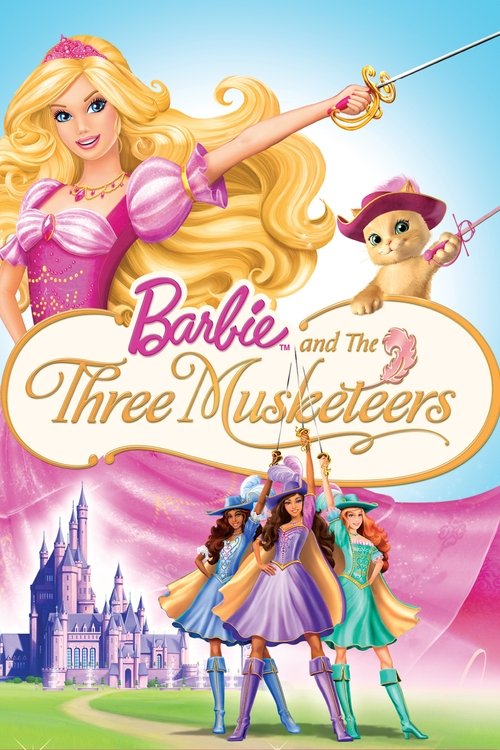
Barbie and the Three Musketeers (2009)
Directed by William Lau
Yes — Barbie and the Three Musketeers is woke, scoring 60 out of 100 on our wokeness meter.
Barbie and the Three Musketeers (2009) is the sixteenth entry in the Barbie direct-to-video catalog, a CGI adaptation of Dumas that replaces the swaggering swordsmen with four young women and a kitten with a pun problem.
Consciousness Markers
The central plot explicitly challenges the gender barrier that keeps girls from becoming musketeers, with four women training in secret and proving themselves equal to men.
The film features a female-led ensemble with one Black character and one tan-skinned character among the four musketeers, but diversity is incidental rather than a stated casting goal.
The film carries a clear 'girls can do anything' message, but it is delivered through a light children's adventure rather than heavy-handed modern lecturing.
The film reimagines the classic male-dominated Musketeer story with female protagonists, a gender-swapped revision of a literary/historical setting.
No LGBTQ+ characters, relationships, or themes are present.
The film includes a Black musketeer but never engages with racial identity, racism, or racial consciousness as a theme.
There is no environmental or climate-related content.
The film is a Mattel toy commercial and contains no anti-capitalist or class-conscious messaging.
No body positivity themes or diverse body types are present; the characters follow conventional Barbie aesthetics.
No neurodivergent characters or themes are depicted.
Why it received this score
Barbie and the Three Musketeers (2009) is the sixteenth entry in the Barbie direct-to-video catalog, a CGI adaptation of Dumas that replaces the swaggering swordsmen with four young women and a kitten with a pun problem. The film's central engine is a gender barrier: Corinne wants to be a musketeer, the palace tells her girls cannot, and she and three maids train in secret until they can save a prince and earn royal commissions. This is a clean, child-sized argument for female capability, delivered with songs and ribbon whips. It is not subtle, but it is not a lecture either. The message arrives through adventure, pratfalls, and a hot-air balloon, which keeps the sermonizing at a low simmer.
Representation is present but incidental. The four musketeers include a Black character and a tan-skinned character, and the film never remarks on the fact. That is representation by casting rather than by thesis. The same restraint applies to the source material's gender swap: the story revises a male-dominated literary tradition by simply putting women in the roles, which counts as a mild historical reimagining and little more. No racial consciousness follows from the Black musketeer. No LGBTQ content appears. No climate concern, no class anger, no body-diversity project, and no neurodivergent character enters the frame. The film is a Mattel product, and its commercial instincts are untroubled by anti-capitalist critique.
Where the film does push, it pushes gently. The girls-can-do-anything theme is unmistakable, but it is wrapped in a children's adventure with a prince, a villain, and a cat. The result is progressive in a narrow, early-2000s sense: feminist in its premise, diverse in its ensemble, and otherwise content to sell dolls. We are left with a curious artifact. It wants to break a gender barrier and move units at the same time. It does both, without much strain.
Analysis generated by our Consciousness Algorithm


Synopsis
Corinne is a young country girl who heads to Paris to pursue her big dream – to become a female musketeer! Never could she imagine she would meet three other girls who secretly share the same dream! Using their special talents, the girls work together as a team to foil a plot and save the prince. It's all for one and one for all!
Questions about Barbie and the Three Musketeers
Is Barbie and the Three Musketeers woke?
Yes — Barbie and the Three Musketeers is woke, scoring 60 out of 100 on our wokeness meter. That earns it a verdict of Woke.
What makes Barbie and the Three Musketeers woke?
3 of the 10 markers register at 30 or above, led by Feminist Agenda (80), Lecture Energy (35) and Representation Casting (35). On Feminist Agenda: The central plot explicitly challenges the gender barrier that keeps girls from becoming musketeers, with four women training in secret and proving themselves equal to men.
How does Barbie and the Three Musketeers compare to other 2009 movies?
It ranks #4 of the 230 films from 2009 we've scored; their average is 14. The wokest is Home (79).
How is the Woke Score calculated?
An AI-assisted process researches the film and its reception, scores it 0–100 on ten markers, then combines those into one 0–100 Woke Score. It measures a specific set of 2020s cultural themes, not film quality.