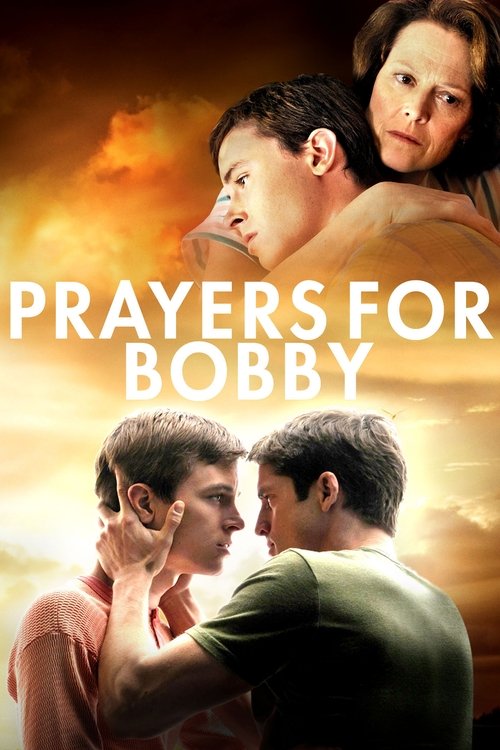
Prayers for Bobby (2009)
Directed by Russell Mulcahy
Yes — Prayers for Bobby is woke, scoring 60 out of 100 on our wokeness meter.
Prayers for Bobby arrives from 2009 with the grim efficiency of a Lifetime movie that knows exactly which buttons it intends to press, and presses them in sequence.
Consciousness Markers
The entire narrative—coming out, conversion therapy, religious homophobia, suicide, and a mother's journey to PFLAG and gay-rights activism—is explicitly and centrally about LGBTQ experience.
The film is openly didactic, culminating in Mary's televised city-council speech condemning religious homophobia as 'bigotry' and 'dehumanizing slander,' with an explicit moral addressed to the audience.
The film is built entirely around a gay protagonist and a community of gay characters, giving substantial LGBTQ presence on screen, though the cast is otherwise overwhelmingly white and the gay roles are largely played by straight-identified actors.
Mary Griffith is the protagonist and her moral transformation drives the film, but the focus is on maternal grief and gay rights rather than any feminist critique of patriarchy.
The story unfolds entirely within a white suburban evangelical milieu with no engagement of race as a theme.
No environmental or climate themes appear in the film.
There is no economic critique or class-conscious messaging; the antagonists are religious and social, not corporate.
Body image and body-positivity themes are absent from the film.
Bobby's anxiety and depression are depicted as responses to familial and religious rejection, not framed as neurodivergence or neurodiversity.
Though based on a true story and tagged as History, the film presents events faithfully rather than revising or reinterpreting the historical record.
Why it received this score
Prayers for Bobby arrives from 2009 with the grim efficiency of a Lifetime movie that knows exactly which buttons it intends to press, and presses them in sequence. Bobby Griffith is a gay teenager in Walnut Creek, a suburban evangelical hothouse where the family jokes land like small stones. The film follows him through a suicide attempt, a conversion therapist who blames the parents, a summer of tentative romance in Portland, and a bridge. Then it follows his mother. Sigourney Weaver's Mary moves from certainty to grief to something like reckoning, and the film's real subject is that journey, not the boy who did not survive it.
On the matter of representation, the film is a curious artifact. Its entire narrative apparatus is built around gay experience, and the screen is full of gay characters, yet the milieu remains monochrome and comfortably suburban, and the central roles are carried by performers whose own lives are not part of that story. Mary's maternal anguish is the engine here, though the film treats it as a story about a mother's love, not a critique of the structures that shaped her. Race, class, the body, the wiring of the mind: none of these enter the frame. The antagonists are pastors and parents, not boardrooms, and the weather is never a character.
Where the film commits, it commits fully. Bobby's depression is rendered as the product of rejection, not diagnosis. The history is presented straight, faithful to the record, no reinterpretation required. And then there is the final act: a city council meeting, a live television camera, a speech that names religious homophobia as bigotry and dehumanizing slander, and a closing instruction to the audience that a child is listening. The measure fails. The moral does not. This is a film that would rather you leave changed than entertained, and it says so out loud, twice, in case the first time did not take.
Analysis generated by our Consciousness Algorithm


Synopsis
Bobby Griffith was his mother's favorite son, the perfect all-American boy growing up under deeply religious influences in Walnut Creek, California. Bobby was also gay. Struggling with a conflict no one knew of, much less understood, Bobby finally came out to his family.
Questions about Prayers for Bobby
Is Prayers for Bobby woke?
Yes — Prayers for Bobby is woke, scoring 60 out of 100 on our wokeness meter. That earns it a verdict of Woke.
What makes Prayers for Bobby woke?
3 of the 10 markers register at 30 or above, led by LGBTQ+ Themes (95), Lecture Energy (68) and Representation Casting (48). On LGBTQ+ Themes: The entire narrative—coming out, conversion therapy, religious homophobia, suicide, and a mother's journey to PFLAG and gay-rights activism—is explicitly and centrally about LGBTQ experience.
How does Prayers for Bobby compare to other 2009 movies?
It ranks #4 of the 230 films from 2009 we've scored; their average is 14. The wokest is Home (79).
How is the Woke Score calculated?
An AI-assisted process researches the film and its reception, scores it 0–100 on ten markers, then combines those into one 0–100 Woke Score. It measures a specific set of 2020s cultural themes, not film quality.