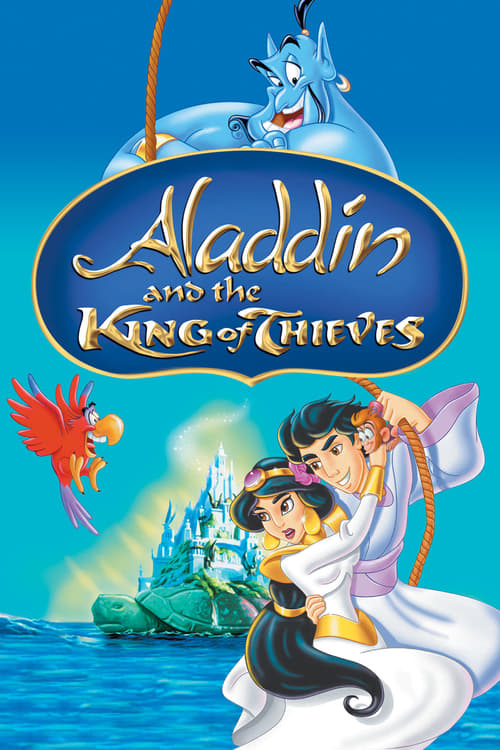
Aladdin and the King of Thieves (1996)
Directed by Tad Stones
No — Aladdin and the King of Thieves is not woke, scoring 7 out of 100 on our wokeness meter.
Aladdin and the King of Thieves arrives as the third and final installment of a franchise that had already learned to travel light.
Consciousness Markers
The Arabian Nights setting is populated almost entirely by white voice actors (Weinger, Williams, Larkin, Rhys-Davies), with CCH Pounder as the Oracle the lone notable exception; the Middle Eastern coding is decorative rather than representational.
The Hand of Midas and Cassim's gold-obsession carry a mild 'family is the real treasure' moral, but it is a generic greed-fable rather than a systemic critique of wealth.
Jasmine exists largely as the wedding prize and briefly speaks up for Aladdin; she has no arc of her own and the film's emotional core is entirely father-son.
A brisk direct-to-video adventure that delivers its moral ('a son is the ultimate treasure') through plot rather than sermon; almost no preachy address to the audience.
No LGBTQ+ characters, themes, or subtext of any kind.
The film uses a fantastical 'Arabian Nights' backdrop as exotic set dressing with no engagement with race, identity, or cultural politics.
No environmental themes; the Vanishing Isle's giant turtle is a fantasy set piece, not an ecological statement.
No body-diversity themes or messaging present.
No neurodivergent characters or themes; the Genie's antics are comedic performance, not representation.
A fantasy adventure with no historical record to revise.
Why it received this score
Aladdin and the King of Thieves arrives as the third and final installment of a franchise that had already learned to travel light. Released direct to video in 1996, it lures Robin Williams back to the Genie, a million-dollar apology for a merchandising dispute, and sends the cast chasing a father, a magic hand, and a turtle the size of a fortress. The animation is Saturday morning work. The score does not linger. It is a modest object, and it knows it.
The film's emotional architecture is entirely paternal. Cassim, the absent father turned King of Thieves, receives the arc, the redemption, and the farewell ride into moonlight. Jasmine receives a wedding. She exists as the prize at the end of the ceremony and speaks up once on Aladdin's behalf, which is roughly the narrative allotment of a decorative vase. The Arabian Nights setting remains what it was in 1992: a backdrop of domes and scimitars, staffed almost entirely by white voice actors, with CCH Pounder's Oracle the single exception. Nothing here engages with the culture it borrows.
The moral is a greed fable, the Hand of Midas turning its wielder into gold, and the lesson settles on family as the true treasure. That is a proverb, not a critique. There is no systemic argument, no environmental sermon, no closing address to the audience about how to live. The film offers a brisk adventure that trusts its plot to do the talking, a rare and slightly old-fashioned virtue. As a document of modern social consciousness, it is nearly blank. The wedding happens, the father rides away, and the credits roll without a single instruction on how to feel.
Analysis generated by our Consciousness Algorithm


Synopsis
Legendary secrets are revealed as Aladdin and his friends—Jasmine, Abu, Carpet and, of course, the always entertaining Genie—face all sorts of terrifying threats and make some exciting last-minute escapes pursuing the King Of Thieves and his villainous crew.
Questions about Aladdin and the King of Thieves
Is Aladdin and the King of Thieves woke?
No — Aladdin and the King of Thieves is not woke, scoring 7 out of 100 on our wokeness meter. That earns it a verdict of Ultra Based.
Does Aladdin and the King of Thieves have any woke elements?
Very few. None of the 10 markers reaches 30, the level where a marker counts as present; the highest is Eat the Rich at 12.
How does Aladdin and the King of Thieves compare to other 1996 movies?
It ranks #46 of the 93 films from 1996 we've scored; their average is 11. The wokest is Bound (60).
Is Aladdin and the King of Thieves the most woke Aladdin movie?
No. It ranks #2 of the 3 Aladdin films we've scored; the wokest is Aladdin (12).