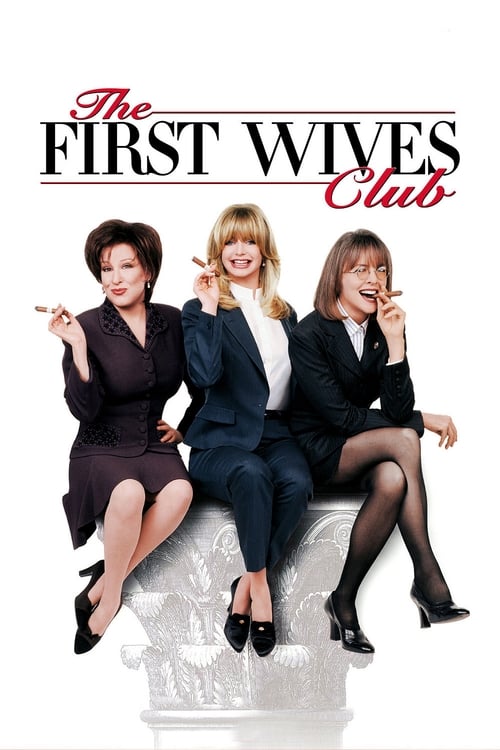
The First Wives Club (1996)
Directed by Hugh Wilson
No — The First Wives Club is not especially woke, scoring 37 out of 100 on our wokeness meter.
The First Wives Club arrives from 1996 with three actresses over forty planted squarely at the center of a studio comedy, a casting choice that carried weight in its era.
Consciousness Markers
The entire plot is a female-solidarity revenge fantasy against husbands who trade wives for younger models, culminating in a women's crisis center and a defiant 'You Don't Own Me' finale.
The film wears its feminist message openly—Gloria Steinem cameos, the crisis center is named after Cynthia, and the finale is a sing-along of 'You Don't Own Me'—but it remains a broad comedy rather than a sermon.
Three women over forty headline a major studio comedy, a meaningful age/gender casting choice for 1996, but the cast is otherwise overwhelmingly white and affluent.
Annie's daughter Chris is explicitly a lesbian feminist, and Lea DeLaria appears in a cameo, but queerness is a minor subplot rather than a central concern.
The revenge is financial—buying out advertising partners and blackmailing an electronics tycoon—but the film ultimately celebrates entrepreneurial wealth rather than critiquing capitalism.
No meaningful engagement with race; the principal characters and their grievances are uniformly white and upper-middle-class.
No environmental themes whatsoever.
No sustained body-positive thesis; a rival's fat-shaming is used as villain characterization, not as a platform for fat acceptance.
Annie's anxiety and therapy are played for comedy and self-esteem arcs, not as neurodivergent representation.
No historical revisionism; it is a contemporary comedy.
Why it received this score
The First Wives Club arrives from 1996 with three actresses over forty planted squarely at the center of a studio comedy, a casting choice that carried weight in its era. Goldie Hawn, Bette Midler, and Diane Keaton play women discarded for younger models and then organize. The animating idea is female solidarity as financial strategy, and the film pursues it with a broad, crowd-pleasing grin. The grievance is real. The revenge is cheerful.
The feminist engine here is not subtle and was never meant to be. Gloria Steinem turns up as herself. The women name their crisis center after a friend who jumped from a balcony, and the finale is a street-corner sing-along of "You Don't Own Me." Queerness appears briefly through Annie's daughter, who is a lesbian and a feminist, and through a cameo by Lea DeLaria, though the film treats this as texture, not thesis. The economic critique stays muddy. Our heroines buy out advertising partners and blackmail an electronics tycoon, yet the movie celebrates their arrival into wealth, so the knives never reach capital itself.
The absences tell us as much as the presences. The principals are uniformly white and comfortable, and race never enters the conversation. No environmental concern surfaces. A rival's fat-shaming exists to mark her as a villain, not to launch a movement. Annie's anxiety is played for laughs and a self-esteem arc, which is not the same as representation. Left standing is a brisk revenge comedy that wears its social consciousness openly and still remembers to be funny. That balance is rarer than it should be, and this film, for all its sermonizing impulses, mostly holds it.
Analysis generated by our Consciousness Algorithm


Synopsis
After years of helping their hubbies climb the ladder of success, three mid-life Manhattanites have been dumped for a newer, curvier model. But the trio is determined to turn their pain into gain. They come up with a cleverly devious plan to hit their exes where it really hurts - in the wallet!
Questions about The First Wives Club
Is The First Wives Club woke?
No — The First Wives Club is not especially woke, scoring 37 out of 100 on our wokeness meter. That earns it a verdict of Based.
Does The First Wives Club have any woke elements?
4 of the 10 markers register at 30 or above, led by Feminist Agenda (78), Lecture Energy (35) and LGBTQ+ Themes (30). On Feminist Agenda: The entire plot is a female-solidarity revenge fantasy against husbands who trade wives for younger models, culminating in a women's crisis center and a defiant 'You Don't Own Me' finale.
How does The First Wives Club compare to other 1996 movies?
It ranks #6 of the 93 films from 1996 we've scored; their average is 11. The wokest is Bound (60).
How is the Woke Score calculated?
An AI-assisted process researches the film and its reception, scores it 0–100 on ten markers, then combines those into one 0–100 Woke Score. It measures a specific set of 2020s cultural themes, not film quality.