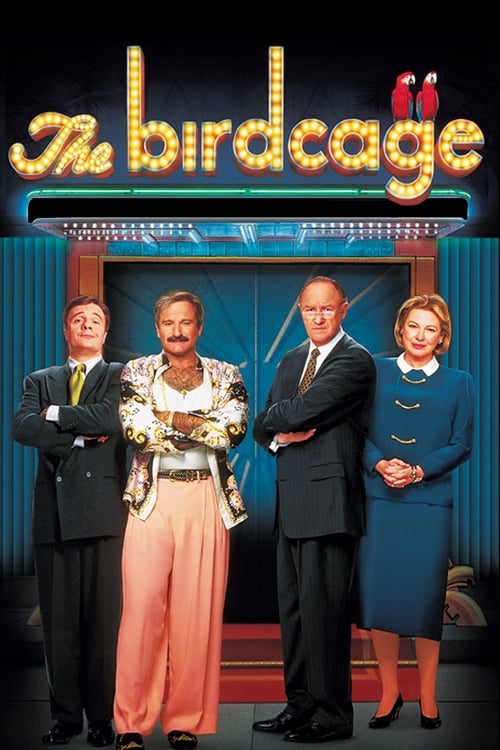
The Birdcage (1996)
Directed by Mike Nichols
Yes — The Birdcage is woke, scoring 60 out of 100 on our wokeness meter.
Mike Nichols opened The Birdcage in March of 1996 and watched it sit atop the domestic box office for four consecutive weeks, which says something about what mainstream audiences would absorb when the tolerance arrived dressed as farce.
Consciousness Markers
The film is centered on a gay couple, a drag queen, coming out, homophobia, and an alternative family structure, making it a landmark of mainstream LGBTQ representation.
Features a gay couple as leads and a Guatemalan housekeeper, but the cast is otherwise predominantly white and the Latino role is played by a non-Latino actor.
The film embeds a message about tolerance and the validity of non-traditional families, but delivers it through comedy rather than overt preaching.
Female characters exist but the film does not engage with feminist themes or challenge patriarchal structures in any substantive way.
No exploration of racial identity, systemic racism, or racial justice; a Black prostitute is mentioned only as a plot device in a political scandal.
No environmental or climate-related themes are present.
The film satirizes conservative politics but does not critique capitalism or wealth inequality.
No body positivity themes or challenges to conventional beauty standards are present.
No neurodivergent characters or themes are depicted.
The film is a contemporary comedy and does not engage in historical revisionism.
Why it received this score
Mike Nichols opened The Birdcage in March of 1996 and watched it sit atop the domestic box office for four consecutive weeks, which says something about what mainstream audiences would absorb when the tolerance arrived dressed as farce. Robin Williams and Nathan Lane play Armand and Albert, a South Beach couple whose son wishes to marry the daughter of a Republican senator. The plot demands that the pair perform heterosexuality for a single evening. The comedy lands because the performance is doomed. Elaine May's screenplay retains the machinery of the 1978 French original and sharpens the politics of the in-laws.
The film's social center is unambiguous. It asks that a gay couple and their improvised household be granted the dignity any other family receives, and it was unusual for a major studio to place that request at the middle of a commercial comedy. The delivery is comic, not sermonizing, which is why the message travels. Representation elsewhere is thinner. Hank Azaria's Agador, the Guatemalan housekeeper, is a scene-stealer and a collection of mannerisms, performed by an actor with no Guatemalan heritage; the production had earlier declined to cast a Black performer in the role for fear of the racial implication, solving one problem by creating another. The women in the room react, and nobody asks them to do anything further.
On the remaining indices we find mostly silence. No environmental argument. No indictment of wealth. No body politics, no neurodivergence, no revision of the historical record. The satire aims at conservative moralism, an easy and renewable target, and it hits cleanly. We file The Birdcage as a landmark of mainstream gay representation and, on the broader ledger of contemporary social consciousness, a modest and very funny artifact of its decade.
Analysis generated by our Consciousness Algorithm


Synopsis
A gay cabaret owner and his drag queen partner agree to put up a false heterosexual front so that their son can introduce them to his fiancée's conservative parents.
Questions about The Birdcage
Is The Birdcage woke?
Yes — The Birdcage is woke, scoring 60 out of 100 on our wokeness meter. That earns it a verdict of Woke.
What makes The Birdcage woke?
3 of the 10 markers register at 30 or above, led by LGBTQ+ Themes (95), Representation Casting (45) and Lecture Energy (30). On LGBTQ+ Themes: The film is centered on a gay couple, a drag queen, coming out, homophobia, and an alternative family structure, making it a landmark of mainstream LGBTQ representation.
How does The Birdcage compare to other 1996 movies?
It is the wokest of the 93 films from 1996 we've scored; their average is 11.
How is the Woke Score calculated?
An AI-assisted process researches the film and its reception, scores it 0–100 on ten markers, then combines those into one 0–100 Woke Score. It measures a specific set of 2020s cultural themes, not film quality.