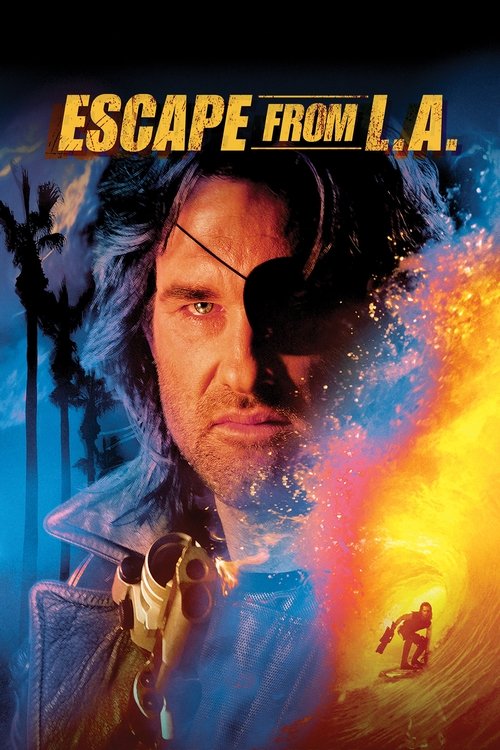
Escape from L.A. (1996)
Directed by John Carpenter
No — Escape from L.A. is not especially woke, scoring 31 out of 100 on our wokeness meter.
John Carpenter returns to the wasteland with a sequel that took fifteen years to arrive and roughly ninety minutes to squander the goodwill.
Consciousness Markers
Hershe Las Palmas, a trans woman and former criminal associate of Snake, is a genuine and unusually early mainstream trans character, treated matter-of-factly as a capable military leader.
A notably diverse 1996 ensemble — Pam Grier, Georges Corraface, and a multiethnic supporting cast — though the diversity is genre-typical rather than a stated representational project.
The theocratic regime and the closing lament about class warfare carry a satirical anti-authority, anti-elite edge, though it targets moral tyranny more than capitalism itself.
Cuervo Jones leads a 'third world' invasion and the finale invokes 'never-ending class warfare,' but race is handled as geopolitical texture rather than modern racial consciousness.
Carpenter's satire is anarchic and cockeyed rather than preachy, though the 'Welcome to the human race' finale lands a pointed anti-technology moral.
Utopia and Hershe are assertive figures, but the film remains a macho Snake Plissken vehicle with no discernible feminist argument.
The earthquake is a plot device to sever Los Angeles from the mainland; there is no environmental or climate message whatsoever.
No engagement with body image or size acceptance.
No neurodivergent characters or themes present.
A fictional near-future dystopia, not a reworking of historical events.
Why it received this score
John Carpenter returns to the wasteland with a sequel that took fifteen years to arrive and roughly ninety minutes to squander the goodwill. The premise is a corker: a theocratic president for life has relocated the capital to Lynchburg, banned smoking, red meat, and premarital sex, and turned Los Angeles into a deportation island after an earthquake severed it from the mainland. Snake Plissken, infected with a virus and given ten hours to live, is sent in to retrieve a doomsday remote. The film plays as cockeyed satire, though its target is moral tyranny and petty authoritarianism, not the economic order. The closing lament about never-ending class warfare registers as a shrug, not a manifesto.
The ensemble is more varied than the genre demanded in 1996. Pam Grier, Georges Corraface, and a multiethnic supporting cast populate the island, though the film never pauses to congratulate itself for this. Hershe Las Palmas, a trans woman and former associate of Snake, commands soldiers and is treated as a capable leader without comment, a genuinely early instance of matter-of-fact mainstream casting. Utopia, the president's daughter, is assertive, but the movie remains a macho vehicle for a man in an eyepatch. The earthquake is pure plot mechanics. No environmental argument attends it. The satire aims at televangelist morality and at our devotion to gadgets, and it lands with a smirk instead of a sermon.
Where the film might have lectured, it slouches toward anarchy. The final image, Plissken lighting a cigarette and muttering about the human race after deactivating every machine on Earth, is a pointed anti-technology flourish delivered with a sneer. Carpenter's heart is in the mayhem, and the mayhem is cheap. The result is a curio: a sequel nobody requested, made with visible affection, carrying a few progressive textures that it declines to advertise. We file it accordingly.
Analysis generated by our Consciousness Algorithm
Part of


Synopsis
Into the 9.6-quaked Los Angeles of 2013 comes Snake Plissken. His job: wade through L.A.'s ruined landmarks to retrieve a doomsday device.
Questions about Escape from L.A.
Is Escape from L.A. woke?
No — Escape from L.A. is not especially woke, scoring 31 out of 100 on our wokeness meter. That earns it a verdict of Based.
Does Escape from L.A. have any woke elements?
3 of the 10 markers register at 30 or above, led by LGBTQ+ Themes (45), Representation Casting (40) and Eat the Rich (30). On LGBTQ+ Themes: Hershe Las Palmas, a trans woman and former criminal associate of Snake, is a genuine and unusually early mainstream trans character, treated matter-of-factly as a capable military leader.
How does Escape from L.A. compare to other 1996 movies?
It ranks #8 of the 93 films from 1996 we've scored; their average is 11. The wokest is Bound (60).
How is the Woke Score calculated?
An AI-assisted process researches the film and its reception, scores it 0–100 on ten markers, then combines those into one 0–100 Woke Score. It measures a specific set of 2020s cultural themes, not film quality.